BTC USD 85,894.5 Gold USD 4,314.23
Time now: Jun 1, 12:00 AM
Bitcoin has been hovering around the 30K mark for a second day, forcing the rest of the crypto market to balance declines and gains. Ethereum has lost 1.2% in 24 hours but remains near 2,000. Altcoins from the top ten are mostly declining, losing between 0.7% (DogeCoin) and 3.8% (Polkadot). Tron is gaining 1.7% but has been little changed since the end of last week. Total crypto market capitalisation, according to CoinMarketCap, declined 1.1% overnight to $1.29 trillion. Bitcoin’s dominance index remained unchanged at 44.3%.

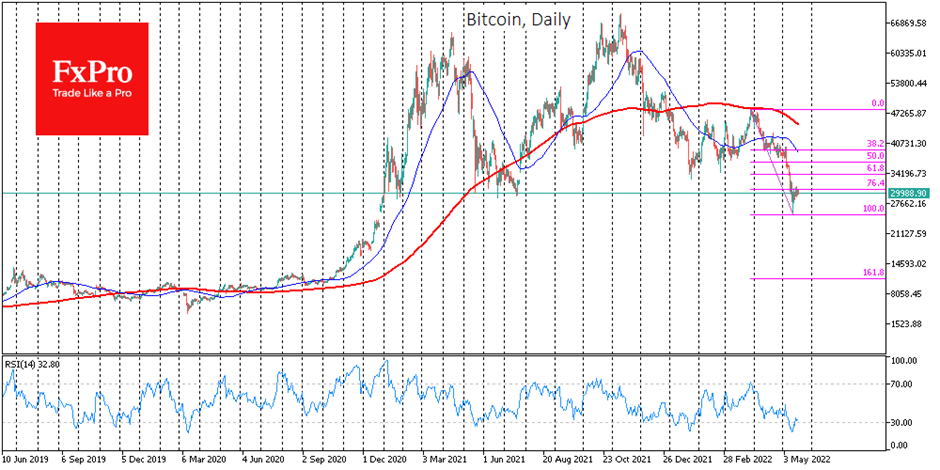
The Cryptocurrency Fear and Greed Index was up 4 points to 12 by Wednesday and remains in “extreme fear”. The index’s recovery from lows since 2019 is due to a waning selloff but not a market reversal to growth. Bitcoin has stalled at the psychologically significant 30K level and has also lost the momentum of the rebound at the 76.4% Fibonacci line from the downward move from late March to last Thursday’s lows.

This is a typical shallow counter-trend correction. The inability of the market to develop the offensive from the current levels would raise the question that the final target for the downtrend would be the 161.8% area of that move, which is near $11.3K. Such a setback would cancel out all upside momentum from October 2020. So far, this scenario looks exceptionally pessimistic and needs to converge the disappointment of crypto-neophytes on top of an actual collapse of the global economy and stock market. Such a dip would leave Bitcoin’s price at only 16% of its peak, which has happened several times in its history.
1652862651388.png

However, a significant drop below previous cyclical highs ($20K) would be unusual, although Bitcoin was previously repurchased on similar drawdowns. Perhaps a more cautious scenario would be a dip into the $20-23K area to close the gap at the end of 2020 or a return to the 2017 highs. The realist-optimistic scenario points to the possibility of cautious buying by long-term investors from current levels said Alex Kuptsikecich, a senior analyst from FxPro.
 
On Wednesday, Bitcoin was down 3%, ending the day around $29,200, remaining near that mark on Thursday morning. Ethereum lost 4.3%. Other altcoins in the top 10 fell from 1.8% (BNB) to 9.8% (Cardano).

The total capitalisation of the crypto market, according to FxPro, fell 3.6% overnight to $1.24 trillion. The Bitcoin Dominance Index rose 0.4% to 44.7%. The Cryptocurrency Fear and Greed Index was up 1 point to 13 by Thursday and remains in ‘extreme fear’ territory.

Bitcoin resumed its decline on Wednesday amid a sharp weakening of US stock indices, which fell even more than BTC. The Nasdaq and S&P 500 lost more than 4% on Wednesday. The impressive oversold strength accumulated by the crypto market after it collapsed 40% from late March levels (versus 16% for the S&P500) temporarily limits the declining scale.
1652957887386.png


Nevertheless, the overall negative market sentiment has prevented the bulls from turning out in full force. So far, it isn’t easy to see reliable signs of oversold or rebound formation. We should be prepared for the cryptocurrency market to test support at last week’s lows again in the near term. We consider the area near 20K the final target for a potential selloff, which corresponds to Bitcoin’s long-term support line.
 
Bitcoin fluctuates around $30K and has crossed that line daily in one way or another over the past 12 days. A 3.5% increase in the day’s results on Thursday turned into another pullback on Friday morning. Ethereum has strengthened by 3.5% in the past 24 hours, finding itself pegged at $2000.

A senior analyst from FxPro said, other altcoins in the top 10 gained between 0.4% (Solana) and 5.5% (XRP). Total cryptocurrency market capitalisation, according to CoinGecko, rose 3.1% overnight to $1.28 trillion. The Bitcoin Dominance Index rose 0.1% to 44.8%. By Friday, the cryptocurrency fear and greed index is unchanged at 13 points (“extreme fear”).
1653054691101.png


Bitcoin’s drop below $30,000 last week came after a large volume of the cryptocurrency entered exchanges. According to IntoTheBlock, traders have sent around 40,000 BTC to exchanges since May 11. According to an audit report by accounting firm MHA Cayman, USDT stable coin issuer Tether Holdings Limited reduced its reserves in the commercial papers by 17%, improving the quality of its funds.

The Ethereum development team said it would migrate the Ropsten test network to the Proof-of-Stake (PoS) consensus algorithm on June 8 2022. According to the legislation, SEC chief Gary Gensler has warned that the regulator is ready to take new measures against unregistered cryptocurrency companies.
 
Bitcoin is down 2.5% over the past week, ending near $29,200. Ethereum lost 10.6%, while other leading altcoins in the top 10 fell from 1% (Polkadot) to 14.8% (Solana). The total capitalisation of the crypto market, according to CoinMarketCap, sank 2.4% over the week to $1.26 trillion. Bitcoin’s dominance index jumped 1.3 points to 44.9% over the same time due to the better performance of the first cryptocurrency.

The cryptocurrency fear and greed index was down to 10 points by Monday. However, this drop does not consider the positive market performance in the early hours on Monday. Bitcoin has closed lower for eight consecutive weeks, the longest sell-off streak in the first cryptocurrency’s existence. But the last two weeks have been very tentative declines.
1653914457763.png

On Monday morning, BTCUSD surpassed the $30K mark again and returned to last week’s highs, breaking above the downside resistance line in a strong move. It will be premature to talk about a bullish counteroffensive until Bitcoin gets above $30.6K, its horizontal resistance line since mid-May. Renewed risk appetite in global markets is fuelling hopes of a turnaround. Divergence in equity and cryptocurrency dynamics was conspicuous last week, highlighting the weakness of the crypto market.

Alex Kuptsikevich, Senior analyst at FxPro, believes the current crypto crisis is not as severe as previous ones, as institutional players have entered the market in recent years and increased market liquidity. We would add that thanks to the expanded crypto market capacity, we haven’t seen as much of a surge in the bull cycle of 2021 as we did in 2013 and 2017, which explains the not-so-high ‘winter’ losses. MicroStrategy CEO Michael Saylor said he will always buy bitcoin.

According to him, BTC is the most reliable asset in this very volatile world. Bill Miller, head of investment firm Miller Value Partners, called bitcoin an effective means of accessing financial services regardless of military and economic situations.

Regulation of cryptocurrencies would help with the crisis in the crypto market, according to Deutsche Bank.
 
Bitcoin collapsed 5.6% in the past 24 hours, retreating again below the $30K mark. Ethereum lost 6.1%, while leading altcoins in the top 10 fell from 5.2% (BNB) to 11.5% (Solana).

Total crypto market capitalisation, according to CoinMarketCap, sank 5.3% overnight to $1.23 trillion. Bitcoin’s dominance index fell 0.2% to 46.1%.

By Thursday, the cryptocurrency Fear and Greed Index was down 4 points to 13.

According to Alex Kuptsikevich a senior analyst FxPro, Bitcoin fell sharply in the US session on Wednesday, along with stock indices, following a strong ISM Manufacturing PMI release. The data raised expectations of the US Fed monetary policy tightening. A stronger dollar and reduced risk traction in stock markets interrupted BTC’s flight, which returned to the previous sideways range it had been trading since mid-May.
1654173012295.png

The Solana blockchain network suffered another disruption on Wednesday. Solana’s validators failed to process new blocks for eight hours, leading to a complete shutdown of all its applications.

Executives at two Australian banks, ANZ and NAB, said they do not plan to allow their retail customers to trade crypto assets due to the high risks of losing funds.

Heng Swee Keat, deputy prime minister of Singapore, warned retail investors against investing in cryptocurrencies, recalling the collapse of Terra and UST. Crypto-assets are very risky and need proper regulation, he said.

Following the collapse of the Terra ecosystem, the Basel Committee on Banking Supervision of the Bank for International Settlements (BIS) plans to issue a second, even more “conservative” version of its recommendations on cryptocurrency regulation.

Harvard University’s anti-digital experts have urged US lawmakers to resist the pressure of crypto investors and not make any easing of the crypto industry.
 
Bitcoin rose 2.4% to $30.5K in the past 24 hours. Ethereum added 0.2% to $1820. Ether was unexpectedly among the laggards. Altcoins from the top 10 rose from 1.5% (BNB) to 4.1% (Solana).

Total crypto market capitalisation, according to CoinMarketCap, rose 1.8% overnight to $1.26 trillion. Bitcoin’s dominance index added 0.2% to 46.3%. The cryptocurrency fear and greed index was down 3 points to 10 by Friday and remains in “extreme fear”.

Bitcoin rebounded on Thursday after falling sharply the day before. The strengthening was helped by a weaker dollar and positive stock indexes. The local downtrend (former consolidation triangle from May 10) turned into a support line. For the short term, this is good news. However, it is worth remembering that this is a fragile structure that could be broken by both a stronger dollar and a market reaction to labour market news.

1654262567351.png


Bitcoin has already reached the “bottom” in the current cycle of decline and will not fall below $25,000, said former BitMEX cryptocurrency exchange CEO, Arthur Hayes. However, a market trend reversal should be expected when the Fed stops raising rates.

According to FxPro’s senior analyst Alex Kuptsikevich, the bearish phase will end in six months. A possible driver for this could be the Ethereum update, which should occur between October and December. Another bullish factor will be the US Federal Reserve’s refusal to hike rates.
 
Bitcoin rose 3.1% over the past week, finishing near $30,000. Ethereum added 0.9%, while other leading altcoins in the top 10 showed mixed dynamics, ranging from a 10.7% decline (Solana) to a 23.2% rise (Cardano).

The new week is off to a promising start. BTCUSD has added 4.6% in the last 24 hours, more than 4% since the start of the day and is again testing the $31.0K mark. Cryptocurrency investors were not spooked by Friday's market decline, as key stock indices were above the recent local lows and had been adding in recent hours.

The total capitalisation of the crypto market, according to CoinMarketCap, rose 3.8% in 24 hours to $1.28 trillion, with the Bitcoin Dominance Index adding 0.2% over the same period to Friday's 46.5%. By Monday, the cryptocurrency fear and greed index rose from 10 to 13 points. For about a month now, this indicator has been steadily below 20 - in a state of extreme fear. While at current levels, BTCUSD remains below the consolidation area at the lows of the middle of last year. It is worth paying attention to the change in the trend seen in the weekly candlesticks. Last week's lows and highs were higher than the week before. The intraday charts show that the price is being pushed up in the absence of investors in the USA.

However, one must make sure that this demand is global. Retail investors may try to promote the start of the rise by feeding them an abundant supply. BTC was climbing to three-week highs but lost almost all its gains by the end of the week. The first cryptocurrency has been trading in a sideways range around the $30,000 level for more than three weeks. The bearish trend in the market has caused long-term investors to capitulate.

This factor signals that the price has reached a multi-year bottom, according to FxPro. Senior analyst Alex Kuptsikevich believes central banks' digital currencies could completely displace private virtual currencies, including bitcoin.

May proved to be a bad month for BTC and ETH miners. Bitcoin miners' earnings fell 21.9% for the month, while miners of the second cryptocurrency fell 24.1%. The market will draw its attention to The annual Consensus 2022 this week. This year's Crypto Industry Excellence Expo will be hosted in Austin, Texas, in June 9-12.
 

Attachments

That analysis is truly fantastic. However, I don't agree with many of you that the crypto market depends a lot on the stock market.
 
Last edited:
Back
Top
Log in Register