BTC USD 83,220.0 Gold USD 4,114.94
Time now: Jun 1, 12:00 AM

AUD/USD : Daily Signal And Analysis From InstaForex

Status
Not open for further replies.
The Aussie got off to the favorites

Since the beginning of the year, the Australian dollar has gained more than 10% relative to the U.S. dollar and is fighting for first place with the euro on the list of the G10 best performers. Firmly high appetite for risk, low volatility in financial markets, increased activity of carry traders, recovery of iron ore prices, improved data of the Green Continent and higher likelihood that the RBA tightens monetary policy are the main drivers for strengthening the "Aussie". The Reserve Bank does not like the strengthening of the Australian currency.

Over the past couple of weeks, the AUD/USD pair has increased by 4% amid the hawkish notes of the protocol of the last RBA meeting, China's GDP and the Australian labor market's strong data. A big role in the acceleration of the upward trend was played by political scandals surrounding Donald Trump and the Fed's willingness to change the previously planned path of hiking the rate for federal funds.

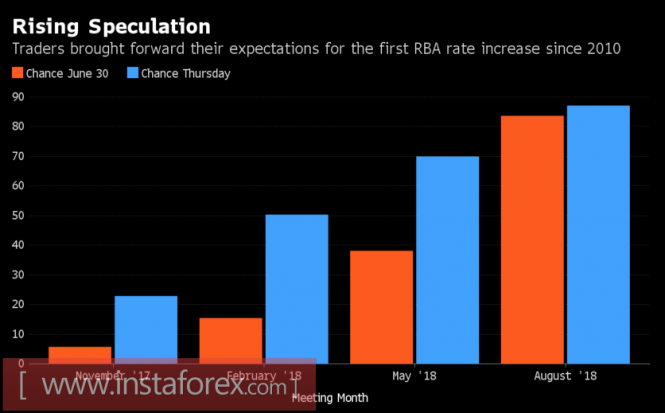
At the same time, according to Credit Agricole, the global appetite for risk will remain stable as long as the Federal Reserve adheres to the practice of dependence of its decision on incoming data on the US economy. This would be possible only if US data continues to disappoint, then the chances for a monetary tightening will be moved to 2018 and the AUD/USD pair will continue the rally. Furthermore, the likelihood of a hike in the cash-rate from the current 1.5% is gradually increasing.

The dynamics of the probability of tightening monetary policy of the RBA
analytics5975de933fdc6.png


Source: Bloomberg. Improving the external background and health of the Australian economy indicates the need to complete the cycle of monetary easing, which started in 2011.

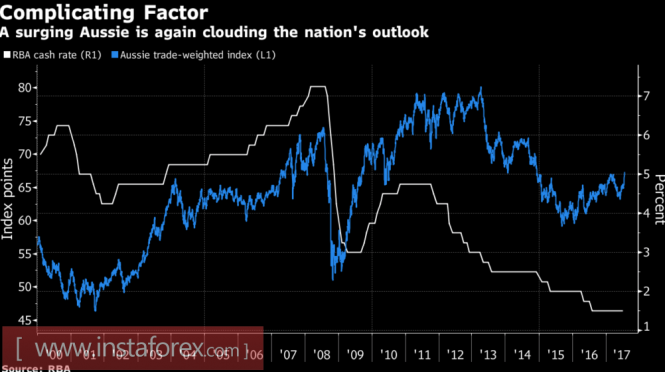
At that time, the main interest rate was at the level of 3.25%. According to HSBC, strengthening the "Aussie" by 5% is equivalent to a cash-rate rise of 25 basis points. At the same time, since the beginning of May, the trade-weighted rate of the Australian dollar firmed by 6%.

Dynamics of cash-rate and the Australian dollar rate
analytics5975de9f2f72d.png


Source: Bloomberg. Moreover, a number of banks warned that the "Aussie" was vulnerable to adjustment in the conditions of the RBA's growing discontent with the national currency and the inflated positioning in the futures market. The AUD/USD pair reacted sensitively to the verbal intervention of Guy Debelle, the deputy head of the Reserve Bank. He noted that the Aussie's high rate complicates the reorientation of the economy from mining to services. Talking about the equilibrium interest rate does not mean that the RBA is going to raise it. Simply, GDP is moving slightly lower than it was in the 1990s. Important factors for the medium-term prospects of the AUD/USD are data releases on Australian inflation, US GDP for the second quarter and the results of the FOMC meeting. CPI will likely slow down, however, correction would most probably be used for buying the "Aussie".

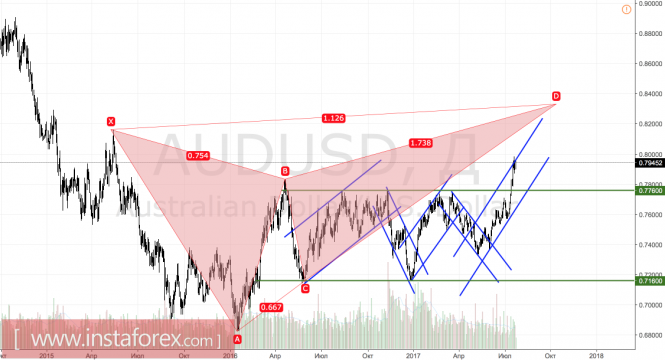
Technically, the implementation of the inverted "Splash and Shelf" pattern with the exit of prices outside the long-term consolidation range of 0.716-0.776 raises the risks of the uptrend development in the direction of the target by 127.2% on the "Perfect Butterfly" pattern.

AUD/USD, daily chart
analytics5975dea8c2e37.png
 
The Australian dollar continues to be in demand amid uncertainty over European currencies. Fundamentally, it helps that raw material prices are growing to two-year highs: iron added 1.1% ($67.86 per tonne), oil (Brent) increased by 1.0% ($48.65 per barrel), copper rose by 0.4%, and coal almost did not change in its current price ($164 per ton of coking coal).

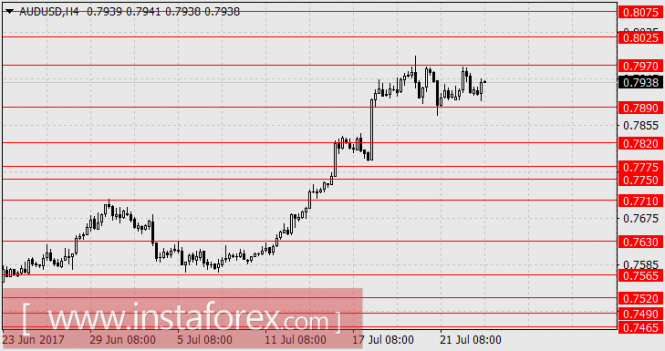
Tomorrow, Australia's consumer price index for the second quarter is expected to grow by 0.4%. The six-day consolidation of the "Aussie" in the range of 0.7890-0.7970 shows the intention of the market to continue its growth. However, the question is, will the investors succeed and will they want to leave this range before the Fed decision on the rate? Today's optimism in the Australian market is associated with a sharp increase in shares of the real estate sector (Mirvac 2.39%) and the mining sector (Fortescue 2.81%, Saracen Mineral 2.45%).

The S&P/ASX200 added 0.91%. The indices of Japan, China, Indonesia, and North Korea are falling. This creates doubts about the continued optimism of Australian investors. We believe that they will not violate the trend of the last six sessions and will wait for the decision of the Fed on the rate. The growth of the Australian dollar to 0.8075 and the decrease to 0.7820 seems equally probable to us.

analytics5976d2707e580.png
 
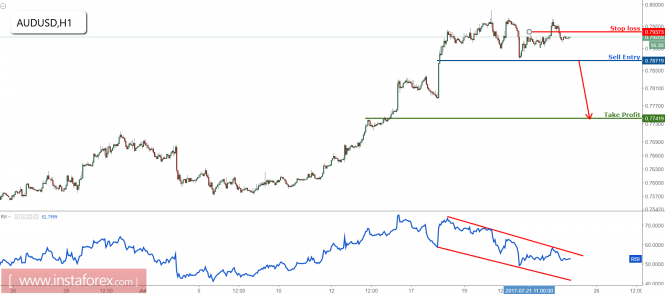
AUD/USD prepare to sell on break of key support

The price is hovering above key support at 0.7871 (Fibonacci retracement, horizontal swing low support) and we prepare to sell once price breaks this key level. Our profit target is a push down to next key support level at 0.7741 (Fibonacci retracement, horizontal pullback support).

RSI (55) is seeing bearish momentum within its bearish descending channel.

Sell below 0.7871. Stop loss is at 0.7937. Take profit is at 0.7741.

analytics5976aaf645232.png
 
24.07.2017audpro.png


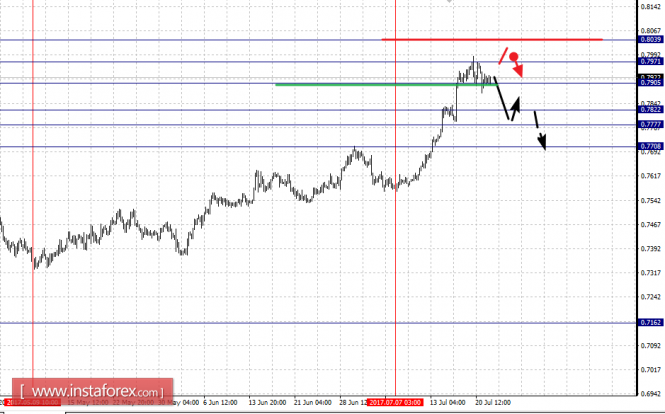
For the Australian Dollar / Dollar pair, key levels on the scale of H1 are: 0.8039, 0.7970, 0.7905, 0.7822, 0.7777 and 0.7708. Here, for the time being, we continue to follow the upward structure of May 9. In the range of 0.7905 - 0.7971 is the price consolidation and hence the likelihood of avoiding a prolonged correction on the scale of H1 is high. The limiting value for this structure is the level of 0.8039, the movement to which we regard as unstable.

Short-term downward movement, possibly in the corridor of 0.7822 - 0.7777 and the breakdown of the last value will lead to in-depth correction. Here, the target is 0.7708 and this level is the key support on the scale of H4.

Trading recommendations:

Buy: Take profit:

Buy: Take profit:

Sell: 0.7820 Take profit: 0.7780

Sell: 0.7772 Take profit: 0.7710
 
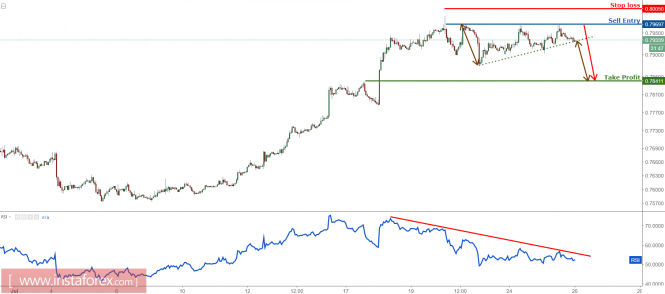
AUD/USD sell below major resistance

The price is hovering below major resistance at 0.7969 (Fibonacci extension, horizontal swing high resistance) and we expect to see a drop from this level towards 0.7841 support (Fibonacci retracement, Fibonacci extension, horizontal pullback support). The trigger for this trade would be when price breaks our ascending support line. Our stop loss is kept at 0.8005 (right above big figure).

RSI (55) is seeing bearish momentum within its bearish descending line.

Correlation analysis: AUD/USD and NZD/USD are both positively correlated.

So, it is good to see a drop on NZD/USD and AUD/USD as that increases our conviction on this trade.

Sell below 0.7969. Stop loss is at 0.8005. Take profit is at 0.7841.

analytics5977f62e8822f.png
 
Data on inflation in Australia cooled the plans of the RBA

Despite the large increase in oil prices, the Australian dollar was under pressure in tandem with the US dollar after the release of weak fundamental statistics.

This indicates a slowdown in inflation for the second quarter for this year. These indicators do not coincide with the plans of the Reserve Bank of Australia to raise interest rates in the near future.

I think we all remember that more recently, the RBA expressed itself very strongly regarding their further plans to tighten monetary and credit policy.

This led to a sharp strengthening of the Australian dollar against the US dollar. This in turn could seriously affect the indicators of Australia's economic growth towards a negative direction since the appreciation of the local currency usually leads to a decline in exports.

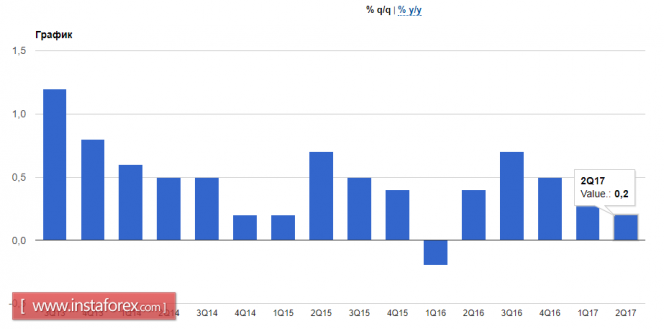
According to the report, Australia's consumer price index in the second quarter of this year increased by 0.2% against the expert's expectations of a 0.4% increase. Compared to the same period last year, growth for the second quarter was 1.9% against economist's expectations of 2.2%.

1501052404_1.png


The Reserve Bank of Australia said that employment growth allows the Central Bank to be patient with interest rates. Moreover, the monetary policy system is well-structured to overcome difficulties. It is important to note that the current policy of the Central Bank is tied to the situation in the labor market. It also takes into account the impact on the balance of households.

The main objective of the RBA is to achieve inflation at the level of 2-3%. However, according to the regulator himself, the desire for a faster inflation will create a risk for financial stability.

The speech by the RBA governor, Philip Lowe, mainly concerned the labor market and wages. It did not contain information of the further prospects of monetary policy. Lowe noted that the central scenario envisages a gradual increase in inflation. The governor is also concerned about the lack of wage growth that will apparently continue. In his view, a gradual increase in wages would be desirable since without wage growth, the target inflation will not be achieved.

As for the technical picture of the AUD/USD currency pair, it is time for buyers to pay attention to the lower border of the 0.7880 channel. The rebound from this range may lead to a return to the 0.7980 area and further upward movement of the trading instrument with a resistance update to 038160. The New Zealand dollar reacted to a decrease in data of the foreign trade deficit.

According to the report, New Zealand's foreign trade deficit from July last year to June of this year amounted to NZD 3.66 billion with a projected surplus of NZD 3.66 billion. Imports to New Zealand in June amounted to NZD 4.46 billion while exports amounted to NZD 4.7 billion.
 
Aussie Falls As Australia CPI Rises Less Than Expected

7.jpg


The Australian dollar weakened against other major currencies in the Asian session on Wednesday, after data showed that the consumer prices in Australia rose less than expected in the second quarter of 2017.

Data from the Australian Bureau of Statistics showed that the consumer prices in Australia gained 0.2 percent on quarter in the second quarter of 2017. That was shy of expectations for 0.4 percent and down from 0.5 percent in the three months prior. On a yearly basis, inflation was up 1.9 percent, also missing expectations for 2.2 percent and down from 2.1 percent in Q1.

Also, the Reserve Bank of Australia's trimmed mean came in at 0.5 percent on quarter, unchanged and matching expectations, and 1.8 percent on year, matching forecasts and down from 1.9 percent in the previous three months. The RBA's weighted median added 0.5 percent on quarter, in line with expectations and up from 0.4 percent in the three months prior.

It was also up 1.8 percent on year, above expectations for 1.7 percent, which would have been unchanged. Meanwhile, investors are cautious ahead of the U.S. Federal Reserve's monetary policy decision due later in the day. The Fed is widely expected to leave interest rates unchanged, but investors will be paying close attention to the accompanying statement for clues regarding future rate hikes.

Tuesday, the Australian dollar showed mixed trading against its major rivals. While the aussie rose against the U.S. dollar, the yen and the kiwi, it fell against the loonie. Against the euro, the aussie held steady.

In the Asian trading, the Australian dollar fell to nearly a 2-week low of 0.9871 against the Canadian dollar and a 5-day low of 0.7887 against the U.S. dollar, from yesterday's closing quotes of 0.9924 and 0.7936, respectively. If the aussie extends its downtrend, it is likely to find support around 0.97 against the loonie and 0.77 against the greenback.

Against the euro and the NZ dollar, the aussie dropped to 2-day lows of 1.4754 and 1.0627 from yesterday's closing quotes of 1.4673 and 1.0701, respectively. The aussie may test support near 1.50 against the euro and 1.05 against the kiwi. The aussie edged down to 88.32 against the yen, from an early 5-day high of 88.92. On the downside, 87.00 is seen as the next support level for the currency. Meanwhile, the other antipodean currency, the NZ dollar, also fell against its major rivals.

In other economic news, data from Statistics New Zealand showed that New Zealand had a merchandise trade surplus of NZ$242 million in June.That beat expectations of a surplus of NZ$150 million following the NZ$$103 million surplus in May. Exports jumped 11.0 percent on year to NZ$4.70 billion, exceeding expectations of NZ$4.60 billion but was down from NZ$4.92 billion in the previous month.

Imports advanced an annual 7.7 percent to NZ$4.46 billion versus forecasts for NZ$4.40 billion and down from NZ$4.84 billion a month earlier. The NZ dollar fell to 82.97 against the yen, from an early near 2-week high of 83.24. The kiwi may test support near the 81.00 region. Against the U.S. dollar and the euro, the kiwi dropped to 0.7411 and 1.5703 from early highs of 0.7436 and 1.5657, respectively.

If the kiwi extends its downtrend, it is likely to find support around 0.73 against the greenback and 1.58 against the euro. Looking ahead, Swiss Credit Suisse economic expectations index for July and U.K. GDP for the second quarter are due to be released later in the day. In the New York session, U.S. new home sales data for June and U.S. crude oil inventories data are slated for release. At 2:00 pm ET, the U.S. Federal Reserve's monetary policy decision is due to be announced. The Federal Open Market Committee is widely expected to leave interest rates unchanged at below 1.25 percent.
 
Australia Consumer Price Growth Weakens in Second Quarter

5978115ce19e7.jpg


Consumer prices in Australia were weaker than expected in the second quarter as lower petrol and travel costs undermined price growth. The headline consumer price index climbed 0.2 percent quarter on quarter in the three months ended June, significantly lower than the rate of 0.5 percent in the first quarter, according to the Australian Bureau of Statistics.

It brought year-on-year price growth to a pace of 1.9 percent, lower from 2.1 percent in the first quarter and also against a median forecast which expected inflation to climb to 2.2 percent in the second quarter. According to the ABS, sharp price increases in the second quarter were from medical and hospital services, which rose 4.1 percent quarter-on-quarter.

New home purchase by owner-occupiers climbed 0.9 percent while tobacco increased one percent. The biggest price declines were from domestic travel holiday travel and accommodation, which fell 3.2 percent, and automotive fuel off by 2.5 percent. The Australian dollar fell against the greenback after the data release to $0.7908.
 
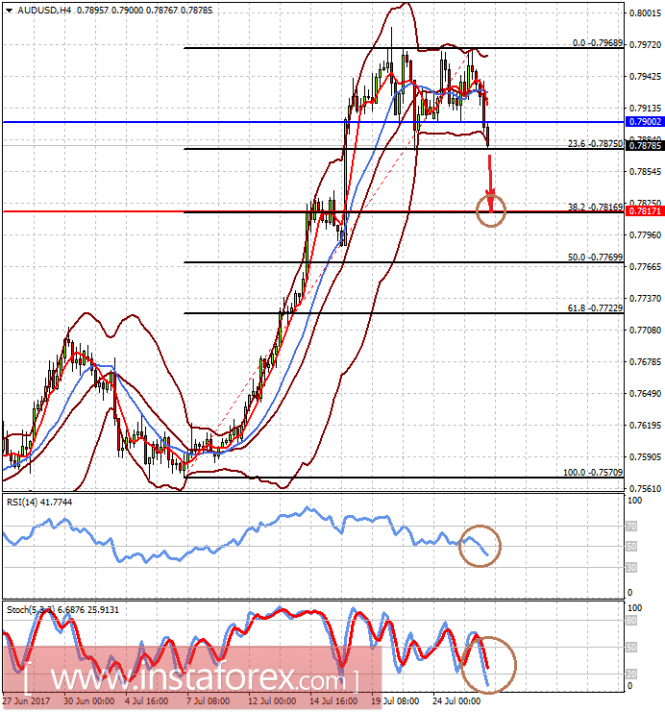
The AUDUSD pair is trading near 0.7880 on the wave of the weak data on consumer inflation in Australia. The pair would probably to continue its decline, following the positive US dollar due to the outcome of the Fed meeting about monetary policy. On this wave, the price may drop to 0.7815.

analytics597842dd1b8b2.png
 
Global macro overview for 26/07/2017

The second quarter CPI data from Australia were worse than anticipated. The Australian Bureau of Statistics revealed that Q2 CPI was at the level of 0.2%, which was a worse than the previous reading of 0.5% and worse than market expectations of 0.4%. In a yearly basis, the CPI deteriorate from 2.2% to 1.9%. Annual inflation comes in roughly at the midpoint of the central bank's 1-3% target range. Last year, CPI fell to multi-decade lows, prompting the RBA to slash interest rates to new record lows.

The Australian Dollar's depreciation is the result of disappointing lower-than-expected inflation readings for the second quarter and the repetition by Reserve Bank of Australia Governor Phillip Lowe of a very dovish Debelle statement from a week In the speech, he reiterated, that RBA is not going to raise rates quickly and will not allow the market to discount such a scenario under the influence of increases made by the Bank of Canada for example. Moreover, it does not look like the iron ore or copper ore prices will be still developing to such an advantage for the Australian dollar as before. In the case of industrial metals, the global investors will probably have to wait longer, but the corrective cycle is indispensable.

The sooner the Chinese economy, which consumes more than all OECD countries together, will lose momentum in the second half of the year, the faster the correction will happen. With that in mind, the global investors should not forget that copper at high levels (today's at 27-month peak) is more stabilized by supply disruptions than demand and the similar situation is on iron ore and aluminum markets. Therefore, there is no reason to expect the industrial metal price to be able to support the Australian Dollar. With the current RBA monetary policy plans and after very strong strengthening to 0.8000 level. the AUD/USD will be one of the most sensitive currencies when the US Dollar begins to make up its losses.

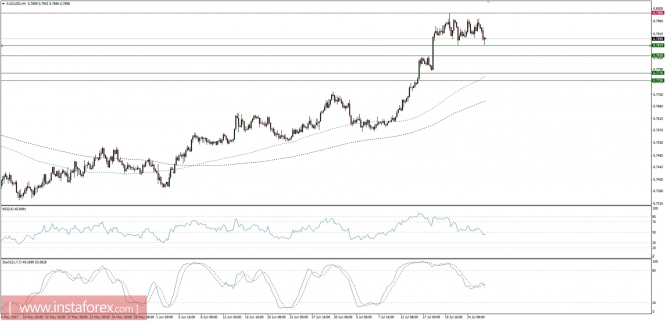
Let's now take a look at the AUD/USD technical picture at the H4 timeframe. The pair is trading close to two years high around the level of 0.7900. The market conditions look overbought on this timeframe and the momentum indicator is pointing to the downside. The next technical support is seen at the level of 0.7874 and 0.7838.


analytics5978601e5f91f.jpg
 
Status
Not open for further replies.

Live Forex Chart

Currency
Rates
EUR / USD
1.13714
USD / JPY
157.382
GBP / USD
1.32550
USD / CHF
0.83202
USD / CAD
1.41746
EUR / JPY
178.965
AUD / USD
0.70179
Back
Top
Log in Register