Elina-Ward
Fun Poster
- Messages
- 136
- Joined
- Dec 2, 2025
- Messages
- 136
- Reaction score
- 5
- Points
- 25
Wednesday 3 June 2026
XAU/USD Weekly Analysis — 25 May 2026 to 29 May 2026Timeframe: H1 | Net Move: -0.08% | Range: +5.24% | Bias & Key Risk: Cautiously Bullish
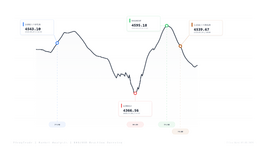
During the week of May 25 to May 29, 2026, spot gold (XAU/USD) executed a dramatic round-trip, ultimately closing virtually flat at $4,539.67 (-0.08%) after testing a key support level at $4,366.56. This high-volatility price action was primarily driven by sharp swings in U.S. Treasury yields, shifting Federal Reserve rate expectations, U.S. dollar movement, and a major geopolitical breakthrough as reports of a possible 60-day U.S.–Iran ceasefire MOU temporarily eased energy-inflation concerns. Although gold staged a powerful 5.24% relief rally from its weekly low, the move failed to fully hold into the close, showing that traders remained cautious despite the improvement in geopolitical sentiment. Looking ahead, the critical question is whether gold can sustain its recovery if yields remain capped, or whether renewed inflation and rate pressure will reassert downward pressure.
As a post-period update, the 3 June 2026 08:00 AM GMT candlestick opened at 4,453.23, which was 1.90% below the 29 May close of 4,539.67, showing that XAU/USD remained under pressure after the weekly rebound.
PRICE ACTION SUMMARY
| Metric | Value |
| Period Open | 4,543.10 |
| Period High | 4,595.18 |
| Period Low | 4,366.56 |
| Period Close | 4,539.67 |
| Net Move (Open → Close) | -0.08% |
| Range Move (Low → High) | +5.24% |
🔴 RESISTANCE said:4543.10 —
🟢 SUPPORT said:4366.56 —
FUNDAMENTAL DRIVERS
DXY & REAL YIELDSThe U.S. Dollar Index (DXY) exhibited strong performance early on, climbing to a high of 99.54 on May 28, driven by hawkish Federal Reserve rate expectations and resilient U.S. PMI figures. However, the DXY and U.S. 10-year Treasury yields pulled back later in the week, with the nominal 10-year yield falling from 4.50% on May 26 to close at 4.45% on May 29, following cooler-than-expected monthly PCE inflation data and optimism surrounding a preliminary U.S.-Iran deal. This pullback in yields and the greenback helped spark the sharp late-week recovery in non-yielding spot gold.
CENTRAL BANK ACTIVITYAt the UBS Asian Investment Conference in Hong Kong on May 29, 2026, the World Gold Council's senior market strategist, Joe Cavatoni, confirmed that global central banks continue a robust diversification strategy rather than an explicit de-dollarization play. World Gold Council data showed that the People's Bank of China (PBoC) added 8 metric tons of gold to its official reserves in April, marking its 18th consecutive monthly purchase and lifting its total holdings to 2,322 metric tons, while the National Bank of Kazakhstan and the Czech National Bank added 12 tons and 5 tons respectively, creating a persistent structural floor for gold prices.
GEOPOLITICAL & SAFE HAVENTensions in the Middle East remained high as the 2026 Strait of Hormuz crisis and the broader U.S.-Iran war, which began on February 28, continued to choke maritime energy trade. On May 28, 2026, Axios reported that U.S. and Iranian negotiators had reached a preliminary agreement on a 60-day memorandum of understanding (MOU) to extend the ceasefire and begin nuclear talks. This critical geopolitical breakthrough led to a sharp drop in international oil prices, reducing the safe-haven risk premium but simultaneously easing global inflation concerns and yield pressure.
COT POSITIONINGThe CFTC Commitments of Traders (COT) report for the week ending May 26, 2026, showed large speculators reducing their net long positions in gold futures by 5.6k contracts to 154.3k. Non-commercial large speculators held 200,704 long contracts and 46,444 short contracts, showing a temporary moderation in speculative optimism during the mid-week pullback, while commercial hedgers maintained 74,641 long contracts and 260,407 short contracts as spot gold successfully tested horizontal support near its 200-day moving average.
WHAT TO WATCH NEXT
June 5, 2026 — U.S. Non-Farm Payrolls (NFP) ReleaseKey labor market data will steer Fed rate expectations and subsequent gold pricing.
June 17, 2026 — FOMC Interest Rate DecisionFederal Reserve policy guidance will directly influence U.S. real yields and the DXY.
BIAS & KEY RISK said:CAUTIOUSLY BULLISH
While the temporary de-escalation in the Middle East removes immediate safe-haven bid energy, the subsequent retreat in U.S. Treasury yields and resilient central bank purchasing should continue to support gold. Holding the 200-day moving average on the weekly dip signals strong institutional buying interest near structural support. We expect gold to consolidate with an upward bias as long as yields remain capped below 4.50%.
CRITICAL RISK: The primary risk is a formal collapse of the temporary U.S.-Iran ceasefire negotiations, which would reignite energy inflation fears and force yields higher.
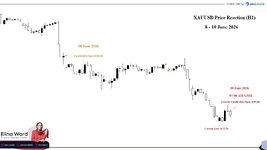
The chart below illustrates the movement of XAU/USD from 25 May to 29 May 2026, based on the 1-hour candlestick timeframe.
Profit Study:
Imagine entering XAU/USD near the period open at 4,543.10 before the sharp decline toward the weekly low.On a 1 standard lot position, this move from 4,543.10 to 4,366.56 represented a market range of 176.54 points, equal to a potential gross movement of $17,654. Based on the opening price, the required margin would have been approximately $908.62 with 1:500 leverage or $227.16 with 1:2000 leverage.
Alternatively, traders who missed the downside move could have focused on the rebound from the weekly low of 4,366.56 to the weekly high of 4,595.18. This recovery covered 228.62 points, equal to a potential gross movement of $22,862 on a 1 standard lot position. Based on the weekly low price, the required margin would have been approximately $873.31 with 1:500 leverage or $218.33 with 1:2000 leverage.
This was the power of volatility. Traders did not need to capture the full move perfectly — even a partial position within that range could have created a significant opportunity for those who were prepared, disciplined, and aware of the risks.
Attachments
-
 150.3 KB Views: 18
 +3.20 ↗ / +3.36% ↗
 -2.67 ↘ / -2.64% ↘


 High-Impact Economic Calendar – 15–19 June 2026
 Week Overview
 Monday, 15 Jun 2026
 NZ
NZ CH
CH Week Summary