Question 1: How soon can guppies multiply?
Females mature at about 3 months of age, perhaps sooner in a warmer tank. Males sexually mature somewhat sooner. The males will develop a modified, pointed anal fin called gonopodium, after several weeks. The male with the least desirable traits often impregnates the females, and all chances of controlled breeding is lost. This is a good reason to separate them before the male can develop his gonopodium.
Question 2: Is my guppy pregnant? Where is the gravid spot?
If your female has been around other males, then chances are she is pregnant. Females from pet store tanks are usually pregnant. Signs of pregnancy are a large belly, a boxy-look from the front view, and a darker gravid spot. The spot, under the fish's tail, is like a stained-glass window where the fry come out. Near the day of delivery you can sometimes see eyes of the unborn fry as tiny black dots.
Question 3: When will my guppy have her babies?
There really is no telling. You will just have to keep a close eye on her as she gets larger and her gravid spot gets darker, because there are no definite signs. Sometimes a female will become rather still and solitary near birthing. If you know when she had her last drop, you can expect another drop in about 4 weeks or so.
Question 4: How do I save the fry?
The best way is to have a separate tank loaded with fake or live plants and a small box filter. Before the female is to deliver, put her in this tank, and when she drops the fry will have lots of cover in which to hide. The mother will sometimes make a meal of them if she sees them, since she is very hungry.
Question 5: How and when can I tell the sexes apart?
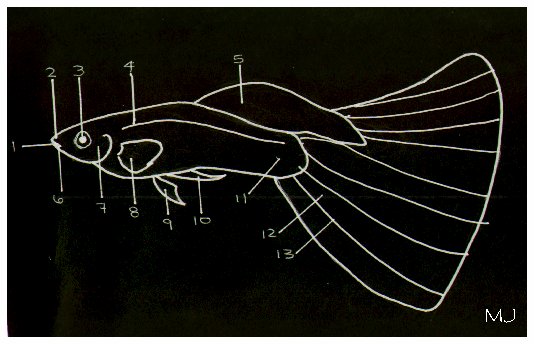
The answer is, believe it or not, at one week of age! Just look for the gravid spot which every female has. Use a small magnifying glass and a flashlight. When separating them, if there is a question as to whether a guppy is male or female, put it with males. Keep in mind that there is no urgency to separate them until the male's anal fin begins to look pointed. He cannot inseminate females until his gonopodium ( see Anatomy ) is
developed.
1. Mouth - points forward.
2. Nostril - smell and taste (closely intertwined) is accomplished in the nasal openings, mouth and head.
3. Eye - almost spherical in shape, selective near/far focus. Eye structure suggests fish can see in colour.
4. Lateral line - line of scales with pores. Senses motion in water, extremely sensitive. Enables fish to control swimming.
5. Dorsal fin
6. Chin
7. Operculum (gill cover) - pumps water over gills for gas exchange.
8. Pectoral fin - paired "arms" - Used for fine movement backward and forward.
9. Pelvic (ventral) fin - paired "legs" - Used for stability in the water.
10. Gonopodium - modified anal fin of all live-bearing toothcarps. Used to introduce sperm to the female - has five rays.
11. Caudal peduncle - supports the caudal fin.
12. Caudal (tail) fin - many shapes. See Guppy Tails
13. Fin rays - fin support structure.
Question 6: How can I make sure who the father is?
Since a female stores sperm and has often 4, sometimes 8, drops from just one fertilization (this is called "superfetation"), it is impossible to know (unless you buy a virgin female and mate her). If the female is fertilized again at the time she drops her young, that male's sperm should take over and the next drop should be his fry.
Question 7: When do guppies start to get their colour?
This depends mostly on genetics. Some strains get colour sooner than others. For instance, the reds that you see in this website did not show any red until 6 weeks of age. The Moscows display most of their colour by the time they are 6 weeks old. Half-black males typically show dark caudal peduncles from about one week of age. Rate of development makes a difference as well. If fry are kept in cool water with infrequent water changes and dry food only, they will mature at a much slower rate.
Question 8: When is it safe to put my fry in the tank with adults?
Those hobbyists that are serious about seeing their fry develop to their full potential will not mix fry with adults. Though unproven, it has long been held that older fish release a pheromone which inhibits growth in fry. Also, adult fish produce much more waste than smaller fish, thus causing lesser water conditions than is needed for the healthy development of fancy guppies. Also, growing fish need more food than older fish, and usually find it difficult when forced to compete with adults; feeding more food simply contributes to the problem of poor water quality.
Specifically, however, the question deals with "safety", which implies that one wants to know when the fry will be able to survive the adult tank. This is the question many people have when they do not keep separate tanks for the fry to mature in. Assuming there are no other species of cannibalistic/aggressive fish in the tank, fry should be able to live with adult guppies when they are large enough so as not to be considered food, compared with the size of the adult guppies. No age can be specified since development in size varies.
Question 9: What kind of home does my new guppy need?
Many people new to guppies think a fish bowl of 1 or 3 gallons is sufficient. However, this is incorrect.
A guppy is very active and needs space, and space also gives you the benefit of seeing the amazing colours of the fish in all their glory. Also, they are social fish and it is a sad injustice to submit one to solitary confinement. A group of three, a male and two females, is the minimum, and for this you need at least a 4 to 5 gallon tank.
Question 10: Does that mean a large investment then?
It is not necessary to spend a lot of money on a guppy set-up. All that is needed is a tank (I suggest a 10 or 20 gallon tank in the beginning as there is more room for errors than in a smaller one!), a filter, and possibly a heater. Some people find great bargains on secondhand fish tanks and accessories. Remember that the larger the tank your fish have, the better, so get the largest you can afford.


 (
(