seether
CG Top Poster Club

- Messages
- 28,415
- Joined
- Jul 30, 2010
- Messages
- 28,415
- Reaction score
- 6
- Points
- 311
A large collection of pictures of the Holocaust, including pictures of the concentration camps, death camps, prisoners, children, ghettos, displaced persons, Einsatzgruppen (mobile killing squads), Hitler, and other Nazi officials.
Terlalu banyak gambar2 yg dinyatakan disini tp untuk tatapan kawan2 CG kita mulakan dengan Einsatzgruppen (mobile killing squads).
The Einsatzgruppen were German mobile killing units that operated within German-occupied territory after Germany invaded the Soviet Union in 1941. The Einsatzgruppen rounded up Jews, Gypsies, the disabled, Communists, and prisoners of war and then murdered them.
One of the more well known mass killings conducted by the Einsatzgruppen was at B.A.B.I Yar, where 100,000 people were slaughtered.
By the spring of 1943, it is estimated that the Einsatzgruppen had murdered approximately 1.25 million Jews and thousands of others.
The following pictures show the Einsatzgruppen preparing their victims and then killing them.

Jews, on their way out of the city of Kiev to the B.A.B.I Yar ravine, pass corpses lying on the street. (September 29, 1941)

Jewish women and a child - after they had handed over their belongings to German soldiers and before a mass execution. (1941 - 1942)

Close-up of a young mother with her two children, sitting among a large group of Jews from Lubny who have been assembled for mass execution by the Germans. (October 16, 1941)

Unidentified people sit among piles of clothing at the bottom of a ravine presumed to be B.A.B.I Yar. Above them, German police officers patrol the ravine. (September 29-30, 1941)

German police and Ukrainian collaborators in civilian clothes look on as Jewish women are forced to undress before their execution. (1942)

Naked Jewish women, some of whom are holding infants, wait in a line before their execution by Ukrainian auxilliary police. (October 14, 1942)

Jewish men are forced to dig their own graves before being executed by Waffen-SS troops. (1942)

Men with an unidentified unit execute a group of Soviet civilians kneeling by the side of a mass grave. (June 22 - September 1941)

German soldiers of the Waffen-SS and the Reich Labor Service look on as a member of Einsatzgruppe D prepares to shoot a Ukrainian Jew kneeling on the edge of a mass grave filled with corpses. (1942)

The execution of civilians at an unidentified location in the German-occupied eastern territories. (June 22, 1941 - 1943)

A German policeman shoots individual Jewish women who remain alive in the ravine after a mass execution of Jews from the Mizocz ghetto. (October 14, 1942)

German police look through the clothing of people killed during a shooting action, presumably at B.A.B.I Yar. (Sep 29-30, 1941)

A member of an Einsatzgruppe speaks with two women at the top of what is presumably the ravine at B.A.B.I Yar. Soviet POWs in the ravine are busy exhuming the bodies of the thousands of Jews, Gypsies, and Soviet POWs killed there in the previous two years. (August 19, 1943)

The remains of shoes and clothing of people killed in the ravine at B.A.B.I Yar. (Circa 1944)

An exhibit of human remains and artifacts retrieved by the American Army from a pathology laboratory run by the SS in Buchenwald. These items were used as evidence of SS atrocities in the Buchenwald war crimes trial held at Dachau, Germany. The two shrunken heads are from Polish prisoners who were recaptured after escaping from the camp and executed. (April 16, 1945)

A guide shows jars containing human organs removed from prisoners in Buchenwald to Jack Levine, an American soldier. (May 27, 1945)

Six thousand Mauthausen prisoners wait in the camp courtyard for disinfection. After 24 hours, nearly 140 had died. (July 1941)

A British Army truck transporting corpses to mass graves for burial. (Bergen-Belsen) (April 28, 1945)

U.S. troops watch a passing cart laden with corpses intended for burial leave the compound of the Dachau concentration camp. Allied authorities required local farmers to drive their loaded carts through the town of Dachau as an education for the inhabitants. (May 1945)

Railway cars loaded with the corpses of prisoners who died on route to Dachau from other concentration camps. (April 30, 1945)

American troops inspecting Ohrdruf view the charred remains of corpses that were burned upon a section of railroad track in the camp. (April 4-15, 1945)
Children Of The Holocaust

Polish children imprisoned in Auschwitz look out from behind the barbed wire fence. (July 1944)

Group portrait of children living in a Kielce ghetto orphanage, administered by the Judenrat (Jewish Council). (January 1, 1942)

Six-year old Anna and three-year Jon Klein, the children of Aladar Klein. Both perished in Auschwitz. (1942)

An American soldier stands above the corpses of children that are to be buried in a mass grave dug by German civilians from the nearby town of Nordhausen. (April 14, 1945)

Joseph Schleifstein, a 5 year old survivor of Buchenwald. (After May 1945)

The baby clinic at the hospital in the Zeilsheim displaced persons' camp. (1945-1948)

A child lights a Hannukah menorah during a holiday celebration in the Zeilsheim displaced persons' camp. (1945)
The Dead People

A mass grave in Bergen-Belsen concentration camp. (May 1, 1945)

Prisoners' corpses from the Nordhausen concentration camp lying in a mass grave prepared by civilians from the town of Nordhausen. (April 13-14, 1945)

Prisoners' bodies laid out in a mass grave. (Mauthausen) (May 10-15, 1945)

German civilians from the town of Nordhausen bury the corpses of prisoners found in the Nordhausen concentration camp in mass graves. (April 13-14, 1945)

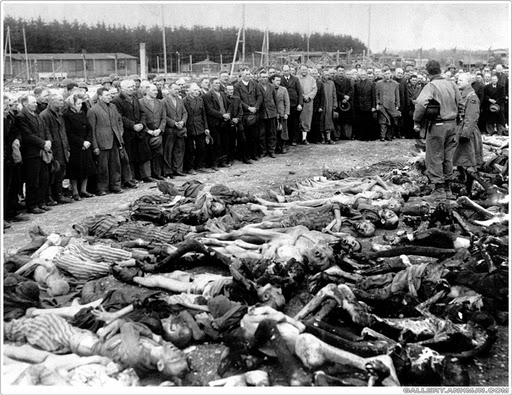
German civilians, under the supervision of American soldiers, are forced to see the results of crimes committed by the SS in Buchenwald. (April 11 - May 1945)

American soldiers of the U.S. 7th Army, force boys believed to be Hitler youth, to examine boxcars containing bodies of prisoners starved to death by the SS. (April 30, 1945)

Under orders from the U.S. Army, Austrian civilians dig mass graves for corpses found in Gusen. (May 5-10, 1945)

A group of American editors and publishers in Dachau are shown the corpses of prisoners during an inspection of the camp. (May 4, 1945)

Gen. Dwight Eisenhower and other U.S. Army officers view the bodies of executed prisoners while on a tour of the Ohrdruf concentration camp. (April 12, 1945)

Congressman John M. Vorys(right) viewing a room full of corpses while on an inspection of the Dachau concentration camp. The group of touring congressmen was led by General Wilson B. Parsons who stands to the left in this photograph. (May 3, 1945)

The dead body of a prisoner lies on the floor between rows of bunks in a barracks in the Woebbelin concentration camp. (May 4, 1945)

Two survivors lie among corpses on the straw-covered floor of the "Boelke Kaserne". (April 11, 1945)

The corpse of Abraham Borenstein lies in the foreground after his execution by the SS at Dachau. Two of the SS pictured who participated in the killing are Egon Zill and Franz Johann Hofmann. A large labor kommando can be seen laboring in the distance. (May 15, 1941)

Two American soldiers view scores of dead bodies in a barracks in the Nordhausen concentration camp. (April 11-20, 1945)

Corpses in the Woebbelin concentration camp. (May 4, 1945)

Troops with the American 82nd Airborne Division examine corpses found in the latrine of the Woebbelin concentration camp. (May 6, 1945)

Survivors counting the corpses of prisoners killed in the Mauthausen concentration camp. (May 5-10, 1945)
Railway cars loaded with the corpses of prisoners who died on route to Dachau from other concentration camps. (April 30, 1945)
U.S. troops watch a passing cart laden with corpses intended for burial leave the compound of the Dachau concentration camp. Allied authorities required local farmers to drive their loaded carts through the town of Dachau as an education for the inhabitants. (May 1945)

Austrian civilians load corpses onto a cart that will transport the bodies to a mass grave. (May 5 - May 12, 1945)

A wagon loaded with corpses intended for burial in Buchenwald. (April 11 - May 1945)
Terlalu banyak gambar2 yg dinyatakan disini tp untuk tatapan kawan2 CG kita mulakan dengan Einsatzgruppen (mobile killing squads).
The Einsatzgruppen were German mobile killing units that operated within German-occupied territory after Germany invaded the Soviet Union in 1941. The Einsatzgruppen rounded up Jews, Gypsies, the disabled, Communists, and prisoners of war and then murdered them.
One of the more well known mass killings conducted by the Einsatzgruppen was at B.A.B.I Yar, where 100,000 people were slaughtered.
By the spring of 1943, it is estimated that the Einsatzgruppen had murdered approximately 1.25 million Jews and thousands of others.
The following pictures show the Einsatzgruppen preparing their victims and then killing them.
Jews, on their way out of the city of Kiev to the B.A.B.I Yar ravine, pass corpses lying on the street. (September 29, 1941)
Jewish women and a child - after they had handed over their belongings to German soldiers and before a mass execution. (1941 - 1942)
Close-up of a young mother with her two children, sitting among a large group of Jews from Lubny who have been assembled for mass execution by the Germans. (October 16, 1941)
Unidentified people sit among piles of clothing at the bottom of a ravine presumed to be B.A.B.I Yar. Above them, German police officers patrol the ravine. (September 29-30, 1941)
German police and Ukrainian collaborators in civilian clothes look on as Jewish women are forced to undress before their execution. (1942)
Naked Jewish women, some of whom are holding infants, wait in a line before their execution by Ukrainian auxilliary police. (October 14, 1942)
Jewish men are forced to dig their own graves before being executed by Waffen-SS troops. (1942)
Men with an unidentified unit execute a group of Soviet civilians kneeling by the side of a mass grave. (June 22 - September 1941)
German soldiers of the Waffen-SS and the Reich Labor Service look on as a member of Einsatzgruppe D prepares to shoot a Ukrainian Jew kneeling on the edge of a mass grave filled with corpses. (1942)
The execution of civilians at an unidentified location in the German-occupied eastern territories. (June 22, 1941 - 1943)
A German policeman shoots individual Jewish women who remain alive in the ravine after a mass execution of Jews from the Mizocz ghetto. (October 14, 1942)
German police look through the clothing of people killed during a shooting action, presumably at B.A.B.I Yar. (Sep 29-30, 1941)
A member of an Einsatzgruppe speaks with two women at the top of what is presumably the ravine at B.A.B.I Yar. Soviet POWs in the ravine are busy exhuming the bodies of the thousands of Jews, Gypsies, and Soviet POWs killed there in the previous two years. (August 19, 1943)
The remains of shoes and clothing of people killed in the ravine at B.A.B.I Yar. (Circa 1944)
An exhibit of human remains and artifacts retrieved by the American Army from a pathology laboratory run by the SS in Buchenwald. These items were used as evidence of SS atrocities in the Buchenwald war crimes trial held at Dachau, Germany. The two shrunken heads are from Polish prisoners who were recaptured after escaping from the camp and executed. (April 16, 1945)
A guide shows jars containing human organs removed from prisoners in Buchenwald to Jack Levine, an American soldier. (May 27, 1945)
Six thousand Mauthausen prisoners wait in the camp courtyard for disinfection. After 24 hours, nearly 140 had died. (July 1941)
A British Army truck transporting corpses to mass graves for burial. (Bergen-Belsen) (April 28, 1945)
U.S. troops watch a passing cart laden with corpses intended for burial leave the compound of the Dachau concentration camp. Allied authorities required local farmers to drive their loaded carts through the town of Dachau as an education for the inhabitants. (May 1945)
Railway cars loaded with the corpses of prisoners who died on route to Dachau from other concentration camps. (April 30, 1945)
American troops inspecting Ohrdruf view the charred remains of corpses that were burned upon a section of railroad track in the camp. (April 4-15, 1945)
Children Of The Holocaust
Polish children imprisoned in Auschwitz look out from behind the barbed wire fence. (July 1944)
Group portrait of children living in a Kielce ghetto orphanage, administered by the Judenrat (Jewish Council). (January 1, 1942)
Six-year old Anna and three-year Jon Klein, the children of Aladar Klein. Both perished in Auschwitz. (1942)
An American soldier stands above the corpses of children that are to be buried in a mass grave dug by German civilians from the nearby town of Nordhausen. (April 14, 1945)
Joseph Schleifstein, a 5 year old survivor of Buchenwald. (After May 1945)
The baby clinic at the hospital in the Zeilsheim displaced persons' camp. (1945-1948)
A child lights a Hannukah menorah during a holiday celebration in the Zeilsheim displaced persons' camp. (1945)
The Dead People
A mass grave in Bergen-Belsen concentration camp. (May 1, 1945)
Prisoners' corpses from the Nordhausen concentration camp lying in a mass grave prepared by civilians from the town of Nordhausen. (April 13-14, 1945)
Prisoners' bodies laid out in a mass grave. (Mauthausen) (May 10-15, 1945)
German civilians from the town of Nordhausen bury the corpses of prisoners found in the Nordhausen concentration camp in mass graves. (April 13-14, 1945)
German civilians, under the supervision of American soldiers, are forced to see the results of crimes committed by the SS in Buchenwald. (April 11 - May 1945)
American soldiers of the U.S. 7th Army, force boys believed to be Hitler youth, to examine boxcars containing bodies of prisoners starved to death by the SS. (April 30, 1945)
Under orders from the U.S. Army, Austrian civilians dig mass graves for corpses found in Gusen. (May 5-10, 1945)
A group of American editors and publishers in Dachau are shown the corpses of prisoners during an inspection of the camp. (May 4, 1945)
Gen. Dwight Eisenhower and other U.S. Army officers view the bodies of executed prisoners while on a tour of the Ohrdruf concentration camp. (April 12, 1945)
Congressman John M. Vorys(right) viewing a room full of corpses while on an inspection of the Dachau concentration camp. The group of touring congressmen was led by General Wilson B. Parsons who stands to the left in this photograph. (May 3, 1945)
The dead body of a prisoner lies on the floor between rows of bunks in a barracks in the Woebbelin concentration camp. (May 4, 1945)
Two survivors lie among corpses on the straw-covered floor of the "Boelke Kaserne". (April 11, 1945)
The corpse of Abraham Borenstein lies in the foreground after his execution by the SS at Dachau. Two of the SS pictured who participated in the killing are Egon Zill and Franz Johann Hofmann. A large labor kommando can be seen laboring in the distance. (May 15, 1941)
Two American soldiers view scores of dead bodies in a barracks in the Nordhausen concentration camp. (April 11-20, 1945)
Corpses in the Woebbelin concentration camp. (May 4, 1945)
Troops with the American 82nd Airborne Division examine corpses found in the latrine of the Woebbelin concentration camp. (May 6, 1945)
Survivors counting the corpses of prisoners killed in the Mauthausen concentration camp. (May 5-10, 1945)
Railway cars loaded with the corpses of prisoners who died on route to Dachau from other concentration camps. (April 30, 1945)
U.S. troops watch a passing cart laden with corpses intended for burial leave the compound of the Dachau concentration camp. Allied authorities required local farmers to drive their loaded carts through the town of Dachau as an education for the inhabitants. (May 1945)
Austrian civilians load corpses onto a cart that will transport the bodies to a mass grave. (May 5 - May 12, 1945)
A wagon loaded with corpses intended for burial in Buchenwald. (April 11 - May 1945)
Last edited: