We have seen a big drop in the dollar during the beginning of this week, after ISM Non-Manufacturing figures sank to 6-year low, sending a clear message to the market that a rate hike in the near future is very unlikely, especially after the recent disappointment in the U.S jobs report last Friday.
Immediately after these figures, September rate hike probability fell to 26.0% 30.8% in November while the chances for a move in December remain at 54.0%.
As of today, the U.S Dollar managed to bounce in the beginning of the U.S trading session on profit taking as September FED meeting looms.
Looking at the major economic releases which came out today, the ECB rate decision was a disappointment for investors today as the central bank decided to keep all the three-benchmark rates unchanged and to keep asset purchase program at 80 billion euros a month. In the meantime, the bank reaffirmed that it is planning to run QE until March 2017 or beyond if needed.
The Euro rose to as high as 1.1327 before to retreat below 1.1300 handle as the bullish momentum faded.
In the U.S, initial jobless claims dropped to 259K down from 263K previously while the continuing claims came out below estimates at 2144K.
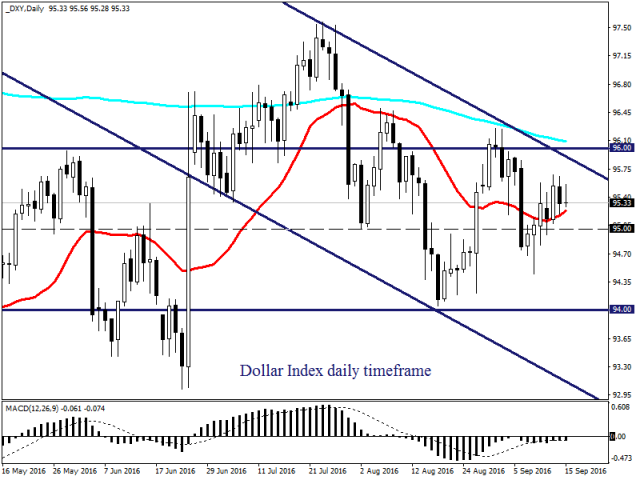
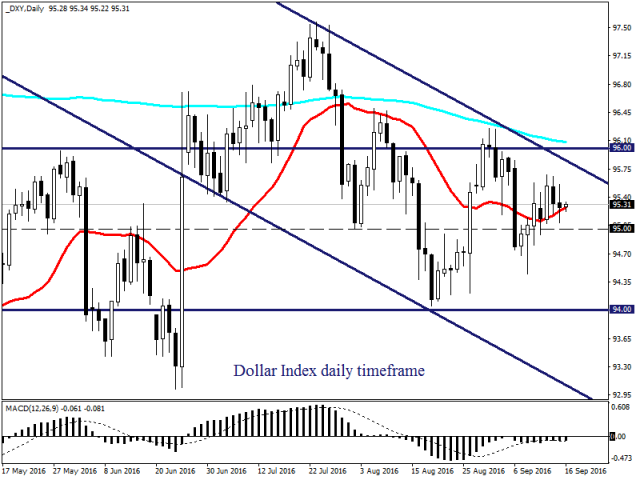
Technically, the dollar remain bearish in the daily chart, while in the near-term, the outlook is flat. The Greenback keep trading sideways between 96.25 level in the upside and 94.00 support in the downside, which keeps the short-term view unclear. Therefore, traders should focus on this zone, as a break outside of it will trigger a big move in the dollar during the following days.
Looking at the levels of interest in the hourly chart, 94.40 is seen as the short-term support, in the opposite, 95.00/20 is considered as a strong resistance zone.
A wave of risk aversion engulfed the financial markets last week following the instances of central bank caution which weighed heavily on investor risk sentiment. Asian shares were depressed on Monday with most stocks suffering their largest losses since June as fears over central banks adopting an inactive stance sparked market jitters. European markets were dragged into bear territory on Friday and could descend lower this week if the ongoing concerns over the effectiveness of central bank intervention repel investors from riskier assets. With expectations fluctuating over the Federal Reserve taking action this year, Wall Street may be flung on a chaotic roller coaster ride as investors systematically offload and reload positions.
Global stocks may be poised for steeper losses if the combination of central bank caution and fading optimism towards the effectiveness of stimulus measures forces investors to scatter from riskier assets. With concerns still elevated over the health of the global economy and the oversupply woes ensuring oil prices remain depressed, stock markets could be set for a heavy selloff. The attributes for a bear rally are already in place with an unexpected catalyst needed for bears to be provided a foundation to install repeated rounds of selling.
Dollar stuck in tug of war
The Dollar has been on a wild ride with prices erratically swinging between losses and gains as expectations over the Fed raising US interest rates fluctuate. Although Janet Yellen gifted investors the clarity long sought in the Jackson Hole meeting a few weeks back, the conflicting domestic data continues to leave most wondering if anything will be done this year. The recent soft US labour report combined with the string of disappointing US data has thoroughly discounted any hopes of September being a live meeting to raise US interest rates. Although there is only a 24% probability that the Fed breaks the tradition of central bank caution in September, the element of surprise has noticeably left investors on edge. Investors may direct their attention towards FOMC Member Lael Brainard’s speech for additional clarity on when the Fed plans to act. If by any chance hawks come out to play then the Dollar bulls could be installed with some inspiration ahead of next week’s FOMC meeting.
Sterling bears make an appearance
Sterling bears were unleashed last week with the GBPUSD sinking towards 1.3250 as the renewed Brexit fears haunted investor attraction towards the currency. Prices were dragged lower following Dollars resurgence which provided a solid foundation for investors to install repeated rounds of selling. Although the string of positive PMI releases in recent weeks provided Sterling somewhat of a lifeline, investors have started to realise that it may be too early to gauge the impacts of Brexit consequently leaving the pound pressured. With the economic news calendar light today, price action could prevail and such may leave the GBPUSD open to further losses. From a technical standpoint, a decisive breakdown below 1.3250 could open a path lower towards 1.3150.
Commodity spotlight – WTI Oil
WTI Oil stumbled below $45 on Monday after U.S oil drillers added rigs in a quest for new production as participants adjusted to prolonged periods of low oil. It is becoming increasingly clear that the oversupply concerns have gripped oil prices with the previous speculative boosts swiftly surrendering their gains. Bears may be back in town with steeper losses expected if OPEC’s informal meeting in September concludes without a solution to quell the excessive oversupply. From a technical standpoint, WTI is turning bearish on the daily timeframe as prices are trading below the daily 20 SMA while the MACD has crossed to the downside. A strong breakdown and daily close below $45 could entice sellers to send prices lower towards $44.
Brainard speech boosts equities, U.S. dollar on the defensive
Global equity markets received a boost on Tuesday after remarks from Fed governor Lael Brainard lowered the odds of an imminent rate hike when the Federal Reserve meets next week. Markets were anxiously awaiting Brainards’ comments to see whether recent economic data were was sufficient to turn one of the most dovish members into a hawk, but she made it clear that there are a’s number of factors to be taken into consideration before pulling the trigger on hiking rates such as the absence of accelerating inflationary pressures and risk from abroad.
Fed officials who were trying so hard to prepare markets for tightening monetary policy as early as September are now being ignored, as future traders are pricing in just a 15% chance for a hike in September down from 28% before Ms. Brainard spoke.
Although delaying a rate hike might continue to provide some artificial support to equity markets I still believe that valuations are high and aren’t supported by economic fundamentals or corporate earnings. When looking at last Friday’s price action, all major U.S. indices dropped by more than 2%., Wwhile gold and U.S. 2-years treasury bonds, which are supposed to be more sensitive asset classes to changes in monetary policy, just fell slightly. This indicates that we are likely to enter a phase of sharp volatility heading into fourth quarter, with risks tilted to the downside.
The greenback traded slightly lower against most of its major peers on Monday but remained in a relatively tight range today. Today’s UK inflation data is likely to provide some price action on the pound with August CPI expected to reach its highest level since December 2014 at 0.7%. But the more interesting release this time is from PPI’s input prices which is forecasted to show a huge spike of 8.1% in August compared to 4.3% in July, making the case harder for BoE to continue loosening monetary policy when the central bank meets on Thursday.
By Hussein Sayed, Chief Market Strategist (Gulf & MENA)
The 'rock star' economy of New Zealand is no longer flying high after the recent GDP figures came in much weaker than expected with GDP q/q slipping to 0.9%. Expectations had been high that we would see a boost in the data, and while we did see a jump on last quarter it was well below the market expectations and economists' predictions. The NZ business manufacturing index also slipped to 55.1 (prev 55.8), however it's still showing signs of expansion just not at the rate that was seen before. The trough of negative data for the NZ economy will take its toll and markets will be looking for a exit plan for the NZD, with many analysts expecting it to correct back down into the 0.70 range as the USD strengthens and the NZ economy struggles.
On the charts technically it has been looking very interesting for the NZD after the recent plunge through the bullish trend line which the market was semi respecting. For me it would seem that the bears have taken hold for two reasons. Firstly, the NZDUSD has rejected off its previous bullish trend line which is a strong bearish signal, and secondly the push higher before GDP figures was shot down by the 20 day moving average. Moving lower for me the next big signal would be the 50 day moving average which has so far been a large point of strength for any bearish movements trying to flex their muscle at the bulls. Below this support can be found at 0.7163 and 0.7046; with market expectations looking for a low around the 0.70 mark over the next few months.
The Australian dollar continues to find itself under ever increasing pressure, as despite rates being high and it still be an attractive buy for fixed interest rate investors, the economy continues to struggle. With no end in sight the market is now worried about the unemployment figures which are due out shortly. Westpac consumer sentiment came in at 0.3% (1.0% exp) yesterday, and the market for the most part is ever cautious now about being optimistic at all. Despite all of this the Australian employment market can be very hard to predict and we have seen many surprises when the market was all priced in for doom and gloom. So sometimes it's a requirement to take anything with a grain of salt.
On the charts the AUDUSD is being dominated by the bears who are trying to push it lower in a tight channel which has so far shot to prominence. The 0.50 level on the fibonacci is so far holding back any dips lower, however, this level can crack under major pressure and this could very much be the case in the coming weeks. I would expect a push through here to lead to further support at 0.7346 and 0.7226. For me the coming strength of the USD and the Australian weakness in the economy create a golden opportunity that should be watched carefully.
Sterling bears made a late appearance on Thursday following the Bank of England’s unanimous decision to keeping UK rates unchanged as the improving domestic data quelled some Brexit concerns. Although it was widely expected that the central bank would maintain a passive stance in this period of central bank caution, the indication of further rate cuts in the future left Sterling vulnerable to losses. While data from the UK post Brexit has been unquestionably resilient, it may be too early to gauge the ramifications of Brexit to the UK with more time needed to fully understand the various impacts. As the doors have been left open for a further rate cut in the future, there may be an increasing focus towards UK domestic data for those seeking additional clarity ahead of November’s BoE meeting.
The lingering Brexit anxieties still have a firm grip on the Sterling with further losses expected as speculation grows over the BoE cutting UK rates in the future. From a technical standpoint the GBPUSD is under pressure on the daily timeframe and a breakdown below 1.3150 could open a path towards 1.3100 and potentially lower.
Dollar dogged by Fed uncertainty
The conflicting comments by Fed officials on US rate timings have created a thick cloud of uncertainty which continues to leave the Dollar vulnerable to losses. Optimism towards the central bank taking action is wavering with the recent soft domestic data from the States thoroughly discounting expectations of September being a “live” meeting to raise US rates. Although it is widely expected that the Fed will maintain a cautious stance in September, the discussions of the US economy overheating if rates are left low for too long has sparked speculation of possible surprise rise, consequently leaving investors on edge. It seems likely that the Federal Reserve will examine further domestic economic data before justifying raising US interest rates in December.
Much attention will be directed towards US retail sales which could provide an additional piece to the Fed rate hike jigsaw. If retail sales exceed expectations, then the Dollar could be offered a welcome boost as optimism is renewed towards the health of the US economy. From a technical standpoint, the Dollar has struggled to break above the 96.00 resistance as uncertainty repels investor attraction. Prices are trading above the daily 20 SMA while the MACD has crossed to the downside. A breakdown below 95.00 could trigger a further selloff towards 94.00.
WTI Oil dips below $44
WTI Oil plunged by 3% on Wednesday with prices cutting through $44 following the sharp 4.6 million barrel build in US distillates inventories which cemented concerns over the excessive oversupply in the global markets. Oil prices have become increasingly sensitive to supply data with negative news exposing the commodity to sharp downside shocks. Major oil producers are still engaged in a quest to bolster production, while anxiety over the returning crude supplies from Nigerian and Libya has haunted investor attraction further. The speculative boosts created from the heated rumours of a production deal are losing ground with bears attacking at any given opportunity. Attention may be directed to the pending informal OPEC meeting in September where the cartel will meet with Russia to discuss ways to mitigate the excessive oversupply. If the meeting concludes without an effective deal then Oil prices could be exposed to steeper losses as the oversupply fears intensify.
From a technical standpoint, WTI is heavily bearish on the daily timeframe as prices are trading below the daily 20 SMA while the MACD has crossed to the downside. A breakdown and daily close below $44 could encourage a further decline towards $41.
The Dollar edged lower on Thursday following August’s disappointing US retail sales report which thoroughly dampened expectations over the Federal Reserve raising US interest rates next week. Headline retail sales fell 0.3% marking its first decline in five months while industrial production stumbled to -0.4% simply cemented concerns over the health of the US economy. Repeatedly conflicting comments from Fed officials on US rate timings had already left the Dollar under noticeable pressure with yesterday’s soft retail sales potential providing a foundation for bears to attack. While it is widely expected that rates are left unchanged next week, the element of surprise continues to leave investors on edge. There could be a possibility that the Federal Reserve observes US economic data in Q4 before justifying raising US interest rates in December.
Attention may be directed towards Friday’s US inflation data which could provide further clarity on the health of the US economy. Price stability is one of the key prerequisites for the Fed to take action with a US inflation which displays signs of improvement potentially renewing optimism over the central bank pulling the trigger this year.
From a technical standpoint, the Dollar Index is almost on standby with prices trading within a modest range. A breakdown below 95.00 could encourage a steeper decline towards 94.00.
WTI Oil finds comfort below $44
WTI bears were unleashed this week with prices sinking to the lows of $43.24 as the persistent oversupply concerns haunted investor attraction towards the commodity. Wednesday’s shocking build in US distillates inventories enticed sellers to attack while the fading optimism over September’s informal OPEC meeting quelling the oversupply has ensured Oil remains depressed. With major oil producers still engaged in a self-fulfilling quest to reclaim market share, this is a bears world and steeper declines are expected. There will be an increasing focus on the pending informal OPEC meeting in September which most hope could provide a solution to the oversupply woes. If the meeting follows the same pattern as Doha with investors left empty handed, then WTI could be poised for steeper declines.
From a technical standpoint, WTI is under pressure with the decisive breakdown below $44 enticing bears to drag prices lower towards $41.
Commodity spotlight – Gold
Gold stumbled to fresh two week lows on Thursday around $1309 as the ongoing uncertainty over the Federal Reserve policy encouraged investors to offload positions. Although expectations have been thoroughly discounted over September being a live meeting to raise US interest rates, the element of surprise has left investors on edge consequently punishing Gold. It seems likely that price action is driving Gold prices lower as the technicals are bearish on the daily timeframe. While further declines could be expected in the early sessions of Friday morning, the pending US inflation report this afternoon has the power to provide Gold a lifeline or even drag the commodity lower. From a technical standpoint, prices are trading below the daily 20 SMA while the MACD has crossed to the downside. If bears conquer the intraday $1315 support then the next target could be $1305.
The greenback ended sharply higher against it major currency peers on Friday, boosted by stronger than expected inflation figures for the month of August. The rises in medical costs along with higher rents were enough to offset the declines in gasoline and transportation. The core CPI which excludes the volatile food and energy items climbed 2.3% in August when compared to last year suggesting that inflation in the U.S. might have started to build-up.
A rate hike is justified.
Theoretically, if the Federal Reserve acts upon its twin objectives of stable prices and maximum employment, then a rate hike is justified. Atlanta Federal Reserve Bank president Dennis Lockhart, already mentioned that 1.6% inflation and 4.9% unemployment rate call for a lively discussion when the central bank meets on September 20-21. Several other Fed officials also argued that recent economic data supports a rate hike as early as September, but will they?
Why not?
Chances of pulling the trigger are very low and I will be very surprised if the Fed hiked rates for several reasons.
• U.S. service industry which makes up more than 80% of the economy expanded at weakest pace in six years in August according to the Institute of Supply Management, indicating that there are serious signs of economic slowdown.
• The manufacturing sector continues to struggle with weak business spending, slowing exports, strong dollar, and uncertain global outlook.
• Retail sales declined in August, diminishing hopes of strong rebound in growth which is led by consumers.
• The race to the white house has tightened with Hillary Clinton’s lead declining considerably in the past several weeks.
The market shares our view with only 12% priced in for a rate hike according to CME FedWatch, suggesting that investors are not well prepared for action, and even a dovish rate hike will create serious headwinds to financial markets. However, I believe that Janet Yellen will take the opportunity to start building the case for a December rate hike, which could continue sending the dollar higher.
BoJ: Deeper into negative territory?
The Fed is not the only central bank under traders’ radar. Bank of Japan is likely to provide more action on Wednesday with speculation of cutting rates deeper into negative territory is being considered as BOJ's massive economic stimulus proved insufficient to boost growth and inflation.
The BoJ might also consider increasing purchases of short term bonds and reduce the ones of longer maturities, an operation change to steepen the yield curve by keeping short term borrowing costs low, meanwhile helping the financial system to find some returns on the longer run.
The 2% inflation target set on January 2013 seems like mission impossible for the central bank to achieve in the next two years, so pushing the target again is highly anticipated but we don’t expect the BoJ to lower or drop their commitment as of yet.
The Yen is not fully pricing in a rate cut, so a 10 basis point cut would drag the Yen lower with a potential of USDJPY reaching 105 over the short-medium term, but this also depends on what the Fed will do later on Wednesday.
The New Zealand dollar bulls have been trying to push higher on the charts as of late as the most recent economic data continues to be positive, and the likelihood of a rate cut is starting to slowly diminish. The most recent economic data was positive with Westpac consumer sentiment lifting slightly to 108.00 (106.00 exp), showing that the so called 'rock-star' economy may be starting to get some life back into it with the recent lift in global commodity prices. Certainly the lift in dairy prices has been major catalyst for the economy, and it's expected to continue into the short to medium term. It seems likely that the Reserve Bank of New Zealand will now be looking to hold back on an interest rate cut in the short term to see if the economy does improve, and if inflation will pick up in the near term which could even warrant an interest rate rise.
On the charts the NZDUSD has so far been relatively upbeat and up until recently the bulls had been in control for the most part. The recent double top at resistance at 0.7475 caused the bears to quickly take control and we've seen since a fall through the old bullish trend line. The drop below the 20 day moving average is not a major concern so far, but the rejection of bullish movement at resistance at 0.7319 is of concern for bullish players. The support so far has looked more and more likely to be found in the 50 day moving average, which in the last push was able to bounce back. A strong signal for the bears will be if the 50 day moving average does not provide any support on the charts and drops much lower. This would signal a strong turn and the bears taking charge, something that seems very possible with the USD strengthening as of late.
Silver has so far been an interesting trade as the market continues to play of US data and risk sentiment when it comes to moves in the silver market. For the most part it managed to claim a lot of ground in recent months as markets were very cautious over the Brexit but it has continued to struggle any sort of ground after that. This has been led in turn by the US market looking to lift interest rates which has sucked out a lot of momentum for the USD, as the risk of deflation quickly becomes obsolete.
On the charts silver markets have struggled to maintain momentum and have slipped down to support at 18.791. The market saw some strong pushback higher today, but even that failed to gather any sort of real momentum as it came up short at resistance at 19.298. This strong rejection is certainly looking bearish and I would be surprised to see the bulls come back into the market unless the Fed looked to hold its dovish tone for some time, something that does seem unlikely given how strong their position has been.
It's a big day in the Japanese economic calendar as the market looks poised to focus on what the Bank of Japan has to say in there monetary policy statement for the year. On top of this the Prime Minister Shinzo Abe is likely to further extend support for Japanese firms that were affected by the Brexit in the short term. With all of this it's hard not to be hopeful for something from Japan, however, in this case I feel that we won't see any of the previous fireworks as people had previously hoped. This can easily be seen on the charts as the market continues to show less and less movement in the USDJPY at this stage. The Bank of Japan has been the one holding the breaks in the short term, and that is because the previous rhetoric has worn off in the markets, and only real proactive stimulus is likely to be positive for the market. GDP figures from the start of this month for the previous quarter showed little movement at 0.2% (0.0% exp), and for me it seems a case of the BoJ holding off until the US markets start to make a move and caused the USDJPY to spike again.
On the charts this can most certainly be seen when it comes to technical movements. So far the USDJPY has trended downwards in a bearish move as people feel less inclined to bet on the USD and have been keen to hold into the safety of the Yen. However, the BoJ meeting today has caused a pause in volatility and the market is now converging on both sides into a pennant pattern in anticipation of a breakout in the current market climate. Will the BoJ cause such an event? It would seem unlikely in the current climate. If the BoJ was positive for more stimulus we could see a jump in the USDJPY to resistance at 103.378, which could certainly spark the bears into action. If the BoJ continues on the current path it's likely we will see a further dip to support at 101.387 and even 100.601 in the long run.
Lastly the NZD had a welcome boost today as the milk price forecasts from Fonterra received an increase of 50 cents pushing them well past the breakeven point in New Zealand. This will likely have a large roll over effect in the economy in the long as it is currently the second top export from New Zealand. However, the NZDUSD failed to break through strong resistance at 0.7319 with today's market movements. I would imagine though that we could indeed see further pressure on the NZD with this news and a push through higher to resistance at 0.7375 is likely to be a real candidate for any future movements. Any dips lower are likely to hit the 50 day moving average which will be acting as dynamic support in the long run.
A strong feeling of anxiety engulfed the financial markets on Wednesday as investors awaited the heavily anticipated Fed and BoJ central bank policy meeting decisions which have the ability to create explosive levels of volatility. Asian markets rallied this morning with the Nikkei lurching +1.91% higher as of writing after the Bank of Japan overhauled its policy framework. European markets were flat on Tuesday and this could rollover into the new trading day if market participants remain on the side-line ahead of the Fed meeting. Although Wall Street painted a similar static picture to Europe, some direction could be achieved if the Fed takes action or provides further clarity on US rate hike timings.
The praised stock market rally which repeatedly seized the limelight this year continues to display signs of exhaustion as the mixture of uncertainty and concerns over the global economy sour risk appetite. Depressed oil prices have heavily weighed on sentiment while the uncertainty ahead of the US elections could encourage investors to scatter away from riskier assets. With the ingredients of a bear market ripening by the day, stocks could be poised for a steep decline in the future if provided the correct catalyst.
Will the Fed take action?
The Dollar has been on a chaotic rollercoaster ride this month with prices recently displaying an incredible rebound as optimism grows over the Federal Reserve potentially raising US interest rates before the end of 2016. Although expectations that the central bank may take action in September has been thoroughly discounted following the uncertainty and soft domestic data, the glimmer of hope for December being a live meeting could keep the Dollar buoyed. Attention may be directed towards the FOMC meeting where Yellen could potentially tilt towards the hawks which could leave the door wide open for the Fed to break the trend of central bank caution before year end.
Bank of Japan keeps rates unchanged
Yen bears were unleashed on Wednesday following the Bank of Japans decision in setting a long term interest target in an overhaul of its monetary stimulus programme. The central bank left negative rates unchanged at 0.1% but discarded its base money target which was replaced with a yield curve control. Although the markets warmly welcomed this unexpected change in policy framework, questions may be asked on the sustainability of both the positivity and Yen selloff.
Japan remains entangled in a fierce battle with slowing economic growth while static inflation has left the Bank of Japan under noticeable pressure. If this policy overhaul fails to improve Japan’s situation in the medium term, then the Yen could regain ground as optimism fades over the central bank’s ability to revive growth.
Sterling gripped by lingering Brexit jitters
Sterling was left vulnerable to heavy losses on Tuesday with the GBPUSD sinking towards 1.294 after news highlighting the UK’s uncertain future relationship with the EU enticed sellers to attack. Sentiment remains bearish towards the Sterling with further declines expected as the post Brexit jitters haunt investor attraction towards the currency. It seems like investors are slowly digesting the impacts of Brexit to the UK economy with fears heightening over the potential long-term economic damages. Although the Bank of England decided to leave UK interest rates unchanged in September’s policy meeting, the bias towards further rate cuts in the future could keep the Sterling pressured.
From a technical standpoint, the GBPUSD is bearish on the daily timeframe as prices are trading below the daily 20 SMA while the MACD has crossed to the downside. Previous support around 1.3000 could transform into a dynamic resistance which encourages a further decline towards 1.2900.
Commodity spotlight – WTI Oil
WTI Oil rebounded from six week lows on Tuesday with prices lurching towards $44.50 after comments from OPEC sparked discussions that a production freeze deal could last longer than anticipated. Regardless of the short term gains, Oil remains heavily pressured and could be destined for steeper declines as the oversupply concerns haunt investor attraction. Oils main focus will be the pending informal OPEC meeting which if concludes unsuccessfully could leave prices exposed to steep losses. From a technical standpoint, bears need to break back down below $44 to trigger a steeper decline towards $41