Perodua Viva .. First Looks


As a manufacturer of entry-level cars, it may be imagined that Perodua doesn’t really need to worry about developing new models. After all, they make the cheapest cars in the market and their customer base is constantly getting refreshed (not many people would want to own a Perodua forever) and many are people who are first-time buyers or those who just want a reliable set of ‘wheels’ for daily transportation. They probably don’t crave for the latest and greatest, one might imagine.
Yet customers in this segment – referred to as the ‘A segment’ in the industry – actually have expectations not that much different from those of upper segments who pay more for their cars. In fact, according to a senior Perodua executive, Malaysian A-segment customers are actually much more demanding than those in other countries like Japan or Europe where, because they buy cheap cars, they know that they should not expect much. “Our Malaysian customers are, in a sense, spoilt and they want features and even quality levels to be comparable to cars that are at higher levels and cost more!” he once told me.
Thus Perodua has faced a big challenge all along even though it makes the cheapest cars in Malaysia . It has had to offer quality which is better than similar models in other countries and because it is a Malaysian company, it is expected to also provide its products to Malaysians at a low price.
Because of its customers high expectations, Perodua has made sure that it not only keeps improving quality but also constantly refreshes and updates its products. Since being established, it has introduced six all-new models which cater to a broad range of customers. It’s no secret that the models have been adapted from models that are produced by Daihatsu Motor, Perodua’s partner. In some cases, the adaptation has been cosmetic although in the case of the Myvi, it was actually a collaborative effort in which Perodua was a partner in the original development of the model that is now shared with Daihatsu, Toyota and Subaru.
Tonight, Perodua launches its seventh all-new model which is intended to offer its customers new technology, better performance and comfort – at an affordable price. Known as ‘Viva’, this new Perodua replaces the Kelisa so it is positioned above the Kancil. Thus, contrary to rumours that the Viva is to be a replacement for the Kancil and Kelisa, it is only the Kelisa that is going to be retired… somewhat odd since it is younger than the Kancil which was Perodua’s very first model.
“We debated the issue of retiring the Kancil for a long time and while it is indeed our oldest model – though it was updated some years ago – its price is still lower than that for the Viva. The price difference is a few thousand ringgit which, in this segment, does mean a lot to buyers. So our plan is to continue to make available the Kancil, which will still be our cheapest model, until such time that demand falls substantially,” said Hafiz Syed Abu Bakar, MD of Perodua.
Rather surprisingly, according to Encik Hafiz, the volume of the A-segment (including other models like the Naza Sutera and Proton Savvy) has been falling in the past four years. It was 124,000 units in 2004 but last year, it was down to 84,000 units. Of course, Perodua has not been affected (and has, in fact, seen rapid growth in volumes during that period), thanks to the strong sales of its other models, especially the Myvi.
“The A and B segments are Perodua’s domain and we want to maintain strength and dominance in them so we’re introducing an all-new model for the A-segment to draw more customers. We believe the new Viva has what it takes with its ‘Practical-Spacious-Compact’ concept which will suit today’s Malaysian lifestyles,” he said.
As mentioned earlier, Perodua’s models are shared with Daihatsu and the Viva has been adapted from the Daihatsu Mira which, coincidentally, was also the basis for the original Kancil. It is not from the same model as the Kelisa, which was the Cuore. However, it is interesting to see how the Mira has evolved from the model in the early 1990s to the one today which was chosen for the Viva in terms of design, technology and even dimensions.
DESIGN
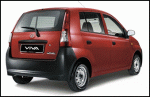
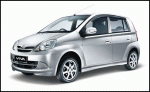
At first glance, the Viva seems like a ‘baby Myvi’ but it has its own character with a more flowing profile which suggests good aerodynamics. The height to width ratio is also well balanced with the wheelarches flared out slightly, giving a sporty undertone. On the 1000 cc versions, the sportiness is further enhanced with side skirting and there’s also a rear roof spoiler with the 1000 cc Viva Premium.
Since it replaces the Kelisa, the first comparison should be made with that model and in overall length, the Via is 95 mm longer but its width is narrower by 15 mm (although that actually makes no different to interior space as we will see later). It stands taller by over 100 mm and sits on a wheelbase of 2390 mm, 30 mm longer than the Kelisa’s.
INTERIOR
The area which Perodua highlights about the Viva is interior length which it claims to be superior to local rivals – and even the Myvi. According to Perodua-supplied data, the Viva’s interior length is 1845 mm which is 10 mm more than the Myvi, a bigger car. Of course, 10 mm isn’t meaningful so let’s compare to the Kelisa and Kancil, both of which are over 120 mm shorter in cabin length. Perodua also provided data for rival models (but didn’t identify them) and the closest is 55 mm shorter.
The couple distance is also another measure of spaciousness in a cabin and with the Kancil, one could say the occupants were rather close. No so with the Viva which has a front couple distance (width-wise)of 840 mm, 114 mm more than the Kancil. This comes from having an interior width of 1300 mm, which is 115 mm wider than the Kancil.

Different mirrors for different versions. Top version has
retractable feature too
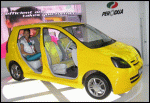
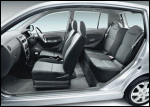 Large interior space is a highlight
 Doors open 90 degrees from the body
Perodua also claims the Viva is Best-in-Class when it comes to cabin volume (interior height x interior width x interior length) at 2.99 cubic metres. The Myvi, one class above, is 3.26 cubic metres while the closest rivals are 2.90 cubic metres. Both the Kancil and Kelisa have smaller volumes that the Viva.
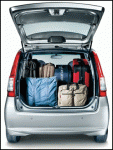
Another impressive thing about the Viva’s cabin space is the luggage capacity – 449 litres when the rear seat is flat. It’s not as big as the Kenari (which has a high ceiling) or the Myvi but it is substantially more than the Kelisa and Kancil and its immediate rivals. Access to the boot space is easy as the opening is pretty large and yet the sill is just 600 mm off the road. A thoughtful provision is a net which can keep loose items in place although its position would be better across the 1010 mm opening than behind the backrests. If it is across the opening, then it can also serve as a barrier to prevent things from falling out when the door is raised.
Like the Myvi, the doors of the Viva open extra-wide to 90 degrees… even wider than the Myvi which is 80 degrees to the body. With an opening that wide – almost like the doors have been taken off – it is very easy to get in and out. As a precaution, the hinge has three stages so that it does not swing open fully inadvertently and hit a wall or another car. Incidentally, for most cars, the opening angle is between 60 and 70 degrees.
Besides boasting of generous cabin space, Perodua is also proud to say that they have put in a lot of effort to provide a car of higher quality with the Viva. It’s not just having better materials but also the thoughtfulness in the textures on surfaces and the interior colour scheme, all of which can make a difference to the ambience. Grey is the dominant colour but it is not a dull shade and blends well with the other trim in certain areas.
The centre section of the dashboard has a metallic finish which adds class and has a clean layout for the ventilation controls and audio system. Audio enthusiasts will be happy to note that Perodua has not integrated the audio head unit into the panel, unlike the Myvi. This means that it will be possible to replace the unit with an after-market set more easily if you don’t like what Perodua gives you. The 850 cc and 1000 cc Vivas come with a 1DIN radio/CD-player and 4 speakers while the 660 cc version has a cassette player only with the radio.