biggie80
Active+ Member
- Messages
- 3,293
- Joined
- Jul 14, 2010
- Messages
- 3,293
- Reaction score
- 803
- Points
- 71
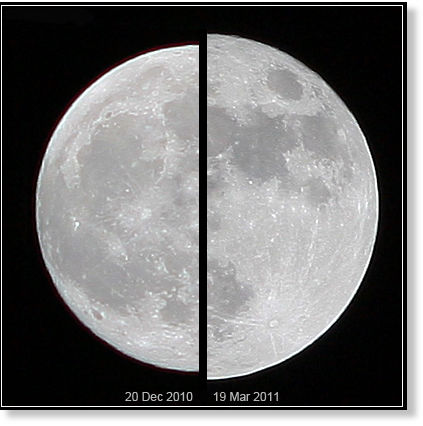
The supermoon of March 19, 2011 (right), compared to an average moon of December 20, 2010 (left).
Yes, many will call the June 2013 full moon a supermoon. The upcoming full moon on June 23, 2013, will not only be the closest and largest full moon of the year. It'll also present the moon's closest encounter with Earth for all of 2013.
This year's closest and largest full moon will occur on June 23 at precisely 11:32 Universal Time. At United States' time zones, that means the moon will turn full on June 23 at 7:32 a.m. EDT, 6:32 a.m. CDT, 5:32 a.m. MDT and 4:32 a.m. PDT. We astronomers call this sort of close full moon a perigee full moon. The word perigee describes the moon's closest point to Earth for a given month. Two years ago, when the closest and largest full moon fell on March 19, 2011, many used a term we'd never heard before: supermoon. Last year, we heard this term again to describe the year's closest full moon on May 6, 2012.
This year, we also hear the term supermoon referring to the year's closest full moon on June 23, 2013. What does supermoon mean exactly? And how special is the June 23, 2013 supermoon?
The word supermoon didn't come from astronomy. Instead, it came from astrology. Astrologer Richard Nolle of the website astropro.com takes credit for coining the term supermoon. In 1979, he defined it as:
...a new or full moon which occurs with the moon at or near (within 90% of) its closest approach to Earth in a given orbit (perigee). In short, Earth, moon and sun are all in a line, with moon in its nearest approach to Earth.
By this definition, according to Nolle:
There are 4-6 supermoons a year on average.
That doesn't sound very special, does it? In fact, the June 2013 full moon lines up much more closely with perigee - the moon's closest point to Earth - than Nolle's original definition. According to Guy Ottewell's Astronomical Calendar 2013, the 2013 June full moon falls only 22 minutes after the moon reaches perigee, the moon's closest point to Earth for this month and year. At perigee, the moon lies only 356,991 kilometers (221,824 miles) away. Two weeks from now, on July 9, the moon will swing out to apogee - its farthest point for the month and year - at 406,490 kilometers (252,581 miles) distant.

Day and night sides of Earth at instant of full moon (2013 June 23 at 11:32 Universal Time). In North America, the full moon is setting in the west at sunrise. From eastern Asia, it’s rising in the east at sunset. The full moon resides close to zenith – straight overhead – as seen from the Samoan islands in the central South Pacific Ocean.
How often does the full moon coincide with perigee?
Closest full moons recur in cycles of 14 lunar (synodic) months, because 14 lunar months almost exactly equal 15 returns to perigee. A lunar month refers to the time period between successive full moons, a mean period of 29.53059 days. An anomalistic month refers to successive returns to perigee, a period of 27.55455 days. Hence:
14 x 29.53059 days = 413.428 days
15 x 27.55455 days = 413.318 days
This time period is equal to about 1 year, 1 month, and 18 days. The full moon and perigee will realign again on August 10, 2014, because the 14th full moon after the 2013 June 23 full moon will fall on that date.
Looking further into the future, the perigee full moon on November 14, 2016 (356,509 km) will even be closer than the one on March 19, 2011 (356,575 km). The perigee full moon will come closer than 356,500 kilometers for the first time in the 21st century on November 25, 2034 (356,446 km). The closest moon of the 21st century will fall on December 6, 2052 (356,421 km).
Will the tides be higher than usual?
Yes, all full moons bring higher-than-usual tides, and perigee full moons bring the highest (and lowest) tides of all. Each month, on the day of the full moon, the moon, Earth and sun are aligned, with Earth in between. This line up creates wide-ranging tides, known as spring tides. High spring tides climb up especially high, and on the same day low tides plunge especially low.
Today's extra-close full moon accentuates these monthly (full moon) spring tides all the more.
If you live along a coastline, watch for high tides caused by the June 23 perigee full moon - or supermoon - over the next several days. Will the high tides cause flooding? Probably not, unless a strong weather system moves into the coastline where you are. Still, keep an eye on the weather, because storms do have a large potential to accentuate high spring tides.
As a result, if you live near a coast, you'll want to be on the lookout for higher-than-usual tides.
Each full moon has its own name. Here's a list.
Because the moon - as always - shines opposite the sun in our sky at full moon, you'll see the moon beaming all night tonight from dusk until dawn. This extra-close full moon is likely to usher in large tides along the ocean shorelines for the next several days, especially if these high tides are accompanied by strong onshore winds.
Bottom line: The full moon of June 23, 2013 is the closest and largest full moon of this year. Some will call it a supermoon.
Saper nk Tolong translate....silakann