BTC USD 63,733.0 Gold USD 4,326.83
Time now: Jun 1, 12:00 AM

FXCM - FXCM.com

Month End Flows and Official Speak Encourages Volatility in Friday Trade

Things could certainly heat up in the final sessions of trade for the week, with the market having consolidated over the past few days and now seemingly ready for some form of a breakout on the last trading day of the month.

FUNDYS


Things could certainly heat up in the final sessions of trade for the week, with the market having consolidated over the past few days and now seemingly ready for some form of a breakout on the last trading day of the month. The summer is nearly gone and traders are starting to filter back to their desks. Month end flows ahead of September therefore could take on a new meaning, as market participants gear up for the final stretch of 2010. For the time being however, there are two pressing issues that are waiting for more clarity in Friday trade that could ultimately dictate broader direction in the markets over the coming days. The first is the issue of the Yen, and what exactly if any measures will be taken by Japanese officials to counter the recent strength. The second is what type of outlook Fed Chair Bernanke will give at today’s highly anticipated symposium in Jackson Hole Wyoming.

Relative Performance Versus USD Friday (As of 7:20GMT)

1. KIWI+0.26%
2. AUSSIE+0.16%
3. EURO+0.09%
4. STERLING-0.01%
5. SWISSIE-0.03%
6. CAD-0.07%
7. YEN-0.25%


The announcement from PM Kan that he will be holding a press conference later today, specifically on the topic of fighting Yen strength has been enough to spark some form of Yen selling, and this selling could accelerate on any news of official measures to counteract the Yen appreciation. Japanese FinMin Noda has also reiterated Japan’s resolve to act on FX as needed. In our opinion, the Yen is at a high risk for some form of a material sell-off over the medium-term and although there has been no direct catalyst as of yet, it seems like we are inching closer to one. Technical studies also confirm a Yen bearish bias, with the single currency at multi-year highs against the USD and Euro.

The other hot topic of the day is the upcoming Jackson Hole symposium in which Fed Chair Bernanke will provide some added insights into the direction of monetary policy which should be quite interesting in light of the latest slowdown in the US economy following a slew of softer economic data. Bernanke’s remarks could have a major influence on the direction of the buck, but at this point it is unclear which direction the USD will head. Should the Fed Chair announce that the central bank now has a clear plan on how to counteract the latest slowdown through the implementation of new policies, we are likely to see a sell-off in the USD and rally in equities as market participants feel comforted by the Fed’s actions and look to buy back into risk. However, should the Fed Chair announce that the Fed will increase policy as needed and remain in a wait and see mode, the reaction is likely to be net USD bullish and equity negative as market participants grow increasingly concerned that not enough is being done to counteract the slowdown, resulting in some flight to safety trade.

There is one other possibility, and that is that Bernanke balances his statement and says that the Fed is in a wait and see right now but also concedes that things have been weaker than they had thought, and as such, the Fed is prepared to act if things persist. The market reaction in this scenario is likely to be net USD and equity neutral.

There are some major data releases out of the UK and US today that would otherwise dominate trade, but at present are taking a backseat to the broader global macro developments. UK GDP has already been released and was slightly better than forecast, while US GDP (1.4% expected) is due at 12:30GMT. Other noteworthy data includes University of Michigan confidence (70.0 expected) at 13:55GMT.

GRAPHIC REWIND


Month_End_Flows_and_Official_Speak_Encourages_Volatility_in_Friday_Trade_body_dxy8.png


TECHS

EUR/USD: (See below).

USD/JPY: The market has not been able to hold onto to its fresh multi-year lows set in Tuesday trade below 84.00, with the price rallying since and threatening a break back above initial resistance by the 10-Day SMA just over 85.00. However, while the market trades below the 20-Day SMAs on a close basis, the downtrend remains intact and deeper setbacks below 83.60 can not be ruled out. A close above the 20-Day SMA will be required at a minimum to offer some form of relief to downside pressures. The market has not closed above the 20-Day SMA since mid-June when the pair was trading over 90.00.

GBP/USD: Although the inter-day structure looks quite bearish at present following the latest break below 1.5500, there is a shorter-term risk for additional upside to allow for recently oversold technical studies to unwind. However, we expect any rallies to be well capped ahead of 1.5700 in favor of the next downside extension towards the 100-Day SMA by 1.5100. Setbacks have been supported for now by the 50-Day SMA. Ultimately, only a break back above 1.5700 would negate outlook and give reason for pause. Back under 1.5370 accelerates declines.

USD/CHF: Has managed to break to yet another multi-week low below 1.0300 to open a fresh downside extension towards the yearly lows from January by 1.0130 over the coming sessions. However, any additional declines below 1.0130 are seen limited, with medium-term studies looking stretched. As such, we would be more inclined to be looking for opportunities to buy at current levels. For now, a break and close back above 1.0320 will be required to relieve immediate downside pressures.

FLOWS

Japanese exporter offers; importer bids in Usd/Jpy. Stops cited above 108.05 in Eur/Jpy. Eur/Usd well offered ahead of 1.2800. Corporate bids in Usd/Cad. End of month flow demand for Aussie and Kiwi. Some buy-side interest in Eur/Chf by 1.3000.

TRADE OF THE DAY

Month_End_Flows_and_Official_Speak_Encourages_Volatility_in_Friday_Trade_body_eur2.png


Eur/Usd: The market seems to have found some form of a base for now by 1.2585 ahead of the latest bounce and while the overriding structure remains bearish, shorter-term technical studies do not rule out the possibility of additional upside before we see a bearish resumption below 1.2585. Given end of month flows and some fundamental risk, volatility could be running quite high for the remainder of the day and this could result in a meaningful intraday rally for the pair. At the moment, our daily ATR analysis projects a potential high on Friday in the 1.2820 area, while the 78.6% fib retracement off of the latest 1.2920-1.2585 move comes in slightly higher by 1.2850. As such, we will look to take advantage of any intraday rallies towards these levels, with the market still confined to a broader downtrend. STRATEGY: SELL @1.2845 FOR AN OPEN OBJECTIVE; STOP 1.2945. RECOMMENDATION TO BE REMOVED IF NOT TRIGGERED BY NY CLOSE ON FRIDAY.
 
Canadian GDP Advances 0.2 Percent in June

Economic activity in Canada rose 0.2 percent in June after rising 0.1 percent the month prior, while the second quarter annualized gross domestic product advanced 2.0 percent amid economists’ forecasts of 2.5 percent. Indeed, the USDCAD pushed higher subsequent to the release of the report; however, we will likely see increased volatility during the North American trade as market participants shift their focus to the U.S. consumer confidence report and the FOMC minutes.

(Detailed analysis forthcoming…)

Canada’s GDP

Canadian_GDP_Rises_0.2_Percent_in_June_body_canada.png


Source: Bloomberg

USD/CAD Daily Chart

Canadian_GDP_Rises_0.2_Percent_in_June_body_usdcad.png


Source: FXCM’s Strategy Trader – Prepared by Michael Wright

After testing the 38.2 percent Fibonacci retracement, the pair ahs reversed course, and now looks poised to test 1.0700. At the same time, with the recent break above the descending channel and our speculative sentiment at -1.180, I do not rule out further gains in the pair.
 
FXCM King of the Micro Contest

New York—August 30th , 2010—FXCM Micro’s monthly currency trading contest starts on Wednesday September 1st, 2010. $25,000 in cash is awarded to the trader with the highest monthly trading return; $10,000 is awarded for second, and $5,000 for third place. FXCM Micro wants you to be the King!

Click here (http://bit.ly/aIGpaw) to read the 1st, 2nd and 3rd place winner’s questionnaire on how they won the contest! Here are some quick statistics for our July winners:

1st place: Lin Weihong with a staggering profit of 998.39%*
2nd place: Adegeye Oluwaseun with a profit of 973.45%*
3rd place: Jin Baoqiu with a profit of 644.50%*

It’s not too late to take part in the King of the Micro Contest for September. No registration is required. All micro accounts with equity of at least $500 at the end of this month automatically qualify. Click here (http://bit.ly/akTJ8E) to deposit funds into your micro account. If you do not have a micro account, click here (http://bit.ly/bGjMkA) to apply.
The popular currency-trading contest has been running for over four years, and it’s free to enter. King of the Micro is available to clients all around the world. Recent winners have come from the United States, China, Malaysia, Canada, and the United Kingdom.

There is no registration needed, and the requirements are simple: all FXCM Micro clients with $500 in their Micro account at the beginning of the month are automatically entered. And traders must make at least ten trades during the month.
Traders may open an FXCM Micro currency trading account with as little as $25. All FXCM Micro clients receive free buy and sell trading signals through DailyFX+, complete with blue buy arrows to buy and red arrows to sell.

For more information on the King of the Micro contest, to read the full contest rules, and to deposit money into your FXCM Micro account, click here (http://bit.ly/9bxoU6) .
FXCM Micro is a division of FXCM that provides new traders with access to the currency markets for as little as $25. With a small (1K) lot size, FXCM Micro provides a great way to get started in the forex market. FXCM Micro is offered for individual, self-traded accounts. All participants of the King of the Micro contest can receive the FXCM Power Course free to improve their chances to be the King.

FXCM Holdings, LLC Facts

FXCM Holdings, LLC is a leading global forex and CFD broker* that caters to both retail and institutional markets. Founded in 1999, FXCM is one of the largest brokers, regulated by several of the world’s most respected financial authorities.

At the heart of FXCM’s client offering is No Dealing Desk forex trading. Clients have market access to some of the world's largest liquidity providers which enables FXCM to offer clients spreads as low as 1 pip on major crosses. Clients also have the benefits of mobile trading, one-click order execution and trading from real-time charts. FXCM LTD’s CFD product offers no re-quote trading and allows traders to trade oil, gold, silver, and stock indices, along with forex on one platform. In addition to currency and CFD trading*, FXCM offers educational courses on forex trading, and provides free news and research through DailyFX.com.

* Past performance is not necessarily indicative of future results. Trading foreign exchange on margin carries a high level of risk, and may not be suitable for all investors. Read full risk disclaimer (http://bit.ly/9N7MUu).

Media Contact:
Kiana Danial
E-mail: [email protected]
 
Australian Dollar Soars as Q2 GDP, Chinese PMI Top Expectations

The Australian Dollar surged against all of its major counterparts after second-quarter Gross Domestic Product figures showed the economy added 1.2 percent in the three months through June, topping economists’ forecasts calling for a 0.9 percent increase and marking the largest increase in three years.

The currency was already on its way higher ahead of the GDP report after Chinese Manufacturing PMI figures showed growth in the East Asian giant’s industrial sector accelerated for the first time in three months in August. The outcome was interpreted as supportive for Australia via export demand considering China is the world’s largest consumer of the antipodean nation’s mining goods as well as for overall risk appetite given China’s central role as a driver of global growth in the aftermath of the 2008 Great Recession.

Australian Dollar Trade-Weighted Index Spot (1min chart)
Australian_Dollar_Soars_as_Q2_GDP_Chinese_PMI_Top_Expectations_body_AUD_TWI.png


Looking ahead however, overnight gains don’t seem to have much scope for longer-term follow-through. Indeed, the Chinese PMI gauge remains in a downtrend in place since the metric topped out in December 2009, with today’s result coming nowhere near violating that trajectory. Furthermore, the Australian GDP result has done nothing for RBA rate hike expectations, with a Credit Suisse index tracking priced-in policy changes still pointing to toward a static posture for the year ahead. Meanwhile, signs of a broad-based slowdown in global growth abound, with JPMorgan’s Global PMI down to a 5-month low in July while the Baltic Dry Index – a gauge of international trade activity – slid to the lowest since April 2009 over the same period. On balance, this hints that the path of least resistance points toward continued risk aver
 
U.S. Dollar Continues To Lose Ground, European Central Bank Holds Rate at 1.00%

Euro showed little reaction to the European Central Bank interest rate decision as policy makers held the benchmark interest rate at 1.00% in September, but the slew of data scheduled for the U.S. trade is likely to stoke increased volatility in the exchange rate as investors weigh the outlook for future growth.

Talking Points

* Japanese Yen: Gains Ground Against Most Counterparts
* Pound: Manufacturing Expands at Slower Pace
* Euro: 2Q Growth Rate Expands 1.0%
* U.S. Dollar: Pending Home Sales, Factory Orders on Tap

At the same time, ECB President Jean-Claude Trichet will be holding a press conference at 12:30 GMT regarding the decision made by the Governing Council, and the central bank head is likely to talk down the risks for the region as he expects to see a moderate recovery going forward.

Nevertheless, the preliminary 2Q GDP reading for the Euro-Zone showed economic activity expanded 1.0%, which was in-line with expectations, while the annualized rate increased 1.9% from the previous year amid an initial forecast for a 1.7% rise in the growth rate. The breakdown of the report showed household consumption increased 0.5% to top projections for a 0.2% rise, with government spending increasing 0.5%, while gross fixed capital formations advanced 1.8% from the first three-months of the year. At the same time, a separate report showed producer prices in the region increased at an annualized pace of 4.0% in July to mark the fastest pace of expansion since October 2008, and the data reinforces an improved outlook for growth and inflation as the recovery gathers pace. As a result, the ECB may look to revise its economic assessment and drop its dovish outlook for future policy as it maintains its one and only mandate to ensure price stability, and the Governing Council may see scope to reestablish its exit strategy going into 2011 as growth prospects improve.

The British Pound pared the previous day’s advance and slipped to a low of 1.5372 as the economic docket reinforced a weakened outlook for the region, and the GBP/USD may continue to trend lower over the near-term as it maintains the downward trending channel from the August high (1.5997). Meanwhile, the International Monetary Fund warned that the U.K. will need long-term reforms to manage its public finances as the group sees the region’s debt-to-GDP ratio more than doubling by 2015 from 44.1% in 2007, but went onto say that “current market indicators of default risk seem to reflect some market overreaction” as the government takes unprecedented steps to lower the budget deficit. At the same time, the economic docket showed home prices in the region fell more than expected in August as the Nationwide index tumbled 0.9% amid forecasts for a 0.3% decline, while prices increased 3.9% from the previous year, which marked the slowest pace of growth since November. As policy makers withdraw fiscal support despite the ongoing weakness in the real economy, the Bank of England is likely to maintain the expansion in monetary policy as it aims to encourage a sustainable recovery, and the central bank may hold a wait-and-see approach over the coming months as it aims to balance the risks for the region.

The greenback continue to lose ground against most of its major counterparts, with the USD/JPY retracing the previous day’s advance to reach a low of 83.99, and the dollar could face increased selling pressures throughout the day as the economic docket is expected to reinforce a weakened outlook for future growth. Pending home sales in the world’s largest economy is forecasted to fall 1.0% in July after contracting 2.6% in the previous month, while final 2Q reading for nonfarm productivity is projected to show a 1.9% decline amid an initial forecasts for a 0.9% drop. At the same time, factory orders are anticipated to rise 0.2% in July after falling 1.2% in the previous month, but the majors may hold its current range ahead of Friday’s Non-Farm Payrolls release as market participants forecast the U.S. economy to shed another 100K jobs in August.
 
U.S. Nonfarm Payrolls Declines Less Than Econmists Expectations, Unemployment Rate...

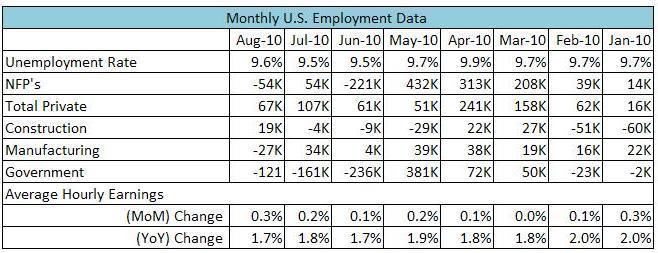
Nonfarm payrolls in the world’s largest economy tumbled 54,000 in August after falling a revised 54,000 the previous month amid economists’ expectations of -105,000. At the same time, the unemployment rate rose to 9.6 percent from 9.5 percent in July. In turn, the Japanese yen, and the U.S. dollar lost ground against all major currencies as sentiment shifted gears. Meanwhile, U.S. futures pushed higher subsequent to the report, and indeed, risk appetite maybe the main theme going into the North American trade.

Taking a look at the breakdown of the report, the private sector jumped 67,000, with most of the gains in education and healthcare. Following the healthcare industry, professional services also increased. Also worth noting, the average hourly earnings rose 0.3 percent, which is up from 0.2 percent in July, while annualized earnings increased 1.7 percent.

U.S._Unemployment_Rate_Rises_to_9.6_Percent_body_1.jpg


Prepared by Michael Wright


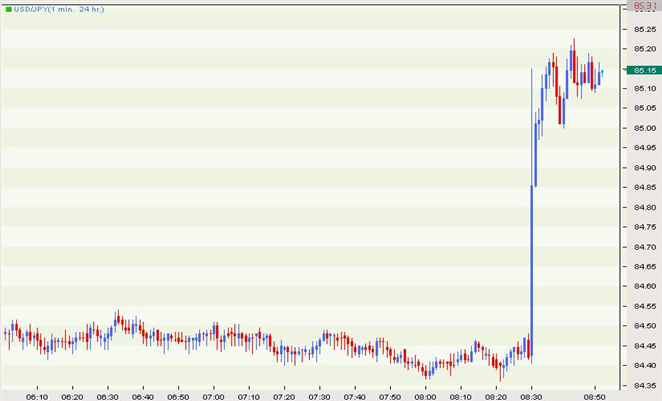
USD/JPY Intraday Chart
U.S._Unemployment_Rate_Rises_to_9.6_Percent_body_usdjpy.png


Source: Intellicharts – Prepared by Michael Wright

Following the “better” than expected report, the USDJPY pushed higher and now looks poised to maintain its northern journey going into the North American trade.

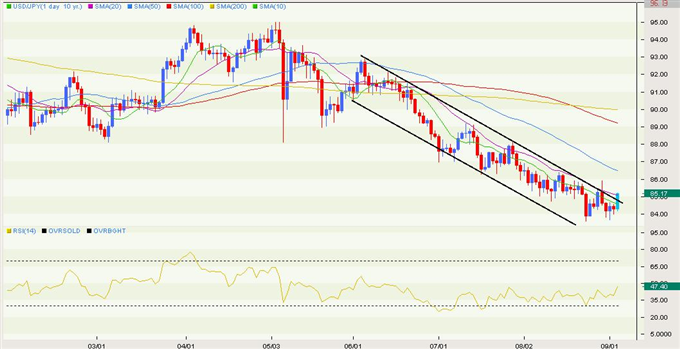
USDJPY Daily Chart
U.S._Unemployment_Rate_Rises_to_9.6_Percent_body_usdjpy2.png


Source: Intellicharts – Prepared by Michael Wright


Taking a look at the USDJPY daily chart, the pair has worked its way into a descending channel. As of late, the end of the trend may be on the horizon as the pair once again tests the upper bounds of the range. I
 
Risk Slammed Ahead of US Open But Not Sure Will Continue; Long EUR/JPY

Currencies have come back under pressure in Tuesday trade, with the Euro leading the declines on the back of news that some of the European banks may have under-reported on their exposures to sovereign debt and then accelerating on the shockingly bad German factory orders.

FUNDYS

Currencies have come back under pressure in Tuesday trade, with the Euro leading the declines on the back of news that some of the European banks may have under-reported on their exposures to sovereign debt and then accelerating on the shockingly bad German factory orders. Comments from EU Rehn have also not helped matters after saying that the Euroone was not out of the woods yet. The Euro had rallied up just shy of some key short-term resistance by 1.2925 on Monday, but was unable to take out the level to keep the pressure on the downside.

Relative Performance Versus USD Monday (As of 11:05GMT)

1. YEN+0.41%
2. SWISSIE-0.03%
3. STERLING-0.19%
4. KIWI-0.35%
5. CAD-0.58%
6. AUSSIE-0.69%
7. EURO-0.99%


Broader price action does not look to be risk favorable, with the Swiss Franc and Yen also remaining well bid and just off some recent key highs. This suggests that we could be in store for yet another round of declines in both Usd/Jpy and Usd/Chf and it will be worth keeping a close eye on these markets. Our in-house speculative sentiment index shows that retail traders are still overwhelmingly long Usd/Chf and Usd/Jpy to further support the case for another wave lower in these pairs. Meanwhile, warnings from Japanese FinMin Noda on excessive moves in the Yen have been shrugged aside with market participants still comfortable with their long Yen positions, particularly after Bank of Japan Governor Shirakawa said that monetary policy is not determined by short-term FX moves and that authorities can not control forex rates.

The big event risk for the day is now behind us, with both the Bank of Japan and Reserve Bank of Australia making decisions on rates. As was widely expected, there was no change on the rate end from either bank, with the main market reaction seen in the Australian dollar after the accompanying RBA statement was more on the dovish side. The key takeaway from the RBA statement was that the global outlook was “somewhat uncertain.” This immediately weighed on the higher yielding currency and also forced another selloff in risk related currencies intraday. On the Australian political front, we are closer to gaining clarity with the Labour party securing the necessary pieces for a stable government.

Looking ahead, the economic calendar is empty for North American trade and as such, market participants will be looking to take their cues from overall price action in the US equity markets. Surprisingly, US equity futures are only moderately lower following the latest wave of risk negative news, while oil has been slammed, down well over 2% on the day thus far. Gold is also lower but only by some 0.30%.

TECHS

EUR/USD: The latest rally has been well capped ahead of key short-term resistance by 1.2925, with the market now looking like it is poised for a bearish resumption back towards 1.2585 over the coming sessions. Coiling 10/20/50/100-Day SMAs warn of a major move ahead and given broader price action, it looks as though this move could be to the downside. In the interim, key levels to watch above and below come in by 1.2925 and 1.2700 respectively.

USD/JPY: While the market trades below the 20-Day SMAs on a close basis, the downtrend remains intact and deeper setbacks below 83.60 can not be ruled out. A close above the 20-Day SMA will be required at a minimum to offer some form of relief to downside pressures. The market has not closed above the 20-Day SMA since mid-June when the pair was trading over 90.00. A break below 83.60 will open a test of next key psychological barriers by 83.00.

GBP/USD: The market looks poised for a fresh drop following the latest bout of consolidation, with a lower top now confirmed by 1.5600, following the break back below 1.5370. Below 1.5370 now exposes a more meaningful drop to test next key medium-term support by the 100-Day SMA in the 1.5100 area. Ultimately, only back above 1.5700 would negate bearish bias and give reason for pause.

USD/CHF: Has finally managed to take out the yearly lows from January by 1.0130, with the market easily dropping below this level to 1.0065 thus far. However, any additional declines below 1.0065 are seen limited, with medium-term studies looking stretched. As such, we would be more inclined to be looking for opportunities to buy at current levels. For now, a break and close back above 1.0240 will be required to relieve immediate downside pressures.

FLOWS

Japanese exporters still looking to sell Usd/Jpy. CTAs and short-term accounts on the offer in Eur/Usd; various buy-side shops and real money names on the bid. Model funds selling Aussie. Decent two-way price action in Eur/Chf and Eur/Jpy.

TRADE(S) OF THE DAY
Risk_Slammed_Ahead_of_US_Open_But_Not_S, Risk Slammed Ahead of US Open But Not Sure Will Continue; Long EUR/JPY

Eur/Jpy: If the cross is going to stall out, our entry point is ideal, with the level coinciding with some key hourly rising trend-line support off of the 24Aug yearly lows. This in conjunction with the daily average true range having already been exceeded and a severely oversold hourly RSI helps to reaffirm our short-term bullish bias, and we look for a decent corrective bounce over the coming hours. Stop has been placed below the previous hourly higher low at 106.15, as well as the 106 figure to provide some defense from a potential overshoot. POSITION: LONG @106.89 FOR AN OPEN OBJECTIVE; STOP 105.89.

Risk_Slammed_Ahead_of_US_Open_But_Not_Sure_Will_Continue_Long_EURJPY_body_EURCHFtradeofday9.png


Eur/Chf: While we realize that this cross is closely correlated to Eur/Jpy, we can not ignore what we believe to be a highly attractive buy opportunity below 1.2900. Technical studies continue to warn that the market is highly overextended on a medium-term and longer-term basis, and fresh record lows from here are limited. As such, our strategy continues to be to look for oversold intraday moves where the daily average true range has been exceeded to attempt to establish a counter-trend long. If this trade does trigger, we see a scenario playing out where the market stalls out once again below 1.2900 in favor of the formation of a major double bottom on the daily chart with the neckline by 1.3165. STRATEGY: BUY @1.2880 FOR AN OPEN OBJECTIVE; STOP 1.2780. RECOMMENDATION TO BE REMOVED IF NOT TRIGGERED BY NY CLOSE (5PM ET) ON MONDAY.
 
USDJPY Trading Opportunities

Potential exists for a USDJPY reversal and strength up towards 8800-9000 before the longer term downtrend resumes.

Monthly USDJPY Bars
USDJPY_Trading_Opportunities_body_100908_114920_CQG_IC_Screen.png


Prepared by Jamie Saettele

For years, I’ve focused on the impulsive nature of the USDJPY decline since the 1970s and expectations have been for a drop below the all-time low of 7975 (1995) in a 5th wave. With just 400 pips to go until that level, it would be foolish to alter this bias now. What’s more, it’s likely that a 5th wave break from a 12 year 4th wave triangle extends (70 or lower?).

Weekly USDJPY Bars
USDJPY_Trading_Opportunities_body_100908_120446_CQG_IC_Screen.png


Prepared by Jamie Saettele

The problem with the decline from the 2007 wave 4 high is that it’s a mess. 5th waves, especially after significant moves in the prior 3rd wave (see previous chart) sometimes unfold as ending diagonals. That is, the decline is overlapping and consisting of 3 wave movements. Such is the case here. There is not a clear count from the 2007 high yet…so it is unlikely that the decline is complete (if you can’t count, then it’s not over). A long term trendline has held as resistance and the long term trend is down against 9500.

Daily USDJPY Bars
USDJPY_Trading_Opportunities_body_100908_120524_CQG_IC_Screen.png


Prepared by Jamie Saettele

Zooming in to the daily, we see that RSI divergence warns of a near term reversal. There are also intermarket divergences as the only Yen crosses below their 2008 lows are the USDJPY and EURJPY (the GBPJPY, AUDJPY, NZDJPY, and CADJPY are above their 2008 lows). These divergences WARN of a reversal. Trading above 8525 is required for confirmation.

In summary, potential exists for a USDJPY reversal and strength up towards 8800-9000 before the longer term downtrend resumes.
 
Canadian Dollar Rallies as Employment Tops Forecast

Employment in Canada increased 35.8K in August after unexpectedly contracting 9.3K in the previous month, which exceeded forecasts for a 30.0K rise.

Meanwhile, the jobless rate unexpectedly advanced to 8.1% from 8.0% in July as discouraged workers returned to the labor force, and conditions are likely to improve going forward as the economic recovery gathers pace. The breakdown of the report showed full-time positions increased 79.9K following the 139.0 contraction in July, while part-time employment slipped 44.1K to mark the first decline in three-months. Given the recent developments, the Bank of Canada may see scope to normalize monetary policy further throughout the remainder of the year as businesses continue to increase production and employment.

Canadian_Dollar_Rallies_as_Employment_Tops_Forecast_body_ScreenShot006.gif


Speculation for another rate hike in October would instill a bearish outlook for the USD/CAD, which could lead the exchange rate to retrace the advance from August. The dollar-loonie immediately spiked to a low of 1.0287 following the better-than-expected data, but the corrective retracement subsequent to the release has pushed price action back above 1.0300 going into the North American trade. As equity futures foreshadow a higher open for the U.S. market, risk appetite could drive the exchange rate back towards the lows as the economic docket remains fairly light for Friday.
 

Live Forex Chart

Currency
Rates
EUR / USD
1.15417
USD / JPY
160.035
GBP / USD
1.33518
USD / CHF
0.79633
USD / CAD
1.39402
EUR / JPY
184.707
AUD / USD
0.70574
Back
Top
Log in Register