U.S Dollar continue to strengthen, Gold hits two-month low
Beginning with yesterday market developments, the U.S Dollar resumed its rally against the G10 currencies as FED rate hike is on the table again. The Dollar index traded higher on Tuesday and has reached two-week high at 96.14 boosted by a strong increase in the consumer confidence index during the month of August.
The Japanese Yen plunged by 1.13% against the Greenback to reach 103.10, highest level since July 29. In the meantime, both the Euro and the British pound extended last Friday decline to stabilize at 1.1140 and 1.3070 levels respectively.
In the equity market, the Dow fell by 49points, while the S&P500 was off 0.2%. Gold retreated to two-month low at $1310 per ounce, meanwhile, Oil prices settled down 1.34% at $46.35 on the back of a strong Dollar.
Now let us have a look at the technical picture of the Euro, the British pound, Gold and the U.S Dollar index.
EUR/USD
The Euro resumed its decline after bears managed to push prices below 1.1240 hourly support. As of now, the trend remain bearish in the near-term, and a continuation to the downside is likely in the coming hours. However, when looking at momentum indicators, the pair is clearly oversold and a bounce can happen soon. Technically, the drop should find strong demand around 1.1110-1.1080, from where we expect to see the beginning of at least three corrective waves higher.
In the daily chart, the single currency remain under pressure below 1.1365 peak, meanwhile, prices are likely to test the 61.8% Fibonacci retracement of the entire recovery that began from 1.0910 low which stands at 1.1085. Consequently, the recent sell-off may slow down once prices get there.
Support: 1.1120-1.1085-1.1055
Resistance: 1.1160-1.1190-1.1205
GBP/USD
The British pound keep fighting for a clear direction in the near-term and volatility is likely to increase in the coming hours, ahead of the U.S Non-farm payrolls due later this week.
From a technical standpoint, the Sterling remain positive in the hourly chart as far as 1.3025 support is in place. However, the current market environment is in favor of the U.S Dollar, which can keep the upside potential limited in this pair.
In the near-term, the focus should be 1.3070 support as a break below it will bring the bearish pressure and can send the pair to as low as 1.3025 in the next days.
In the flipside, a daily close above 1.3157 level can be the trigger for a move back up towards 1.3170/95 resistance zone will offer fresh selling opportunities for bears and another wave lower to be seen.
Support: 1.3072-1.3025-1.2975
Resistance: 1.3157-1.3170-1.3195
GOLD
After several attempts to break above 1357 hourly resistance that failed, prices succeeded to break below the support zone of $1333/1328 in the daily chart, which cleared the path for a re-test of the daily support of $1305.
Technically, gold turned bearish in the near-term as prices has shown four consecutive lower highs (1375-1367-1357-1342) from the yearly peak of $1375, which reinforces the probability of further weakness in the coming days. As of now, $1325 represents the short-term resistance level and as far as prices keep trading below it, further weakness is here to stay in the coming hours.
To conclude, gold remain under pressure and the upside potential is likely to be limited, while another towards 1300 psychological support is imminent.
Support: 1305-1300-1287
Resistance: 1316-1322-1325
Dollar index
Looking at the U.S Dollar price action ahead of the U.S Jobs report scheduled for Friday. The Greenback continue to strengthen as FED rate hike bets increased significantly, the sentiment shifted towards buying the U.S Dollar in the recent days.
Technically, prices overtook 96.00 handle, which keeps the near-term outlook bullish for the U.S Dollar, in addition, the break above this resistance should expose 96.50 area in the coming days, and from where strong sellers may appear. From a larger perspective, the Dollar keep trading sideways in the weekly chart, as investors remain skeptical about the date of the next interest rates hike. Consequently, volatility can persist in the near-term unless we see a clear break above 97.65 peak or below 93.00 weekly support.
Meanwhile, we can see that bulls managed to preserve the higher lows structure that began from 92.95 low, which may lead to further gains in the Greenback especially if a daily close above 96.50 level happens.
A resurgent Dollar rattled the financial markets on Wednesday with most currencies kneeling to the greenback following the firm ADP Non-Farm employment figure of 177k which heightened hopes over the Federal Reserve raising rates in 2016. With US labour repeatedly displaying signs of resilience in a period of global uncertainty, part of the prerequisites for the Fed to take action this year may have been achieved. This has been a solid week for the Dollar and the string of positive economic data release could entice bulls to send the Dollar higher as optimism rises over the Fed breaking its tradition of central bank caution.
Although there have been ongoing talks of there being a live meeting to raise US rates in September, such could be slightly abrupt with the possibility that the Fed will digest further positive data to support hiking rates in December. With an increasing focus on US data as an attribute to fulfil the conditions of a rate increase, much attention may be directed towards Friday’s NFP report. If the Non-Farm payroll for August exceeds expectations, then the central bank may be offered another compelling reason to pull the trigger in December.
The rising optimism over the Fed taking action this year has propelled the Dollar Index above 96.00. This Index is turning bullish on the daily timeframe as prices are trading above the 20 SMA. Previous resistance around 96.00 could transform into a dynamic support which encourages buyers to send prices towards 96.50.
UK Manufacturing PMI in focus
Sterling bulls made a valiant effort to reclaim control on Wednesday with the GBPUSD lurching towards 1.3150. While bulls may be commended on their efforts to elevate the GBPUSD higher, it has nothing to do with an improved sentiment towards the Sterling but Dollar instability from the fluctuating expectations over the Fed taking action this year. Sterling remains chained by the Brexit uncertainty which has haunted investor attraction towards the currency, while speculations of further easing by the BoE continue to entice bears to install repeated rounds of selling. Investors may direct their attention towards the UK Manufacturing PMI for August which may offer some clarity on how the manufacturing industry is faring post-Brexit. A further contraction in manufacturing may rekindle fears over a slowdown in economic momentum consequently bolstering hopes of the BoE easing further in 2016. On the other hand, the Sterling could be offered a lifeline if an upbeat manufacturing PMI release quells easing speculations.
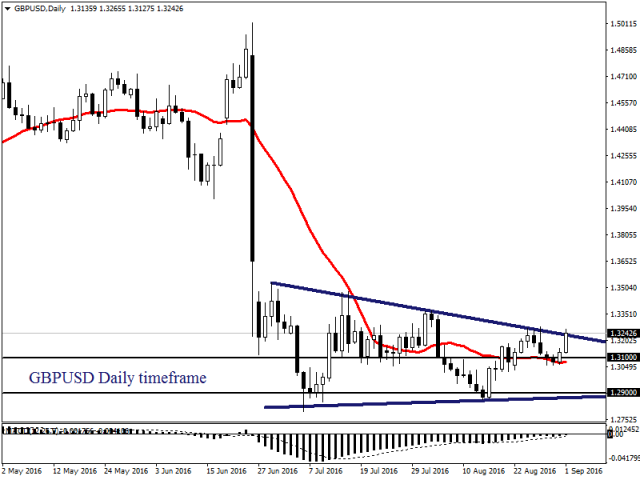
The GBPUSD has been flung onto a chaotic roller coaster ride with prices sharply swinging between losses and gains amid Fed hike hopes. Sterling remains heavily pressured and the divergence in monetary policy between the BoE and Fed could entice sellers to attack the GBPUSD. From a technical standpoint, prices are trading below the daily 20 SMA while the MACD has crossed to the downside. A breakdown below 1.3100 may open a path towards 1.2900.
Commodity spotlight – Gold
Gold remains under immense pressure with the metal breaking below the firm $1315 support as the growing expectations over the Fed raising US rates this year continues to encourage bears to install heavy rounds of selling. It should be kept in mind that although Gold is very attractive in times of uncertainty, the metal is zero yielding and also priced in Dollars which make it very vulnerable to rate hike speculations.
Friday’s NFP could be a critical attribute which will decide where Gold trades towards in the coming weeks with a strong employment report potentially leaving prices vulnerable to heavy losses. From a technical standpoint, prices are trading below the daily 20 SMA while the MACD has crossed to the downside. Previous support at $1315 could transform into a dynamic resistance that encourages a further decline towards $1285. While the technicals are currently firmly bearish, an extremely weak NFP would destroy the hopes of the Fed raising rates in the short term and could offer Gold a lifeline.
Sterling displayed an incredible rebound during trading on Thursday with the GBPUSD surging towards 1.3265 following August’s blockbuster manufacturing PMI of 53.3 which instantly dispelled the ongoing Brexit fueled concerns. UK Manufacturing has hit a 10-month high clawing out of contractionary territories aided by a vulnerable Sterling that helped bolster export orders and input costs. While the rebound in manufacturing is unquestionably encouraging, investors should still keep in mind that it may be too early to gauge the ramifications of Brexit to the UK with more time needed for a clear picture. Although Sterling may enjoy further gains in the short term as expectations erode over the BoE easing further, the lingering Brexit uncertainty should cap upside gains in the longer term.
From a technical standpoint, Sterling bulls were offered a lifeline and the GBPUSD has already lurched over 130 pips to the upside. Prices are trading above the daily 20 SMA while the MACD is in the process of crossing to the upside. While bulls may seem to be in control on the daily timeframe, a solid NFP on Friday could swiftly quell the uptrend with prices trading back towards 1.3100.
Commodity spotlight – WTI Oil
WTI Oil descended towards three-week lows at $44.60 on Thursday as the persistent concerns over the excessive oversupply of oil in the global markets haunted investor attraction towards the commodity. It is becoming increasingly clear that investors have digested the oversupply reality with the fading optimism over OPEC securing a freeze deal in September’s informal meeting enticing sellers to attack further. U.S crude stockpiles have risen consecutively while OPEC heavyweights such as Saudi Arabia and Iraq continue to pump incessantly into a market that is already heavily saturated. WTI Crude remains fundamentally bearish with further declines expected as the combination of supply fears and soft demand encourages bears to install rounds of selling. The sharp breakdown below $46 may open a clean path towards $44.00.
A sense of anticipation has firmly gripped the financial markets on Friday as investors await the Non-Farm payrolls report for August which could provide clarity on when the Federal Reserve plans to raise US rates in 2016. Global stocks remain mixed with most major markets on standby as anxious investors observe from a distance ahead the market shaking employment report. Asian equities have already drifted lower on Friday and this caution could trickle into Europe consequently leaving European stocks vulnerable to losses. Wall Street was punished on Thursday by the downbeat U.S manufacturing data that rekindled concerns over the US economy with further losses expected as investor jitters intensify ahead the NFP.
The over-extended stock market rally may be displaying signs of exhaustion with September being a potential month where bears emerge from hibernation. Although the heightened expectations of the Fed raising US interest rates has somewhat elevated global sentiment, the persistent concerns over the health of the global economy are still lingering in the background. Prolonged periods of depressed oil prices have eroded investor risk appetite while uncertainty is still a recurrent theme which has left market participants on edge. With volatility making a comeback it could take an unexpected catalyst to trigger a steep stock market selloff. Conventional wisdom holds that a strong Dollar is problematic for stocks which should keep investors alert as hopes heighten over the Fed taking action this year.
UK Construction PMI in focus
Sterling bulls were gifted a lifeline on Thursday with the GBPUSD lurching towards four-week highs above 1.3300 following August’s solid manufacturing PMI of 53.3 which alleviated the Brexit fuelled fears. Sterling weakness from the persistent Brexit uncertainty helped uplift export orders and input costs consequently propelling the UK manufacturing to fresh 10 month highs. While this data was quite impressive, it still remains too early to come to a conclusion with more time needed to weigh the impacts of Brexit to the UK economy.
Investors may direct their attention towards the UK construction PMI which if also exceeds expectations could provide the Sterling another welcome boost. Sterling could accumulate further gains in the short term as the positive data diminishes expectations over the BoE easing further. In the longer term, upside gains could be capped as the Brexit uncertainty persistently haunts investor attraction towards the currency.
From a technical standpoint, Sterling bulls were unchained on Thursday with the GBPUSD rising over 170 pips in a single trading day. Prices are trading above the daily 20 SMA while the MACD has crossed to the upside. Although bulls may be currently in control, a positive NFP figure which bolsters hopes over the Fed raising US rates could cause the GBPUSD to tumble back down towards 1.3100.
Soft US Manufacturing pressures Dollar
The Dollar was left pressured on Thursday following the unexpected contraction in U.S manufacturing which rekindled concerns over the health of the US economy. Manufacturing slipped into contractionary territory at 49.4 for the first time since February consequently dimming hopes over the Fed raising US interest rates in September. Although the manufacturing report was somewhat disappointing, overall data from the US has displayed signs of economic stability which has kept hopes alive for the Fed to act this year. Investors may direct their attention towards Fridays heavily anticipated NFP report which if exceeds expectations could renew optimism towards the Federal Reserve breaking the trend of central bank caution.
It may take an extreme anomaly in Friday’s NFP report to abruptly cool the heated expectations over the Fed raising rates at least once this year. A healthy figure above 180k which displays some stability in the US labour force may be enough to keep hopes buoyed over the central bank pulling the trigger in 2016. A figure below 150K could renew concerns over the health of the US economy and potentially erode optimism towards September being a “live” meeting to act. In extreme cases, a repeat of May’s dismal employment report figure of 38k could temporarily sabotage all efforts taken by the Fed to act.
Dollar bulls are still in control and the Dollar Index is still bullish on the daily timeframe. Prices are trading above the daily 20 SMA while the MACD has also crossed to the upside. A decisive breakout above 96.00 could open a path towards 96.50.
WTI Oil breaks below $44
WTI Oil was left vulnerable to extreme losses during trading on Thursday with prices breaking below $44 as investors discounted the possibility of OPEC securing a freeze in September’s informal meeting. Although OPEC may be commended on their ability to exploit the oil price sensitivity by creating speculative boosts in oil prices, it has come at a very heavy cost. Fears over the excessive oversupply in the markets continue to haunt investor attraction towards the commodity while concerns over slowing demand have capped upside gains. Crude oil stocks piles continue to rise while OPEC members incessantly pump to reclaim market share. The ingredients of a bear trend are present and September’s informal meeting could be the catalyst needed to send WTI lower towards $40.
Commodity spotlight – Gold
Gold was elevated slightly on Thursday following the soft US manufacturing data which eroded some expectations over the Fed raising US interest rates this year. Despite the lifeline provided, the metal has been under pressure today with prices trading towards $1310 as anticipation mounted ahead of the NFP. Gold has been very attractive in times of uncertainty and unease but the metal is zero yielding and also priced in Dollars which make it quite vulnerable to rate hike speculations.
Friday’s NFP could be a critical catalyst which will decide where Gold trades towards in September with a firm employment report leaving the metal open to steep losses.From a technical standpoint, prices are trading below the daily 20 SMA while the MACD has crossed to the downside. Previous support at $1315 could transform into a dynamic resistance that encourages a further decline towards $1285.
While the technicals on the daily are currently firmly bearish, an abysmal NFP that diminishes expectations of the Fed raising rates could propel Gold higher.
U.S Dollar consolidates as NFP figures disappoints
The Dollar traded lower on Friday after the recent NFP figures pushed investors to re-evaluate their rate hike expectations.
The U.S economy added only 151 000 new jobs in August compared to estimates of 180 000. This is a significant drop from July figures, which were at 275 000. In the meantime, the unemployment rate stabilized at 4.9% while it was anticipated at 4.8%. Meanwhile, the wages slowed down in August as the average hourly earnings retreated by 0.1% compared to 0.3% previously.
After the release of these disappointing figures, the U.S Dollar immediately plunged across the board (1.3350 against the British pound, 1.1250 against the Euro and 102.80 versus the Japanese Yen) before to trim some losses by the time of the weekly close.
The rate hike probabilities decreased significantly as a move in September has become off the table for the time being. The latest Bloomberg survey show a 32% probability only for September, 36.4% for October, and 59.0% for December.
Looking at the U.S Dollar recent price action after the U.S Jobs report. The Greenback continue to strengthen as FED rate hike is expected before the end of 2016, the sentiment shifted towards buying the U.S Dollar in the recent days.
Technically, prices dropped into a short-term corrective wave and has retraced exactly 50% from the last rally from 94.00 support, this level stands at 95.15 and from where we have seen a strong bounce in the dollar which keeps the near-term outlook bullish for the Greenback. Moreover, prices managed to overtake the bearish trend line in the daily chart and as of now, a move higher in the direction of 96.50 resistance area is likely in the coming days.
In the flipside, 95.15-94.88 levels are considered as a strong support zone for the near-term price action and the downside potential remain limited above this support. Therefore, prices should continue to trade higher during next week as bulls continue to maintain the control.
From a wider angle, the Dollar keep trading sideways in the weekly chart, as investors remain skeptical about the date of the next interest rates hike. Consequently, volatility can persist in the near-term unless we see a clear break above 97.65 peak or below 93.00 weekly support.
Meanwhile, we can see that bulls managed to preserve the higher lows structure that began from 92.95 low, which may lead to further gains in the Greenback especially if a daily close above 96.50 level happens as mentioned above.
Global stocks received a welcome boost last week following the soft U.S jobs data for August which questioned the likelihood of the Federal Reserve raising US interest rates in 2016. Asian markets commenced Monday on a solid footing with the Nikkei rising +0.66% as expectations heightened over the BoJ implementing further stimulus measures to stabilise its ailing economy. European stocks charged into fresh four-month highs last week with further gains expected today if Asia’s bullish contagion trickles into the European markets. Wall Street was elevated higher on Friday as the combination of Dollar weakness and fading rate hike hopes attracted investors to riskier assets.
Although stock markets may be open to further gains in the short term, the ingredients for a bear trend remain visible and such should keep investors alert. The ongoing concerns over the global economy may spark jitters while depressed oil prices weigh heavily on investor risk sentiment. Uncertainty is still a recurrent theme in the markets which could offer an opportunity for bears to exploit the over-extended relief rally in stocks. While a September rate hike may be discounted following the recent soft U.S jobs report, the 41% possibility of the Fed taking action in December could pressure stocks in the future.
Dollar vulnerable post-NFP
Dollar bulls were left empty handed on Friday following August’s soft NFP headline figure of 151k which instantly dampened hopes over the Federal Reserve raising interest rates in September. Average earnings reduced by 0.1% and when such was combined with the soft headline figure of 155k, many questions were raised over the resilience of the US labour force in this period of uncertainty. Although US domestic data in August has followed a positive path, this soft U.S jobs data may have provided a strong reason for the Fed to remain on standby in September. For December to be a “live” meeting for the Fed to break the tradition of central bank caution, US data may have to repeatedly exceed expectations with the U.S labour showing greater signs of improvement.
The Dollar received a heavy blow after the soft U.S jobs report with the Dollar Index finding it difficult to break above 96.00. This Index may turn technically bearish once sellers conquer the daily 20 SMA. A solid breakdown below 95.50 could encourage a further decline back towards 95.00.
Sterling firm ahead of UK services PMI
Sterling experienced an incredible rebound last week with the GBPUSD charging above 1.3300 as the combination of repeatedly positive domestic UK data and Dollar weakness invited bulls to install heavy rounds of buying. Sentiment towards the Sterling has been uplifted following the impressive manufacturing and construction PMI releases which questioned if the Brexit had any negative impacts on the UK economy. With the string of positive economic data eroding expectations over the Bank of England easing further in the future, Sterling bulls have run rampant.
Investors may direct their attention towards the critical services PMI report which may offer clarity on how services have fared post-Brexit. If UK services follow the same positive pattern as construction and manufacturing, then Sterling could be open to extreme gains moving forward.
While further gains in the Pound could be realised in the short term amid the positive data, it still remains too early to come to a decisive conclusion on how Brexit has affected the UK with more time needed to weigh the impacts.
Commodity spotlight – WTI Oil
WTI Oil rallied towards $44.60 on Friday and this has nothing to do with an improved sentiment towards oil but Dollar weakness from fading US rate hike expectations. Although further gains in oil prices may be realised in the short term amid Dollar weakness, this commodity remains fundamentally bearish.
It should be kept in mind that concerns remain elevated over the excessive oversupply of oil in the global markets while the fading hopes over OPEC securing a freeze deal in September’s informal meeting continue to cap upside gains. With crude oil stock piles rising incessantly further losses may be expected in the longer term when bears exploit the current correction to install a heavy round of selling. From a technical standpoint, prices remain bearish and a move back below $44 could open a path towards $40.
The New Zealand dollar has managed to claw back some of it's earlier losses as the strong dollar starts to wane, and as economic data out of New Zealand continues to be a mixed back but mostly bullish. Two ANZ surveys released today showed the New Zealand economy picking up as commodity prices lifted to 3.2% (prev 2.0%). At the same time the ANZ truckometer was released which acts as a proxy for GDP readings and it was strongly up 6.7% m/m (prev -5.7%), which shows that expectations for GDP in the coming quarter are slightly weaker, but the following quarter is expected to see an overall lift in GDP for the economy. For many this will be a positive sign for the New Zealand economy, but for the Reserve Bank of New Zealand they will be looking to make sure that house prices are kept in check and that if the economy starts running red hot it may be time to tighten interest rates in order to keep inflation in check.
Technically the NZDUSD has been struggling lately as volatility continues to play havoc for traders trying to trade key levels. The main level being 0.73118, which so far has had a number of attempts to close above it on the daily chart, but all failing in the last fortnight. However, with pressure building it certainly could be a case of a breakout and the NZDUSD would likely run in such a scenario and looking for higher highs. In this case 0.7475 being the next level of resistance traders are likely to find, unless we see some sort of major economic data which boosts the NZ economy strongly.
Across the pacific ocean in the USA we have seen US data recently seem to lack any real power in the marketplace with non-farm payrolls being much weaker than anticipated at 151k (180k exp), this in turn lead to a spike in the unemployment rate to 4.9%. So far the USD has suffered slightly for this, but for the most part people still expect that not even a blip in non-farm payroll can prolong the odds of an interest rate rise in the USA. Expectations around this continue to build, and if we see any further movement in unemployment claims this may add weight to the theory that something may be stifling the labour market at present. For the S&P 500 this weakness followed by bets on a rate hike have stopped it in its tracks and it's currently ranging as a result.
Resistance at 2185 continues to stop any sort of momentum for the S&P 500 and I would be surprised if the recent push higher can gain any sort of traction to push through at this stage. As the S&P dips lower it's playing between two key support levels at 2168 and 2152, any drop to the 2152 support level is likely to find the 50 day moving average which has acted as dynamic support in the past. However, with the technical build up, it's still possible for the S&P 500 to fall further as the bets for rate hikes increase.
WTI Oil displayed an incredible rebound on Monday with prices piercing above $46 after Russia and Saudi Arabia pledged to stabilise the saturated oil markets. With Russia and Saudi Arabia being the largest oil producers in the world, the prospects of a potential deal formed by these powers has generated sharp speculative boost in prices. Although there have been talks that the cooperation marks a “new era” which would have a “critical significance”, it still does not change the current oversupply woes which have made Oil fundamentally bearish. While the short term gains from freeze deal speculations have been impressive, the commodity remains pressured with further losses expected if September’s informal OPEC meeting concludes without an effective deal.
Oil’s woes remain the oversupply fears which have haunted investor attraction and a freeze deal at the current record output levels may do little to ease these anxieties consequently weighing heavily on investor risk sentiment. For Septembers meeting to have a significant impact on Oil prices there needs to be a solution to remove the excessive oversupply but the question is are other OPEC members willing? It should be kept in mind that OPEC’s crude production jumped to a record high in August while Iran remains on a self-fulfilling quest to reclaim lost market share. The cartel faces an obvious prisoner’s dilemma from cutting production which may entice US shale to jump back into the markets.
WTI is still technically bearish on the daily timeframe as prices are trading below the daily 20 SMA while the MACD trades to the downside. $46 could act as a significant resistance which encourages bears to drag prices back down lower towards $44. A decisive breakdown below $44 could encourage a steeper decline lower towards $40.
Commodity spotlight – Gold
Gold was propelled higher last week with the metal charging towards $1330 following the soft U.S labour report which dented expectations over the Federal Reserve raising US interest rates in 2016. This yellow metal remains highly sensitive to US rate rise speculations and with current hopes fading, further gains could be accumulated in the short term. With concerns still lingering over the health of the global economy, Gold could regain some allure as investors flock to safe-haven safety. Although prices are still technically bearish on the daily timeframe, Dollar weakness could propel the metal back above $1345 consequently handing bulls back control. From a technical standpoint, Gold needs to strongly break above $1330 to signal a further incline towards $1345.
The Australian dollar has come managed to climb the charts on the back of USD weakness today, but all is not as rosy as it seems and it's becoming clear that the Australian economy is really struggling after all three PMI readings this month fell below expectations. Manufacturing and Services PMI readings showed large drops which had many worried, and now Construction PMI data out today came in at 46.6 (51.6 prev) showing a contraction in the sector. This is nothing new that the Aussie economy is struggling but it does lend weight behind the idea that the Reserve Bank of Australia should look to prop up the economy and an interest rate cut may be needed here. However, the property market will be a major concern with housing approvals jumping on the most recent reading on weaker interest rates over all.
Technically on the charts the AUDUSD has broken out of the bearish widget that it was forming and has pushed up to resistance at 0.7690 and is looking very unlikely to continue this movement unless we see further USD weakness. For me a pullback is more likely on the cards given the weak data that continues to come out of the Australian economy and shows no signs of letting up, so support at 0.7638 has become all the more tangible in recent times. I would also watch the 50 day moving average which has been acting as dynamic support and resistance as well for the market.
The New Zealand dollar was spoken about heavily yesterday, and for good reason as pressure was finally building and it seemed that we may indeed see a break out for the NZDUSD. After today it can be confirmed that the bulls have looked to take back control after markets pushed through the ceiling of resistance at 0.7311. This has been lead in two parts, firstly by the shocking ISM non-manufacturing PMI which has shown a bigger drop than anyone expected in the USA to 51.4 (55.0 exp). This has had a large impact as USD selling as a whole was heavy today. Additionally we saw positive data out of the NZ market as manufacturing sales q/q lifted to 2.2% (-2.6% prev), and will be a welcome note to the NZ economy which has for the most part been struggling as of late and looked like further rate cuts may be on the horizon. It will be hard to justify them now given the recent economic turnaround, but the NZD will remain a concern for the RBNZ and it's likely it will look to talk down the high flying NZD.
Glancing at the technical's and as I mentioned yesterday the next level of resistance is looking likely at 0.7475. Any pulls backs are a real possibility after yesterday's move, but I would anticipate support to now be formed at 0.7311 and the likelihood that the previous bullish trend line will hold up further movements. The 20 day and 50 day moving average are also providing support and are just below the trend line and likely to prop up any further drops and assist bulls.
Dollar bears were unleashed on Tuesday following the disappointing U.S ISM services data which dented hopes over the Federal Reserve raising US interest rates in September. The ISM non-manufacturing PMI for August came in at 51.4, making it the lowest since February 2010 consequently rekindling concerns over the health of the US economy. September has been a painful start for the Dollar bulls with the recent soft domestic economic releases challenging the bullish sentiment which initially elevated the Dollar. If US data continues to miss expectations then talks of September being a live meeting to raise rates could be thoroughly discounted with a move in December hanging on a thin line.
The Dollar Index plummeted on Tuesday with prices breaking below 95.00 as hopes over the Fed breaking the tradition of central bank caution faded into the distance. Prices are trading below the daily 20 SMA while the MACD has also crossed to the downside. If the bearish momentum holds then the Dollar Index could trade lower towards 94.20.
Sterling bulls unchained
Sterling has enjoyed an extended period of gains with the GBPUSD charging to eight week highs at 1.344 as the combination of impressive UK economic data and Dollar weakness attracted bulls to install heavy rounds of buying. Sterling has had a good run with the string of positive PMI releases over the past week dispelling ongoing concerns that the EU referendum outcome may have an immediate negative impact on the UK economy. Although further gains in the pound may be accumulated in the short term as expectations diminish over the BoE unleashing further stimulus measures, it may be slightly early to come to a decisive conclusion with more time needed to weigh the impacts of Brexit to the UK economy.
Investors may direction their attention towards the UK manufacturing production data which could provide additional clarity on how the sector has fared post-Brexit. A release which follows the same positive pattern and exceeds expectations could reinforce further confidence into the UK economy consequently propelling the Sterling higher.
The BoE inflation report hearing may be the event which seizes centre stage today where Governor Carney will testify to the Treasury Select Committee. Mark Carney may likely reiterate his dovish mantra on the health of the UK economy while potentially suggesting of further stimulus measures in the coming months to retain economic stability. While questions may be asked if the BoE acted too swiftly to easing monetary policy post Brexit following the recent string of positive data, it still remains too early to gauge the effects of Brexit to the UK.
Commodity spotlight – Gold
Gold displayed an incredible appreciation on Tuesday with prices lurching towards $1352 following the soft US ISM services data which eroded optimism over the Fed raising US interest rates in September. The sharp uplift was complimented with Dollars vulnerability which provided a solid platform for bulls to install heavy rounds of buying. With hopes fading over the Fed stepping forward to raise rates in September, this yellow metal could be open to further gains moving forward. From a technical standpoint, prices have turned bullish on the daily timeframe and the breakout above $1345 could open a path towards $1355.