
hartono
Legendary Member

- Messages
- 17,047
- Joined
- Jun 26, 2012
- Messages
- 17,047
- Reaction score
- 2
- Points
- 125
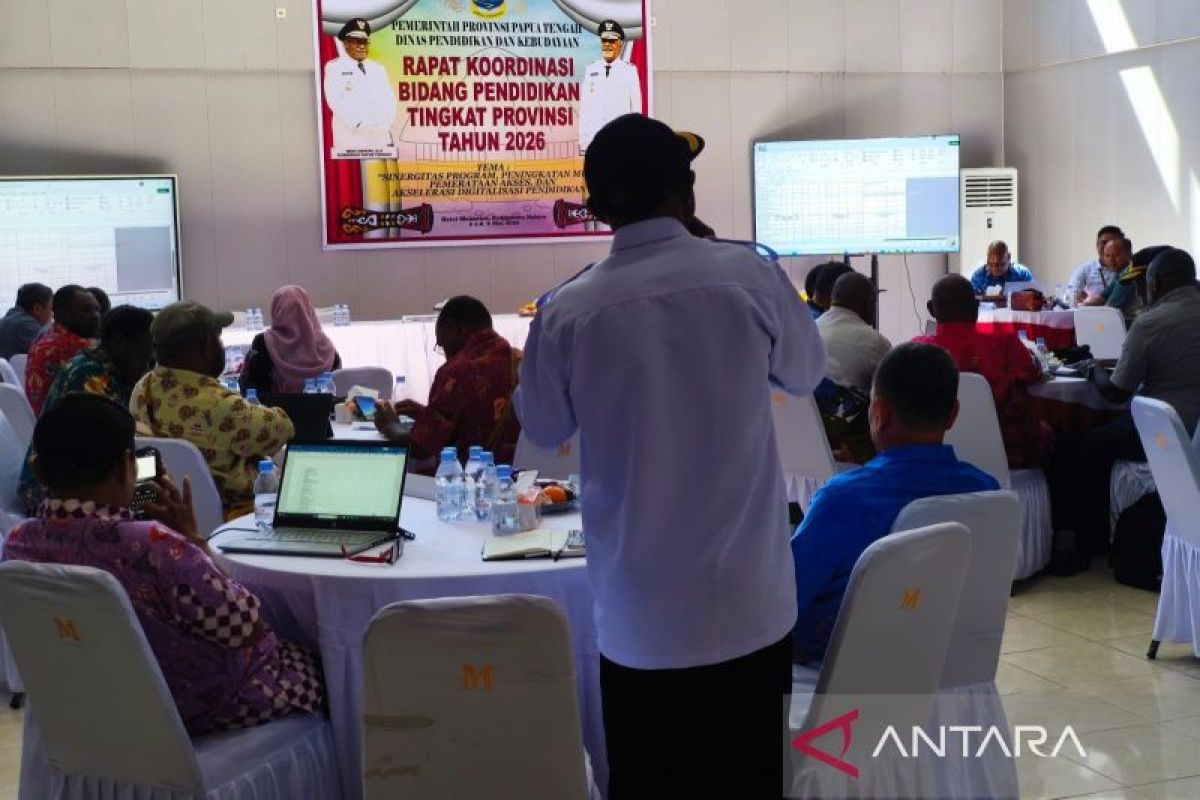
The Central Papua Education and Culture Office holds an education coordination meeting with eight district governments in Nabire, Central Papua, on Thursday (May 7, 2026). ANTARA/Ali Nur Ichsan
Nabire (ANTARA) - The Central Papua provincial government reaffirmed its commitment to intensifying efforts to strengthen the education sector this year, placing emphasis on teacher quality, data accuracy, and school digitalization.
The Education and Culture Office underscored the agenda during the 2026 Education Coordination Meeting, which gathered eight district governments across the province.
“This event’s theme pivots toward program synergy, quality enhancement, access expansion, and the acceleration of education digitalization,” said Nurhaidah, acting head of the office, in Nabire, Central Papua, on Thursday.
She emphasized the need for collective measures to address pressing education challenges in Central Papua, citing low scores in the education index, inaccurate student and educator data, inadequate infrastructure and facilities, and gaps in teachers’ capacity across several regions.
The Central Papua government, she continued, has mandated that all teachers in the province hold at least a bachelor’s degree by 2029. To that end, two affirmative programs have been introduced.
“We have identified 867 potential teachers to be prioritized in qualification enhancement programs in order to achieve the mandatory bachelor’s degree target by 2029,” Nurhaidah added.
She further said that capacity-building initiatives would be complemented by the acceleration of school digitalization, focusing on optimizing interactive digital panels already distributed by the central government.
The official acknowledged, however, that obstacles remain, including limited electricity access in remote areas, risks of device theft, and substandard school infrastructure.
On that note, the provincial government urged district administrations to help install school gates and fences, tailor device specifications to local electrical conditions, and initiate school revitalization efforts.
Furthermore, Nurhaidah underscored the importance of synchronizing data on schools, students, and educators to enable welltargeted policies based on real conditions.
“The accuracy of basic education data should be fundamental to policymaking and school accreditation,” she said.
The coordination meeting also discussed plans to map teacher needs in each district and involve local communities in school revitalization efforts.
Central Papua bets on teacher quality for stronger education system
The Central Papua provincial government reaffirmed its commitment to intensifying efforts to strengthen the education sector this year, placing emphasis on ...
 en.antaranews.com


