
hartono
Legendary Member

- Messages
- 17,047
- Joined
- Jun 26, 2012
- Messages
- 17,047
- Reaction score
- 2
- Points
- 125
Legok Nangka PSEL to boost waste management, clean energy: Ministry
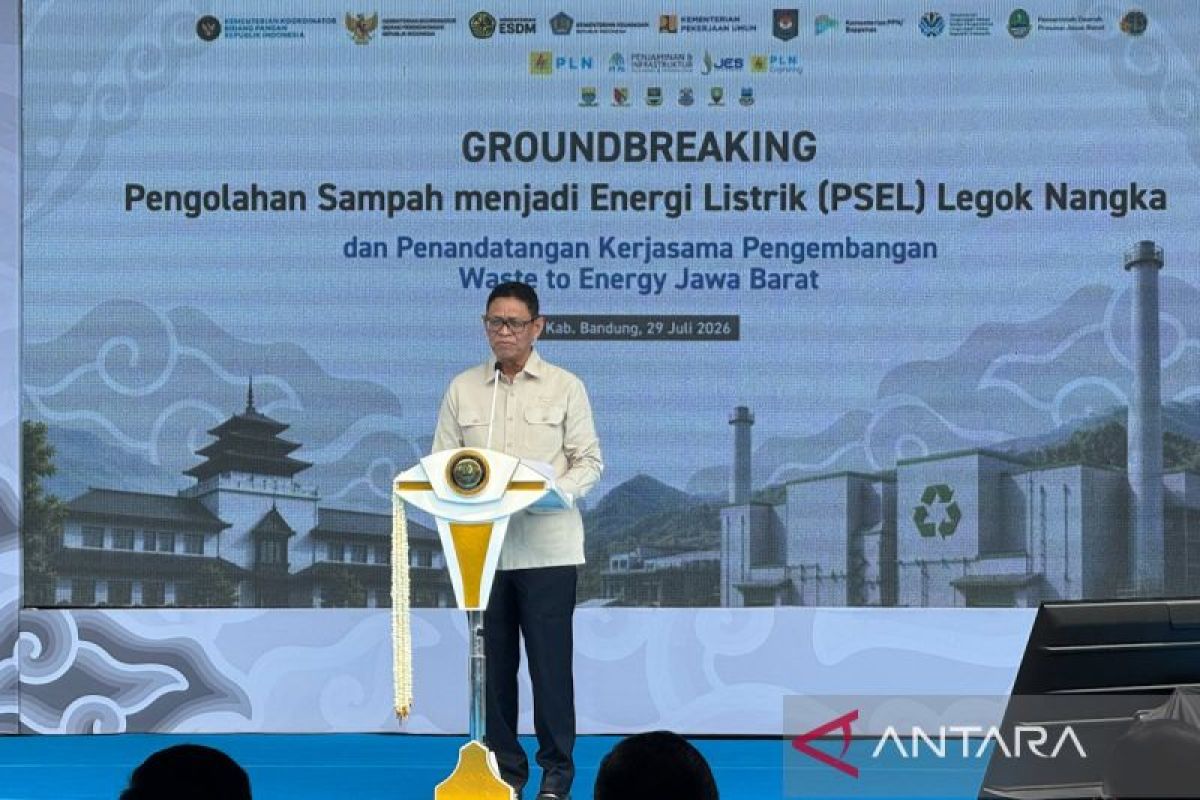
Deputy Minister of Energy and Mineral Resources Yuliot Tanjung at the groundbreaking ceremony for the Legok Nangka Waste-to-Electricity (PSEL) project and the signing of the West Java Waste-to-Energy Development Cooperation Agreement in Bandung District, Wednesday (July 29, 2026). ANTARA/Harianto
Bandung, West Java (ANTARA) - The Legok Nangka Waste-to-Electricity (PSEL) project in Bandung District, West Java, is expected to accelerate urban waste management while simultaneously generating clean energy, as stated by the Deputy Minister of Energy and Mineral Resources (ESDM), Yuliot Tanjung.
According to him, the commencement of Legok Nangka PSEL construction represents a significant milestone in urban waste management, addressing the daily waste accumulation crisis while simultaneously creating a cleaner and healthier environment.
"To realize a cleaner and healthier environment and realize the transformation of energy into new and renewable energy from waste processing," he emphasized at the project's groundbreaking ceremony on Wednesday.
Tanjung said Indonesia continues to face a major challenge, as the country generated 56.6 million tonnes of waste in 2025, most of which has yet to be properly managed.
Some 63.3 percent of waste has been managed through final landfill (TPA), waste banks, and processing facilities, while 35.7 percent, or approximately 20.2 million tons, remains inadequately managed.
Unmanaged waste is often openly burned, dumped into rivers, or dumped illegally, while many TPAs are experiencing overcapacity due to open dumping systems.
Therefore, the government is strengthening the development of waste-to-energy processing through Presidential Regulation Number 109 of 2025 and is preparing to simplify licensing and develop the PSEL within the national RUPTL (Electricity Supply Business Plan).
The Legok Nangka PSEL is designed with a capacity of 40.79 megawatts, capable of processing approximately 2,000 tons of waste per day, and requires an investment of US$400 million (Rp7.2 trillion).
During its 41-month construction period, the project is estimated to employ around 1,500 workers, reduce emissions by 311,000 tons of CO2 equivalent, and is targeted for operation by the end of 2029.
Tanjung expressed hope that the Legok Nangka PSEL would serve as a model for the development of similar waste-to-energy projects across the country through collaboration among all stakeholders, while contributing to a cleaner environment and stronger national energy security.
On the occasion, Yuliot expressed appreciation to the West Java Provincial Government for its commitment to accelerating the development of the waste processing site as both a waste management solution and a source of sustainable energy.
He also praised PT Jabar Environmental Solutions (JES) for advancing environmentally friendly waste-to-energy technology and setting an example for other regions.
In addition, he thanked the Japanese government for encouraging Japanese companies to invest in Indonesia's waste-to-energy sector.
"Today's groundbreaking not only marks the beginning of infrastructure construction, but also symbolizes a shared commitment to realizing a cleaner, greener, and more sustainable future for Indonesia," he stated.
Legok Nangka PSEL to boost waste management, clean energy: Ministry
The Legok Nangka Waste-to-Electricity (PSEL) project in Bandung District, West Java, is expected to accelerate urban waste management while simultaneously ...
 en.antaranews.com


