
hartono
Legendary Member

- Messages
- 17,047
- Joined
- Jun 26, 2012
- Messages
- 17,047
- Reaction score
- 2
- Points
- 125
Indonesia develops virus-free garlic seed technology
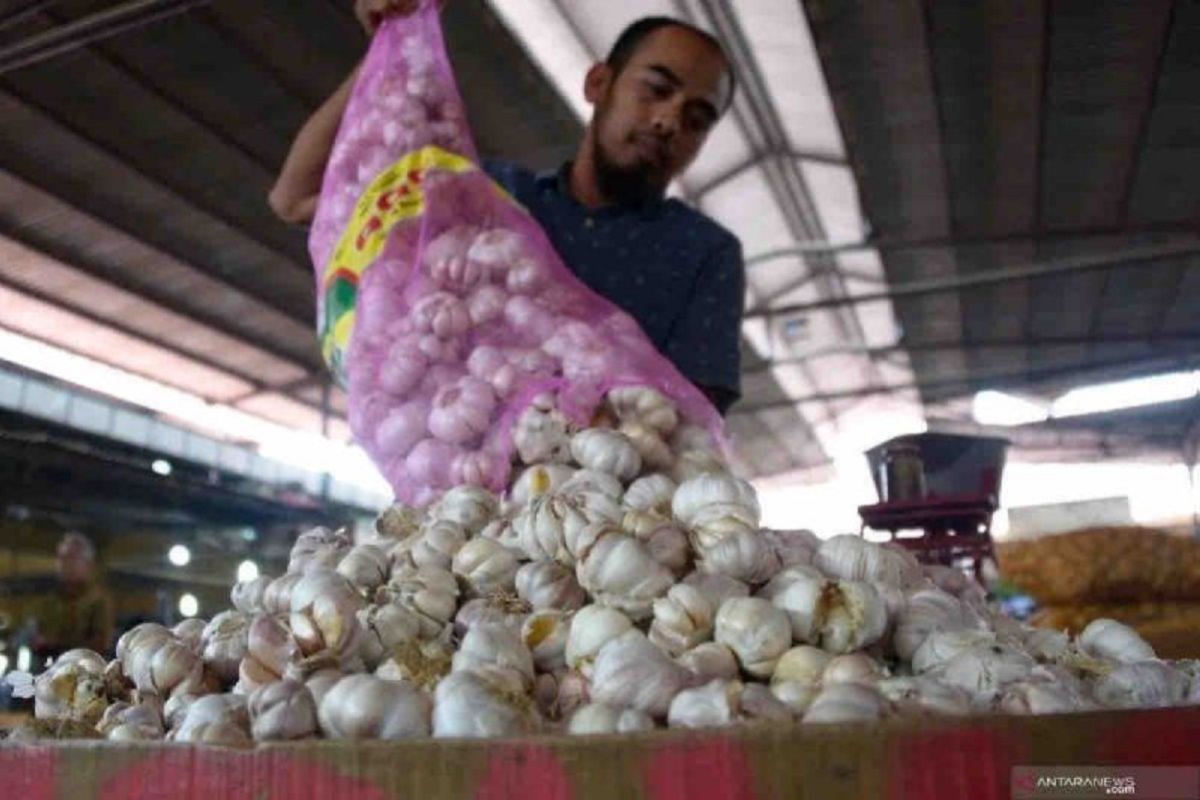
Illustration - Food businesses in Indonesia's Bangka Belitung replenish garlic supplies./ ANTARA/HO-Antaranews.
Jakarta (ANTARA) - Indonesia's National Research and Innovation Agency (BRIN) and Gadjah Mada University (UGM) are developing technology to produce healthy, high-quality garlic seed under a strategic research program aimed at boosting domestic production and reducing reliance on imports.
Dwinita Wikan Utami, head of BRIN's Horticulture Research Center and leader of the garlic Strategic Research and Innovation Program (PRIS), said healthy seed production technology is essential to preserve the long-term performance of improved garlic varieties.
"We need virus elimination technology that is effective, easy to apply and affordable so seed producers and farmers can widely use it to maintain planting material quality," Dwinita said in a statement on Monday.
She said the research focuses on eliminating viruses carried in garlic planting material. BRIN is developing virus elimination methods, designing a prototype device and assessing the treatment's impact on plant growth and productivity.
The technology is expected to help increase Indonesia's garlic production as part of broader efforts to reduce dependence on imported supplies.
The research team is also identifying viruses present in garlic planting material collected from major producing regions.
Sedyo Hartono, a plant virologist at UGM's Faculty of Agriculture, said laboratory testing detected dual infections of Onion yellow dwarf virus (OYDV) and Shallot latent virus (SLV) in about 80 percent of samples.
The infected samples were collected from Enrekang, Magelang, Temanggung, Tawangmangu and Yogyakarta, including seed bulbs, consumption bulbs, and leaves with and without visible disease symptoms.
"Virus infection symptoms are not always clearly visible in plants. In the field, their effects may be masked by other diseases, particularly fungal infections," Sedyo said.
Future studies will measure the treatment's ability to reduce virus concentrations while evaluating its effects on plant growth, productivity and susceptibility to other diseases, he said.
The findings indicate virus infection in garlic planting material is a significant issue requiring attention. However, the results are limited to the tested samples, making broader surveys necessary to map virus distribution.
The virus elimination project is scheduled to run for two years. The initial phase will focus on validating the method and developing a laboratory-scale virus elimination prototype.
The next stage will evaluate field performance of virus-free plants while supporting development of the technology with industry partners for commercial use by seed producers.
Beyond virus elimination, the PRIS program also aims to develop large-bulb softneck and hardneck garlic varieties, cultivars adapted to mid-altitude areas, dormancy-breaking technology, germplasm databases and standards for producing healthy, high-quality seed.
All research outputs will be tested to support garlic production centers, including the Food, Water and Energy Self-Sufficiency Area in Humbang Hasundutan, North Sumatra.
Indonesia develops virus-free garlic seed technology
Indonesia's National Research and Innovation Agency (BRIN) and Gadjah Mada University (UGM) are developing technology to produce healthy, high-quality ...
 en.antaranews.com


