BTC USD 80,819.5 Gold USD 4,353.00
Time now: Jun 1, 12:00 AM

FXCM - FXCM.com

EUR/USD: Trading the Change in Orders for U.S. Durable Goods

Trading the News: U.S. Durable Goods Orders

Why Is This Event Important:


Fading demands for U.S. durable goods are likely to reinforce a weakened outlook for future growth as private consumption accounts for more than two-thirds of the economy, and the data could weigh on the dollar as investors weigh the prospects for a sustainable recovery. However, as market sentiment continues to dictate price action in the currency market, a rise in risk aversion could spur a bullish reaction in the greenback as it benefits from safe-haven flows.

What’s Expected:

Time of release:09/24/2010 12:30 GMT, 8:30 EST

Primary Pair Impact :EURUSD

Expected: -1.0%

Previous: 0.3%

Will This Be Market Moving (Scenarios):

Demands for U.S. durable goods are forecasted to contract 1.0% in August following the 0.3% rise in the previous month, while orders excluding transportation equipments are projected to increase 1.0% after unexpected tumbling 3.8% in July. The mixed batch of data could spur choppy price action in the U.S. dollar as the economic outlook remains clouded with uncertainties, and the ongoing weakness in the private sector could lead the Federal Reserve to expand monetary policy further over the coming months in order to stem the downside risks for growth and inflation.

The Upside

Retail spending in the U.S. expanded for the second consecutive month in August, with business production increasing for the last six-months, and firms may increase their rate of investments throughout the remainder of the year as policy makers anticipate the recovery to gather pace 2011. An unexpected rise in the headline reading is likely to encourage an improved outlook, which could lead the U.S. dollar to recoup the losses from earlier this year.

The Downside

However, the uncertainties surrounding the economic outlook paired with cautious tone held by the central bank could discourage private consumption, and a downturn in business investments is likely to weigh on the recovery, which could stoke increased selling pressures on the U.S. dollar. As a result, a dismal durable goods orders report could lead the EUR/USD to pare Thursday’s decline and lead the exchange rate to retrace the sharp decline from April.

How To Trade This Event Risk

Trading the given event risk clearly favors a bearish outlook for the greenback, but an enhanced report could set the stage for a long dollar trade as growth prospects improve. As a result, if demands for U.S. durable goods contract less that 0.5% of unexpectedly increases in August, we will need to see a red, five-minute candle subsequent to the release to establish a sell entry on two-lots of EUR/USD. Once these conditions are fulfilled, we will place the initial stop at the nearby swing high or a reasonable distance, and this risk will generate our first target. The second objective will be based on discretion, and we will move the stop on the second lot to cost once the first trade hits its mark in order to preserve our profits.

On the other hand, the ongoing slack within the real economy paired with the uncertainties surrounding the outlook for future growth could stoke a drop in private consumption, and a sharp decline in business investments could drag on the exchange rate as the prospects for a sustainable recovery deteriorate. Therefore, if demands fall 1.0% or greater from the previous month, we will look to sell the greenback, and will utilize the same setup for a long euro-dollar trade as the short position laid out above, just in reverse.

Potential Price Targets For The Release

EURUSD_Trading_the_Change_in_Orders_for_U.S._Durable_Goods_body_ScreenShot014.png


July 2010 U.S. Durable Goods Orders

Demands for U.S. durable goods increased 0.3% in July amid forecasts for a 3.0% expansion, while orders excluding transportation unexpectedly slipped 3.8% after rising a revised 0.2% in the previous month. The breakdown of the report showed orders for non-defense capital goods excluding aircrafts, which acts as a gauge for business investments, slipped 8.0% after increasing 3.6% in the previous month, and conditions may deteriorate further in the second-half of the year as the private sector activity remains weak. The data reinforces a weakened outlook for the world’s largest economy and the slower pace of consumption is likely to weigh on the recovery as private sector spending remains one of the leading drivers of growth. As a result, the Federal Reserve is widely expected to maintain the expansion in monetary policy throughout the remainder of the year and may see scope to support the real economy going into 2011 as it aims to encourage a sustainable recovery.

EURUSD_Trading_the_Change_in_Orders_for_U.S._Durable_Goods_body_ScreenShot015.png


What To Look For Before The Release

Traders with access to market depth information via the FXCM Active Trader Platformmay use it to gauge the potency of the economic data release as well as to shed some light on the market’s directional bias. Increasing volume ahead of the announcement will telegraph likely follow-through behind whatever move is to materialize, while an imbalance in available liquidity on the Bid versus the Offer side of the market will tell us the direction major institutions are likely favoring ahead of the announcement:

Bullish Scenario:

If we see substantially deeper available liquidity on the Bid side of the market, this tells us that major price providers in the market are looking to buy the EUR against the US Dollar. Considering that close to 60% of all FX market volume is cleared through just six top banks, we see it prudent to be on the same side of the trade as major institutions and will favor a bullish bias on EURUSD ahead of the data release.

EURUSD_Trading_the_Change_in_Orders_for_U.S._Durable_Goods_body_00001_EUR.jpg


Bearish Scenario:
If we see substantially deeper available liquidity on the Offer side of the market, this tells us that major price providers in the market are looking to sell the EUR against the US Dollar. Considering that close to 60% of all FX market volume is cleared through just six top banks, we see it prudent to be on the same side of the trade as major institutions and will favor a bearish bias on EURUSD ahead of the data release.

EURUSD_Trading_the_Change_in_Orders_for_U.S._Durable_Goods_body_00002_EUR.jpg
 
Currencies Content on Consolidation Following Wild Friday Trade

FUNDYS

Very little in the way of any meaningful price action thus far on Monday, with all currencies consolidating their latest gains against the buck and contemplating the possibility of yet another round of strength. The Euro has been exceptionally well bid over the past several trading sessions, with technical traders scratching their heads after the market finally ended a sequence of 9 consecutive daily higher lows on Friday to warn of a healthy corrective pullback, before totally negating this sequence-break and rallying to yet another multi-day high just shy of 1.3500.

Relative Performance Versus USD Monday (As of 10:10GMT)

1. KIWI+0.08%
2. AUSSIE+0.04%
3. STERLING+0.02%
4. CAD-0.01%
5. YEN-0.02%
6. EURO-0.22%
7. SWISSIE-0.23%

The gains in the currency market continue to be driven by the latest Federal Reserve monetary policy statement which has signaled to the markets that the central bank is ready and willing to implement yet another round of quantitative easing should it be necessary. Since the decision last Tuesday, weak housing data has been the key stand out, and should economic data in the US disappoint some more over the coming weeks, then we will surely see another round of accommodation.

On Monday thus far, we have already seen a much weaker than expected Japanese trade surplus which shows the dramatic negative impact of the stronger Yen on exports and could start to scare away some of the Yen bulls. Also generating some volatility in the Yen has been the fiscal half-year end price action and hedging, and rumors of bankruptcy from Japan’s third largest consumer lender.

Meanwhile in China, despite some fresh highs for the Yuan against the USD, the end result was rather unimpressive with the Yuan depreciating at the fixing. Elsewhere, in the UK, Hometrack Housing was weaker than the previous print, while Bank of England Sentance was out with some hawkish remarks after saying that the BOE should look to raise rates soon. Finally, in the Eurozone, the IMF said that it saw German GDP growth at 3.3% in 2010, and 2.0% in 2011, while a Moody’s downgrade of some subordinated debt at Allied Irish Bank’s helped to keep Euro gains well capped below 1.3500.

Looking ahead, the North American calendar is quite light, with the Chicago Fed national activity index (-0.50 expected) due at 12:30GMT, followed by Dallas Fed manufacturing (-7 expected) at 14:00GMT. With the economic calendar so anemic, market participants will undoubtedly look to broader global macro themes for clearer directional bias over the coming hours. US equity futures are pointing to a mildly firmer open, while commodities are also bid with gold consolidating just under its recently set record highs by critical psychological barriers at $1300.

TECHS

EUR/USD:The market continues to extend gains with the latest recovery now trading into the 1.3500 area ahead of the latest minor setbacks. While the overall bullish structure remains firmly intact at present, it is worth noting that the 1.3500 figure coincides with the 50% fib retracement off of the major 1.5000-1.2000 move which could act as a formidable resistance point on a close basis going forward. The daily RSI has also crossed up into overbought territory to further warn of the need for some form of a corrective pullback. However, a break back below Friday’s low by 1.3285 will be required at a minimum to relieve topside pressures and trigger a short-term corrective decline.

USD/JPY: Rallies have stalled out for now by the 50-Day SMA and just ahead of the Ichimoku cloud bottom to warn that the downtrend is still very much intact. It now looks as though a medium-term lower top is attempting to carve out by 85.95 ahead of the next major downside extension back below 82.85 and towards the record lows at 80.00. A break back above 86.00 would be required to negate outlook.

GBP/USD: The latest break back above 1.5700 threatens the integrity of the downtrend and potentially exposes a move back towards 1.6000 over the coming sessions. The 78.6% fib retrace off of the 1.6000-1.5295 move comes in by 1.5845, and a close above this level will significantly increase the likelihood for a full retracement to 1.6000. Inability to close above 1.5845 keeps the prospects for a bearish resumption intact.

USD/CHF(See Below)

FLOWS

Prop accounts on the bid in Gbp/Chf. Asian central bank bids in Eur/Usd; option barriers by 1.3500. Stops below 84.00 in Usd/Jpy. Soveriegn accounts on the bid in Usd/Cad below 1.0200. Official interest in Usd/Chf.

TRADE OF THE DAY

Currencies_Content_on_Consolidation_Following_Wild_Friday_Trade_body_swiss1.png


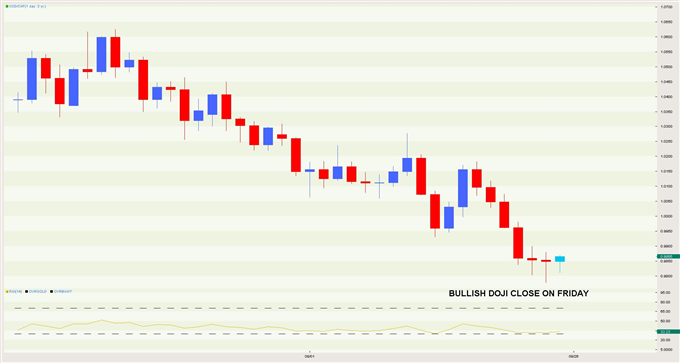
Usd/Chf: Setbacks have finally stalled out ahead of the critical record lows from 2008 by 0.9645, with the market finding a bottom for now by 0.9780 ahead of the latest minor bounce. Short-term and medium-term studies are certainly looking quite stretched and longer-term cyclical studies warn of a major bottom. Friday’s close is quite constructive with the market extending to fresh lows and rejecting the move lower before closing back by daily opening levels. This sets up the potential for a short-term reversal, with a break and close back above 0.9880 to confirm bias and accelerate gains. Inability to establish back above 0.9880 will however keep the downtrend intact and leave the door open for a retest of the record lows by 0.9645. STRATEGY: BUY @0.9885 FOR AN OPEN OBJECTIVE; STOP 0.9770. RECOMMENDATION TO BE REMOVED IF NOT TRIGGERED BY NY CLOSE (5PM ET) ON MONDAY.
 
August King of the Micro Sees 1,284% Profit

New York, September 22, 2010—FXCM crowned the King of the Micro for August amongst 21,570 contestants. Even though August was a complicated month for forex trading, the August King of the Micro gained nearly 1,284% in profit—higher than July’s King (see August Trading Facts below).*

Taking first place and the $25,000 cash prize is Jack Chou of the United States. Chou started trading five years ago when he, out of curiosity, opened a demo account followed by a Micro account. Today, he is August’s King of the Micro. The happily married Chou says that his keys to trading success are following good trends and listening to his wife.

Coming in second with a profit of 883% is Wenzhen Wang of China. Wang, whose favorite source for news is DailyFX Hong Kong, started online forex trading five years ago and spends eight hours a day trading, trying to learn from his past trading mistakes. During the past five years Wang’s trading spirit has remained the same. “Dare to lose money when you make a trading decision,” he says. “Play with your spare money and improve your trading skills by learning from your own mistakes.”

Finishing in third place is Zhanhai Guo of China with a 599% return. Guo believes that following the trends and comparing analysis are the best ways of trading. He trades three hours a day and says his most memorable trade was going short 200K of AUD/USD on August 18. “I entered the market at 0.89745 and exited at 0.88139, holding the trade for five trading days,” he says. “Several times I had thought of exiting early, but I managed to follow my original plan and make a profit of $3,122.”
Read more about our winners here.

Do you want to be the next King?

It’s not too late to take part in the October King of the Micro contest. No registration is required, it’s free to enter, and all Micro accounts with equity of at least $500 at the end of September automatically qualify. The King of the Micro contest is available to FXCM Micro clients worldwide. Recent winners have hailed from the United States, China, Malaysia, Canada, and the United Kingdom.

If you want a chance to be the trading king, click here to deposit funds into your Micro account. If you do not have a Micro account, click here to apply.

August Trading Facts

In August, many of the most liquid pairs fell back into congestion as underlying risk appetite struggled to reestablish a clear trend after the very large and clear trends which ended in July. For traders, this shift in market conditions required a shift in trading approach. Setups meant to exploit momentum and medium-term breakouts no longer worked. Instead, positions that worked with ranges and were developed around short-term opportunities tended to have a more successful outcome. Will this congestion-based scenario continue into October and beyond, or is a new trend just around the corner? The answer to this question could help decide the next King of the Micro.

* Past performance is not indicative of future results.
Trading foreign exchange on margin carries a high level of risk, and may not be suitable for all investors. Any opinions, analyses, or other information contained is provided as general market commentary, and does not constitute investment advice. Read full risk disclaimer.

About FXCM Holdings LLC

FXCM Holdings LLC (FXCM) is a leading global forex and CFD broker* that caters to both retail and institutional markets. Founded in 1999, FXCM is one of the largest brokers, regulated by several of the world’s most respected financial authorities.
At the heart of FXCM’s client offering is No Dealing Desk forex trading. Clients have market access to some of the world's largest forex liquidity providers that enables FXCM to offer clients spreads as low as 1 pip on major crosses. Clients also have the benefits of mobile trading, one-click order execution, and trading from real-time charts. Forex Capital Markets Ltd.’s CFD product* offers no re-quote trading and allows traders to trade oil, gold, silver, and stock indices, along with forex on one platform. In addition to currency and CFD trading, FXCM offers educational courses on forex trading, and provides free news and research through DailyFX.com.
 
Euro Upside Risk Remains But Just For A Short While Longer

FUNDYS (Early Edition)

Another day, another round of broad based USD depreciation, with the Greenback getting hit hard again and extending declines against most major currencies, with much of the price action attributed to elevated expectations for a second round of quantitative easing from the Fed, after a softer US consumer confidence print on Tuesday. Fed Lockhart has however recently been on the wires saying that QE2 is by no means a done deal, and it will be interesting to see how the markets respond in Wednesday trade.

Relative Performance Versus USD Wednesday (As of 8:20GMT)

1. YEN+0.30%
2. AUSSIE +0.21%
3. EURO+0.07%
4. STERLING+0.04%
5. CAD-0.01%
6. SWISSIE-0.06%
7. KIWI-0.15%


For now, the prospects for the Buck are looking quite gloomy, with data so far in Asia exceeding expectations after the Japanese Tankan came out quite solid, while the New Zealand trade balance was also better than forecast. This should further bolster risk sentiment and appetite for higher yielding and seemingly better positioned currencies. The topic of reserve diversification away from the USD has also been resurrected, with the slide in the buck rehashing concerns that the single currency is undergoing a major secular decline. Nevertheless, the Greenback is showing oversold on a short-term technical basis, and we would caution investors from adding to USD shorts at current levels.

Looking ahead to North American trade, US mortgage applications are due at 11:00GMT, followed by Canada industrial product and raw materials prices at 12:30GMT. Oil and gas inventory data in the US caps things off at 14:30GMT. On the official circuit, Fed Kocherlakota speaks at 14:15GMT, while Fed Plosser is slated to speak shortly after on the topic of the economy at 16:30GMT. Fed Rosengren is the final central banker scheduled to speak, with an appearance scheduled in New York for 17:15GMT. US equity futures are tracking marginally lower, while commodities are mildly bid with gold trading just under its recently set record highs.

TECHS

EUR/USD: (See Below)


USD/JPY:Rallies have stalled out for now by the 50-Day SMA and just ahead of the Ichimoku cloud bottom to warn that the downtrend is still very much intact. It now looks as though a medium-term lower top is attempting to carve out by 85.95 ahead of the next major downside extension back below 82.85 and towards the record lows at 80.00. A break back above 86.00 would be required to negate outlook.

GBP/USD:The latest break back above 1.5700 threatens the integrity of the downtrend and potentially exposes a move back towards 1.6000 over the coming sessions. However, the 78.6% fib retrace off of the 1.6000-1.5295 move comes in by 1.5845, and inability to close above this fib on Monday and Tuesday could keep alive the possibility for a lower top below 1.6000 ahead of the next major downside extension. Look for a close back below 1.5720 to confirm outlook and likely accelerate declines back towards 1.5500.

USD/CHF:The market continues to extend declines to fresh yearly lows despite oversold short-term and medium-term studies. From here, the risks are for some more weakness, with a retest of the record lows by 0.9645 seen as the likely target. However, any additional declines below 0.9645 are seen limited and we like the idea of establishing a significant long position on a retest of this level. Back above 0.9880 would be required to officially relieve downside pressures.

TRADE OF THE DAY


Euro_Upside_Risk_Remains_But_Just_For_A_Short_While_Longer_body_eur.png


Eur/Usd: Daily studies are overbought but the market has now easily cleared the 50% fib retrace by 1.3500, and fresh upside towards next key resistance by 1.3695 can not be ruled out over the coming sessions. The 1.3695 resistance area represents the April highs, and this now seems as a very realistic next target. However, from there we would expect to see a major corrective pullback, with daily studies already stretched and the market starting to look exhausted. Back below 1.3385 would be required to officially relieve topside pressures but we like the idea of establishing a very playable counter-trend short on a test of 1.3695 today. STRATEGY: SELL @1.3690 FOR AN OPEN OBJECTIVE; STOP 1.3810. RECOMMENDATION TO BE REMOVED IF NOT TRIGGERED BY NY CLOSE (5PM ET) ON WEDNESDAY.
 
Forex: Bearish U.S. Dollar Sentiment Carries Into October, Euro Extends Rally

Talking Points

* Japanese Yen: Losing Ground Against Majors
* Pound: Housing Withdrawals Fall Further in 2Q
* Euro: Unemployment Pushes Higher in August
* U.S. Dollar: Personal Spending, ISM Manufacturing on Tap


The Euro rallied to a high of 1.3763 during the overnight trade, and the single-currency may continue to push higher going into the end of the week as the bearish sentiment behind the U.S. dollar carries into October. After clearing 1.3500, the 50.0% Fibonacci retracement from the 2009 high to the 2010 low, the EUR/USD looks poised to test the 61.8% Fib around 1.3890-1.3900 as it maintains the advance from the previous month. With the 50-Day moving average (1.3011) approaching the 200-Day at 1.3185, a bullish crossover could lead the euro-dollar to retrace the decline from earlier this month as the greenback continues to weaken against its major counterparts. However, as the near-term rally remains overbought, with the daily relative strength index increasing to 77, we may see a corrective retracement play out in the days ahead.

Meanwhile, European Central Bank board member Ewald Nowotny said the Governing Council will purchase government bonds as long as “inefficiencies prevail” in the financial market, and went onto say that the current situation in some areas remain sensitive as the governments operating under the fixed-exchange rate system struggle to manage their public finances. Given the ongoing weakness within the real economy paired with the uncertainties surrounding the future outlook, the ECB may see scope to maintain the expansion in monetary policy throughout the beginning of 2011 as it holds a dovish outlook for inflation. Meanwhile, the economic docket showed unemployment in the Euro-Zone unexpectedly increased to 10.1% in August to mark the highest reading since June 1998, but the single-currency showed little reaction to the data as it benefits from the weakness in the greenback.

The British Pound pared the decline from earlier this week to reach a high of 1.5872 on Friday after closing above the 38.2% Fibonacci retracement from the 2009 low to high at 1.5700 during the previous day, but the GBP/USD may consolidate going into the following week as investors maintain a cautious outlook for the U.K. A report by the Bank of England showed home equity withdrawals tumbled GBP 6.2B in the second quarter after falling a revised GBP 5.3B during the first three-months of the year, and the ongoing weakness in the private sector could lead the MPC to expand monetary policy further in October as it aims to encourage a sustainable recovery. If we see a three-way split within the BoE, speculation for an expansion in quantitative easing would spark a bearish in the British Pound as investors weigh the prospects for future policy.

The greenback continued to weaken against its major counterparts, with the USD/JPY slipping to a low of 83.15, and the dollar may depreciate further in the following as the bearish sentiment carries into October. As market liquidity tends to taper off ahead of the weekend, the greenback may continue to trend lower throughout the day, but the event risk scheduled for the U.S. trade could spark increased volatility in the exchange rate as investors weigh the outlook for the world’s largest economy. Personal incomes are expected to increase 0.3% in August, with market participants forecasting a 0.3% rise in private spending, while the ISM manufacturing index is projected to fall back to 54.5 in September from 56.3 in the previous month. The mixed batch of data could spark choppy price action in the U.S. dollar, but the ISM report is likely to be the biggest market-mover of the day as manufacturing leads the economic recovery in the U.S.
 
Forex: Euro Under Pressure, U.S. Dollar Benefits From Safe-Haven Flows

Talking Points

* Japanese Yen: Slightly Mixed Across the Board
* Pound: U.K. Construction Expands At Faster Pace
* Euro: Investor Confidence Improves Further
* U.S. Dollar: Pending Home Sales, Fed Chairman Bernanke on Tap


As EUR/USD price action holds below the 61.8% Fibonacci retracement from the 2009 high to the 2010 low around 1.3880-90, a corrective retracement could unfold in the days ahead as the rally from the September remains overbought, and the daily relative strength index should fall back below 70 this week if we see the exchange rate work its way back towards the 50.0% Fib around 1.3500. The euro-dollar showed little reaction to the Sentix survey even though the report showed investor confidence increased to a three-year high of 8.8 in October from 7.6 in the previous month, and shift in market sentiment could drive the exchange rate lower throughout the day as risk trends continue to dictate price action in the currency market. However, if the euro-dollar is able to find short-term support around the 50.0% Fib, there could be a phase of consolidation over the coming weeks given the uncertainties surrounding the economic outlook, and the EUR/USD may trend sideways before we see another breakout in the exchange rate.

Meanwhile, Ireland’s central bank lowered its growth forecast for the region and expects GDP to expand 0.2% this year amid an initial forecast for a 0.8% rise, while the growth rate is anticipated to increase 2.4% next year versus earlier projections for a 2.8% expansion. The central bank went onto say that the recovery in Europe remains “uneven” as the rebound in economic activity appears to be tapering off in the second-half of the year, and went onto say that the outlook remains clouded by high uncertainties as the governments operating under the single-currency struggles to manage their public finances. In addition, the economic docket showed producer prices in the Euro-Zone increased at an annual pace of 3.6% in August after expanding 4.0% in the previous month, and the slower pace of inflation paired with the slowing recovery could lead the Governing Council to maintain a dovish policy stance going into 2011 as it aims to balance the risks for the region.

The British Pound bounced back from a low of 1.5748 during the European trade as U.K. policy makers held an improved outlook for the region, but the GBP/USD is likely to trade within the narrow range carried over from the previous week as price action struggles to hold above 1.5900. Chancellor of the Exchequer George Osborne said the economy has “moved out of the danger zone” during an interview with BBC Radio, while former Bank of England Deputy Governor John Gieve talked down speculation for a further expansion in quantitative easing and said interest rates will have to rise going forward according to an article in the Guardian newspaper. As investors mull over the outlook for future policy, the GBP/USD is likely to hold steady ahead of the BoE interest rate decision later this week, but the central bank may refrain for releasing a policy statement like we’ve seen for the past few months.

The greenback bounced back against most of its major counterparts, with the USD/JPY rallying to a high of 83.86 overnight, but the dollar is likely to face increased volatility later today as the economic docket is expected to reinforce a mixed outlook for the world’s largest economy. Pending home sales in the U.S. is forecasted to increase 0.9% in August following the record 20.1% drop in the previous month, while factory orders are projected to fall 0.4% during the same period after tipping 0.1% in July. In addition, Fed Chairman Bernanke is scheduled to speak regarding the economy later today, and comments from the central bank head could shake up the majors as investors weigh the prospects for future policy.
 
Euro Dips Continue to Be Used As Formidable Position Building Opportunities

FUNDYS


It has been a tale of 2 sessions on Tuesday, with the USD finding some bids early on, and currencies selling off in Asian trade, before turning around sharply in Europe, with the USD coming back under intense pressure. Some of the notable gainers include the Euro, Swissie and Sterling, with the Euro and Sterling finding some bids on better than expected PMI data, while the Franc remains eternally well bid and has rallied to test the record highs from 2008 (USD/CHF lows). But to truly attribute the latest USD selling to economic data would be foolish (especially in light of significantly weaker Eurozone retail sales and some downbeat comments from ECB Ordonez), with most of the price action more likely originating from the increased likelihood that the Fed will implement a second round of quantitative easing.

Relative Performance Versus USD Tuesday (As of 10:45GMT)

EURO+0.68%
SWISSIE+0.45%
STERLING+0.28%
CAD+0.26%
KIWI+0.11%
YEN-0.06%
AUSSIE-0.86%


The Australian Dollar on the other hand is by far the weakest currency on the day thus far, and should continue to be for the remainder of the day after the Reserve Bank of Australia surprised markets by leaving rates on hold at 4.50%, while also offering a far less than hawkish accompanying statement. Although the central bank conceded that higher rates would be appropriate at some point in the future, comments that the “financial markets were still uncertain” and “overall credit growth remained subdued” were enough to send chills down the spines of Aussie bulls.

Euro_Dips_Continue_to_be_Used_as_Formidable_Position_Building_Opportunities_body_tradeofday.png


Technically, the pullback in the currency is certainly warranted, with daily studies rolling over from overbought after the antipodean rallied most impressively against the buck over the past 5 weeks. Rallies have stalled about a hundred points off the key multi-year highs from 2008 by 0.9850, but as we have mentioned in our analysis, the Australian Dollar sits by longer-term cycle highs and is at risk for a material pullback over the medium and longer-term. The fundamental catalyst has yet to fully reveal itself, but we anticipate that today’s rate decision could start to paint that picture with an economy that is becoming more aware of just how reliant it is on a shaky global outlook.


One must not overlook some other key developments over the past few hours that only help to reaffirm the case for additional Aussie weakness. On the data front, Australian retail sales have come in softer than expected, while at the same time, China services PMI has dropped in September. Aussie bulls have been very quick to discount problems in the US and Eurozone, on stronger local fundamentals and a very upbeat China outlook, and although it is only one day’s worth of economic data, the results are sure to force some reconsideration of positioning.


Another major development has been the latest Bank of Japan rate decision which had opened some decent selling in the Yen (in Asian trade) after the BOJ also surprised markets by easing monetary policy further, effectively lowering rates to 0.0% (0.0%-0.10%) and concurrently stepping up asset purchases. The BOJ cited a strong Yen and slower global economy as the reasons for the Japanese slowdown and deterioration in corporate sentiment.


There has been a very apparent pattern over the past several days of early USD buying, followed by a reversal and stronger USD selling into the latter half of the day. We have talked about the overbought nature of the Euro and the need for the market to correct, but have also discussed a critical sequence that needs to be broken in order for a full on correction to play out. The key level to watch today comes in by 1.3665, with a daily close below this level required to force a shift in the structure. Otherwise, the bull trend remains intact and eyes next critical topside barriers by 1.4000.


Looking ahead, US ISM non-manufacturing data (52.0 expected) due at 14:00GMT is the only major release in North American trade. On the official circuit, Treasury’s Miller speaks at 13:00GMT, while Treasury’s Warren follows a while later at 19:20GMT. US equity futures point to a mildly higher open, while commodities are well bid with gold breaking to yet another record high over $1325. At this point, the moves in gold are well overdone on a short-term basis and would recommend the establishment of a short position by $1325. The daily RSI is above 80 and very overbought.

GRAPHIC REWIND

Euro_Dips_Continue_to_be_Used_as_Formidable_Position_Building_Opportunities_body_dxy10.png


TECHS


EUR/USD: The pace and intensity of this latest Euro rally that began in early September, has been most impressive, with the currency pushing higher on a daily basis to now close in on next major psychological barriers by 1.4000. However, daily studies are well overbought at this point, and the risk from here is for some form of a corrective pullback before considering a bullish resumption. The key to a reversal is now entirely contingent on the daily close in the major.Although we have seen previous daily higher lows broken to the downside on numerous occasions throughout the rally, we have yet to see a daily close below the previous daily low. The market has now put in a dramatic 19 consecutive closes higher than the previous daily low, and we would therefore need to see a close below the previous daily low to officially trigger the start to a legitimate corrective decline. Monday’s bearish close opens the door for a potential break of this sequence, and we will need t see a close below 1.3665 to officially confirm. Nevertheless, until we can see a close below the previous daily low, the prevailing uptrend remains firmly intact, and a near test of 1.4000 can not be ruled out.


USD/JPY: The latest setbacks have stalled just shy of the recently established multi-year lows by 82.85, with Monday’s break back above 83.60 temporarily relieving downside pressures after ending a sequence of consecutive daily lower highs and a near-2 week decline. From here there is certainly room for additional upside, but ultimately, while the market trades below 86.00, the overall structure still remains intensely bearish and rallies should be met with solid resistance. As such, we remain sidelined and prefer to look to sell into rallies or buy overdone dips towards the record lows by 80.00 from 1995.


GBP/USD: The latest break back above 1.5800 threatens the integrity of the downtrend and potentially exposes a move back towards 1.6000 over the coming sessions. However, the 78.6% fib retrace off of the 1.6000-1.5295 move comes in by 1.5845, and inability to close above this fib could keep alive the possibility for a lower top below 1.6000 ahead of the next major downside extension. Look for a close back below 1.5670 to confirm outlook and likely accelerate declines back towards 1.5500. A close above 1.5845 negates.

USD/CHF:(See Below)

FLOWS


Japanese investor bids in Usd/Jpy. US commercial bank and US investment bank big buyers of Eur/Usd on dips. Long liquidation seen in Aussie on a break below 0.9550. Local bids in Usd/Cad. Some official interest cited in Usd/Chf below 0.9700.

TRADE OF THE DAY

Euro_Dips_Continue_to_be_Used_as_Formidable_Position_Building_Opportunities_body_tradeofday_1.png


USD/CHF:The market continues to extend declines to fresh yearly lows despite oversold short-term and medium-term studies. From here, the risks are for some more weakness, with a retest of the record lows by 0.9645 seen as the likely target. However, any additional declines below 0.9645 are seen limited and we like the idea of establishing a significant long position on a retest of this level. STRATEGY: BUY @0.9650 FOR AN OPEN OBJECTIVE; STOP 0.9545. RECOMMENDATION TO BE REMOVED IF NOT TRIGGERED BY NY CLOSE (5PM ET) ON TUESDAY.
 
U.S. ADP Employment Change Unexpectedly Drops 39K in September

The ADP employment change in the world’s largest economy unexpectedly fell 39K in September after climbing 10K the month prior amid expectations of a 20K rise. The data does not bode well for Friday’s Nonfarm payrolls release as economists as of late are forecasting for no change in payrolls, while the unemployment rate is forecasted to advance to 9.7 percent from 9.6 percent.

Today’s decline in the ADP employment report marks the first drop since January of this year as the reading for August was revised to the upside. Also worrisome is the fact that the release does not include the effects of federal hiring/firing. This is concerning because census workers declined about 65,000 between the weeks of August and September. Going forward, traders will shift their focus to the monster.com report for further insight on the labor market in the U.S. ahead of Friday’s highly anticipated release.

Indeed, there was little reaction following the ADP report, but looking ahead, market participants are sure to keep a close eye on the EURUSD, USDJPY, and AUDUSD as these pairs remain at critical levels.

EURUSD Daily Chart
U.S_ADP_Employment_Change_Unexpectedly_Drop_39K_in_September_body_eurusd1.png


Source: FXCM’s Strategy Trader – Prepared by Michael Wright

The EURUSD continues to maintain its ascending channel but as of late, the pair is at the crossroads of the 61.8 percent Fibonacci retracement on the December 3rd 2009 to June 7th downswing. Failure to close above this level paired with a break below the narrow range may lead the pair to retest 1.3500 in the near term.

USDJPY Daily Chart
U.S_ADP_Employment_Change_Unexpectedly_Drop_39K_in_September_body_udsjpy.png


Source: FXCM’s Strategy Trader – Prepared by Michael Wright

After the Bank of Japan intervention, the USDJPY has returned to the 83 level and now looks poised to continue its southern journey, with the pair likely to test 82.50 by the end of the week as traders continue to seek safety amid uncertainty in the global markets.
 
As you know, the CFTC has issued new regulations that
are scheduled to take effect on Oct. 18. As of that date,
U.S. traders will be limited to 50:1 leverage. This is
in addition to the "no hedging" and FIFO restrictions
already in place. For those U.S. traders who are trading with
brokers in the UK, such as Forex.com (UK) and FXCM (UK), the
CFTC is forcing the brokers to move your accounts back to
the U.S. as of Oct. 18,so that you will be subject to
the new regulations. :-?#:-S
 

Live Forex Chart

Currency
Rates
EUR / USD
1.14641
USD / JPY
156.876
GBP / USD
1.33707
USD / CHF
0.82419
USD / CAD
1.40087
EUR / JPY
179.844
AUD / USD
0.71102
Back
Top
Log in Register