Trading isn’t about guessing where the market will go. Trading is about understanding the market, managing risk, and having a strategy.
Welcome to ForexHub — a place where traders can discover market insights, trading education, forex news, and the latest updates from the world of Forex.
Forex (foreign exchange) trading is the buying and selling of one currency against another, with the goal of making money from changes in their exchange rates.
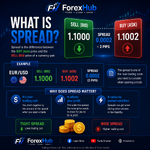
For example, you might trade EUR/USD:
You buy EUR/USD at 1.1000.
This means €1 = $1.10.
If the price rises to 1.1100, your trade has gained value.
If it falls to 1.0900, you've lost money.
Forex is usually traded as currency pairs, such as:
EUR/USD — euro vs. US dollar GBP/USD — British pound vs. US dollar USD/JPY — US dollar vs. Japanese yen USD/IDR — US dollar vs. Indonesian rupiah
================================================================== How do traders make money?
The basic idea is:
Buy low → sell high
But forex also allows short selling: Sell high → buy back lower
So a trader can potentially profit whether a currency pair goes up or down—if their prediction is correct.
================================================================== Why is forex risky?
Forex often involves leverage, which lets you control a larger position with a smaller amount of money.
For example, with 10× leverage, $100 could control a $1,000 position. That can amplify profits and losses. A relatively small market movement can therefore wipe out a large portion of your trading capital.
Forex prices are influenced by things like:
- Interest rates - Inflation - Economic data
- Central-bank decisions
- Political events
- Market sentiment
Important: Forex isn't a guaranteed way to make money. Especially with leverage, beginners can lose money quickly.
If you're completely new, I can also explain forex trading from zero with a simple $100 example, including pips, lots, leverage, stop-losses, and how a trade actually works. ForexHub — TRADE • LEARN • GROW


 Simple Example
 Easy Way to Remember
 What Can Make Spread Wider?