
hartono
Legendary Member

- Messages
- 17,047
- Joined
- Jun 26, 2012
- Messages
- 17,047
- Reaction score
- 2
- Points
- 125
Addressing Indonesia's waste problem from the source
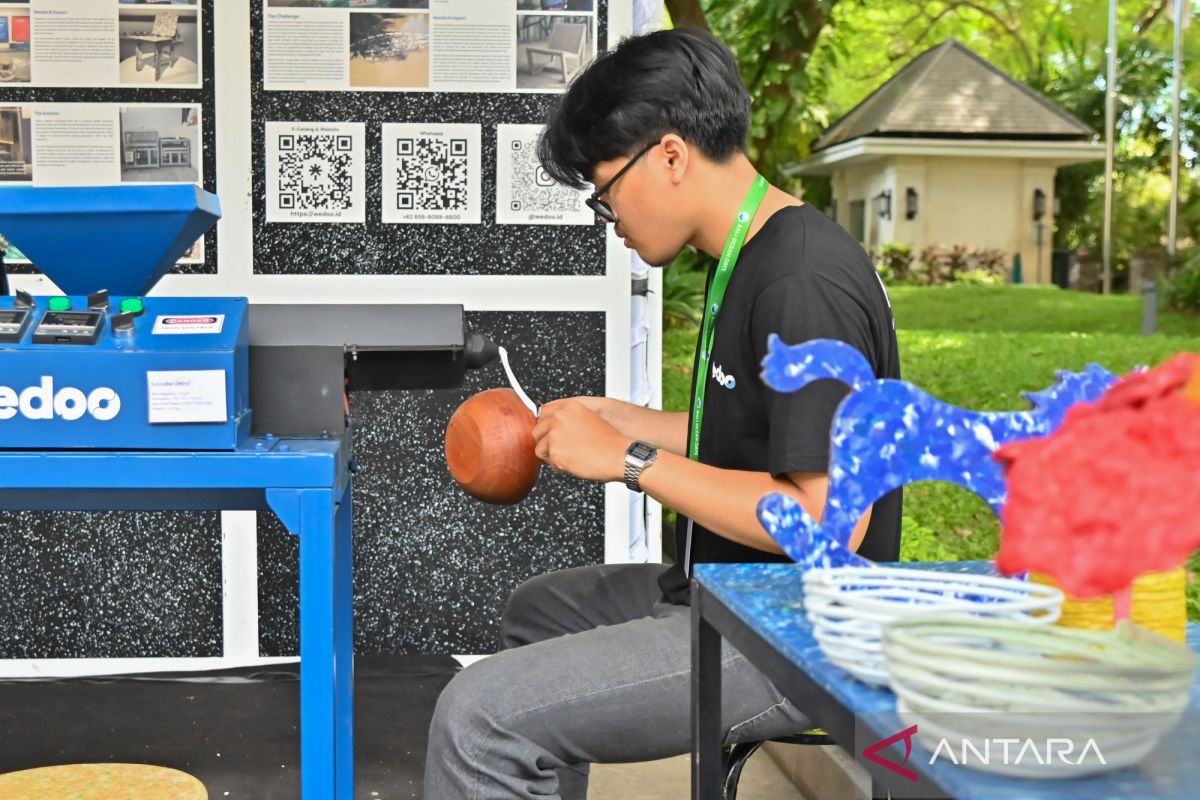
A participant makes a craft using plastic waste during the Bali Ocean Days 2026 in Jimbaran, Badung, Bali, on Saturday (January 31, 2026). ANTARA FOTO/Fikri Yusuf/wsj
Jakarta (ANTARA) - Every day, Indonesia generates millions of kilograms of waste, much of which accumulates in landfills that are fast approaching critical capacity.
In 2026, national waste is projected to reach 51.8 million tons, with approximately 75 percent still managed improperly.
This figure is more than just an environmental statistic; it reflects how modern lifestyles are slowly creating new threats to public health, urban environments, and the future of Indonesia’s development.
Therefore, as the government begins to enforce stricter waste management measures, this issue can no longer be viewed as a mere matter of sanitation; it is a defining challenge for the well-being of future generations.
In this regard, the Ministry of Environment is taking a much firmer stance in tackling the issue. Environment Minister Moh Jumhur Hidayat asserted that the state will use various instruments and its authority to ensure that waste management becomes more rigorous and sustainable.
This was highlighted by the minister at a forum themed "The Future of Waste and Solid Waste Management in Indonesia: Building Sustainable Governance" held recently by the Great Institute in Jakarta.
The Indonesian government has made it clear that addressing waste is now a national strategic agenda.
For years, the waste problem has often only made headlines in the wake of flooding, viral social media posts of trash heaps, or fires and landslides at landfills. Meanwhile, the impact runs far deeper than the eyesore of a dirty environment.
Poorly managed waste can contaminate water sources, damage marine ecosystems, degrade air quality, and increase the risk of diseases.
Impact on national development
In the long term, this issue also affects the quality of the urban economy, tourism, public health, and the community's productivity. Therefore, ultimately, the effectiveness of waste management is directly linked to the overall quality of national development.
Minister Hidayat has reaffirmed the government's target of achieving a 63.54 percent waste management rate in 2026 and further increasing it to 100 percent by 2029.
Indeed, the target is no easy task given the challenges Indonesia is facing in geography, population density, and a wide range of local management capacities.
The government has emphasized that addressing waste cannot solely rely on a downstream approach, such as landfills or increasing the number of garbage trucks.
The old approach has proven inadequate, as it merely transports waste from one point to another without resolving the underlying issue.
Consequently, a shift in public behavior at the source is the ultimate key. Households are now viewed as the most critical link in the national waste management system.
The call to reduce single-use plastics and adopt the habit of sorting organic and inorganic waste may seem simple. However, if implemented widely and consistently, it could significantly alleviate the burden on the environment.
In many countries, successful waste management started with the small, everyday habits of the community.
The awareness to sort waste, use reusable bags, reduce the use of disposable packaging, and foster the habit of recycling serves as a key foundation before large-scale waste management technologies are adopted.
Dwi Sawung, the Indonesia/Malaysia Regional Consultant for the Center for Energy, Ecology, and Development, noted that roughly 75 percent of waste management challenges actually lie at the district and city levels. This indicates that the success of environmental management is largely influenced by the capacity of local governments to build effective and consistent systems.
Many of Indonesia’s major cities still struggle with waste management, triggering various new environmental concerns.
Nevertheless, Jakarta has shown better progress as the province starts to adopt waste sorting at the source.
This reality highlights that waste management is not merely a matter of technology or budget; it is equally about local leadership, regional governance, environmental education, and social discipline. A clean city is realized through firm policies and a community that values the preservation of shared living spaces.
Cross-sector synergy
The forum—which brought together academics, researchers, regional governments, practitioners, activists, and industry players—has also demonstrated that the waste crisis is now regarded as a cross-sector issue.
Chair of the Board of Directors at the Great Institute, Syahganda Nainggolan, stated that the discussion is expected to produce policy recommendations and an action plan to be submitted to the government through the Ministry of Environment.
This step is deemed vital, as waste management requires a more integrated approach involving the central government, regional authorities, the private sector, academia, and the public.
The presence of speakers from the energy, biomass, and cement sectors, as well as universities and waste researchers, demonstrates that waste is increasingly being viewed as a potential resource that can be converted into energy and holds significant economic value.
However, no matter how advanced technologies are, they will not be enough to address the issue without being accompanied by community behavior change. The habit of littering, the excessive use of single-use plastics, and a persistent lack of awareness regarding waste sorting remain significant challenges in many regions.
Therefore, the state of waste management is a direct mirror of a nation's environmental stewardship.
Nations that can maintain environmental cleanliness not only have modern technologies, but also a disciplined populace paired with a government that is consistent in enforcing regulations.
There is still a long way to go for Indonesia to achieve an ideal waste management system. Nevertheless, increased government attention, the involvement of diverse stakeholders, and growing public awareness all signal that change is gradually moving in the right direction.
Amid the threats of climate change and rising global environmental pressures, improving waste management is no longer an option, but an urgent need to safeguard the quality of life for future generations.
Addressing Indonesia's waste problem from the source
Every day, Indonesia generates millions of kilograms of waste, much of which accumulates in landfills that are fast approaching critical capacity. In 2026, ...
 en.antaranews.com


