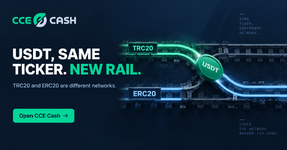
USDT TRC20 vs ERC20: same token, different network - What I Would Check Before Sending If you're looking at USDT TRC20 to ERC20, I would not start with the marketing headline. I would start with the exact network, the receiving address, the rate option and the order record. Those are the things that decide whether a simple exchange stays simple. Pair names look simple, but the network, receiving address and rate mode still decide whether the swap goes smoothly. What the CCE Cash flow says First: CCE Cash lists USDT-TRC20 to USDT-ERC20 as an exchange route on its site. This is the starting point for the topic because it defines the documented behavior rather than a marketing assumption. Second: An address must match the network selected in the Receive field; a network mismatch can be rejected as invalid. In practice, this affects what the user should verify before funding the order. Another useful detail: The exchange page supports fixed and floating rate modes. It also changes how the order should be interpreted if the market or network moves while the transaction is in progress. Finally: Ordinary swap flow does not require account registration. Keeping that boundary visible helps avoid overclaiming what the service can control. That gives enough information to build a sensible pre-send routine without guessing how the backend works. My checklist 1. Check that the sending asset is USDT on TRON/TRC20. 2. Select USDT on Ethereum/ERC20 as the receiving asset/network. 3. Paste an ERC20-compatible receiving address and verify it again. 4. Choose fixed or floating rate, then create the order. 5. Send the exact order amount required by the selected rate mode and keep the order inquiry code. I would keep the order inquiry code until the payout is received and, where a transaction ID exists, keep that too. If something looks slow, I would check the blockchain before assuming the exchange is the problem. If the order page and the blockchain disagree after the deposit has the required confirmations, that is the point where support becomes useful. The common mistake A token ticker alone is not enough. Always verify the network and receiving address before broadcasting a transfer. Crypto pair names are compact, but they hide several decisions. The asset ticker tells you what you are sending or receiving; the network tells you where that asset actually moves. That distinction becomes especially important with stablecoins such as USDT, which can exist on more than one chain. A clean exchange flow therefore begins by treating the asset and the network as one combined choice rather than two separate details. This is especially important for people moving stablecoins or switching between chains because the ticker can look familiar even when the settlement network is different. The same principle also applies to fixed-rate orders: the number on the screen is not separate from the timing and amount conditions attached to it. Support and privacy A support case should be specific. Order code, public transaction ID, selected pair and visible status are useful. A seed phrase, private key or wallet password is not. Those credentials do not identify an exchange order; they only create a new security problem. The second decision is rate exposure. A fixed quote is useful when the exact output matters, but it comes with timing and amount conditions. A floating quote gives more flexibility around timing, while the final amount can move with the market. Neither option is automatically better. The useful question is what you need from the transaction and how quickly you can fund the order. Bottom line The best way to use an automated exchange is to make the human checks before the automation starts. Verify the pair, network and destination. Understand the rate mode. Keep the order record. Then let the network and exchange complete their parts. CCE Cash: https://cce.cash/exchange #CCECash #USDT #CrossChain #Crypto |
BTC
USD
75,470.9
Gold
USD
4,282.65
Time now:
Jun 1, 12:00 AM
USDT TRC20 vs ERC20: same token, different network - What I Would Check Before Sending
- Author irfanpak10
- Create date
- Blog entry read time 3 min read
Blog entry information
More entries in Cryptocurrencies
-
WMIX FAQ Explained: Free Trial or Standard Order? Keep the Same Verification HabitThe pricing path can change; the security routine should not. WMIX offers an exact 0.001 BTC...
-
Clipboard hygiene before a crypto transfer: verify after you paste - What I Would Check Before SendingClipboard hygiene before a crypto transfer: verify after you paste - What I Would Check Before...
-
BTC to USDT: Choose the Stablecoin Network Before the Swap | DEX.foDEX.fo user guide DEX.fo is built around a direct exchange flow rather than a conventional...
-
No registration means no account profile to create | MixTumNo registration means no account profile to create No registration means no account profile to...
-
Why the Minimum and Maximum Belong in Your Pre-Send Check | JustMixPeople searching for bitcoin mixer minimum maximum usually want one thing: a clear answer about...

More entries from irfanpak10
-
Why a Crypto Card Top-Up Is Not Instant Until the Blockchain Says It IsIf you searched for “crypto card top up confirmation time”, the useful answer is not a slogan...
-
How to Handle What Fully Automated 24/7 Really Means on WMIXHow to Handle What Fully Automated 24/7 Really Means on WMIX Automation is a service model, not...
-
A cross-platform swap workflow: desktop quote, mobile wallet, one order record: Step-by-Step GuideQuick answer A short explanation of the mechanics is more useful than a broad speed or...
-
No Cookies Does Not Mean Invisible on a Blockchain | DEX.foDEX.fo user guide DEX.fo is built around a direct exchange flow rather than a conventional...
-
MixTum says it does not use cookies itself | MixTumMixTum says it does not use cookies itself MixTum says it does not use cookies itself is part of...