BTC USD 60,991.9 Gold USD 4,328.60
Time now: Jun 1, 12:00 AM

Never Lose Again (Malaysia Version)

Status
Not open for further replies.
sbnrnya kau conpius jgk...TRO ni dia ajar bpe byk system>
 
Brokers Cheat to maximise profits

FOREX DEALERS VS CLIENTS

Default How the retail Forex works. Dealers vs. clients.
Here is the question I just got in my PM :
“Hello Igrok,
I would like to know one statistic result. How many traders lose money in Forex? Is it really 90% - 95% ?”

I guess someone else might be interested in the info as well. So, I’m posting it here now. This is my article written about the issue long time ago and also posted on my amazon blog:

“Have just found an old laptop with some actual statistics provided to me by a couple of some major international FX dealing companies back a few years ago. The data was extracted directly from their back office systems and is accompanied by a bunch of their own analysis and comments. I guess some of these numbers could be of interest to public.
But first, just a few words about how retail FX business works. Usually, when I was asking my students if they know how dealers make their money the answer was always the same: “On dealing spreads. The difference between bid and ask is what a dealer usually puts in his pocket.” Such naïve belief still persists among the general population of retail FX market traders.
In fact, this business works quite differently. Because cash currency market in its origin is an interbank market it operates in large contracts. Much larger than the contracts traded by an average retail customer. Because of that, the companies providing services to retail clients have no other choice but to bucket small positions of their customers inside the house. Some of such client’s positions are becoming offset by one another but obviously not all of them. When the general sentiment about market’s direction is particularly strong among small-size traders then the total number of open longs and shorts becomes largely disproportional and shifted one way or another. When the “bucket” becomes “too big to carry” the dealer passes it into the market covering house’s exposure. However, because only a couple of percent of traders are actually making money in the Forex market over a longer time, such statistics provides dealer with pretty good opportunity to make a lot of money just keeping their clients’ positions inside the house for as long as possible. In this case a dealing company business is little different than a business of Las Vegas style casino where every customer is betting against the house. In our case it is virtually the same and client’s losses become dealer’s profits and vise versa.
Some of the dealers, especially those with deeper pockets and consolidated management routinely carry very large exposures on daily by betting against their customers. Some of them routinely carry inside the house an exposure in excess of hundreds of mio. USD.
In order to prevent some unnecessary risks and to get some protection from possible bankruptcy if the things go ugly for a dealer, every dealing company has some guidelines and internal policy with the idea of limiting their risks.
Here is what they usually do:

1. Limit their exposure to a certain size. After reaching the preset limit, the position gets covered in the market or hedged. Customers with large capitals and big trades are also treated differently than the rest of the clientele.
2. They also make customers’ profiling. They filter out those clients that could potentially beat the odds and trade profitably. So, they don’t bucket such customers and usually immediately pass their contract to a larger counterpart like the clearinghouse or another bank. Sometimes even to another dealer. The rest of the customers with lack of brains or a lack of experience and relatively small trading capital get bucketed inside the house.

I remember myself trading through a major Europe based dealer, which began to cover all of our positions only after paying us a few mio USD of trading profits out of his own pocket in a couple of month trading period. Then they even established a dedicated telephone line for our two-way communications and greatly improved their services since.
So, here is some approximate statistics for “A Dealer vs. a Trader casino style game” from the dealer’s point of view, which I believe should be true for the industry in general. (Over 24-month period)


Winning months – 15. Losing months – 9.

1. Total annual profit – 63% (of the total amount of all the customers’ funds in trade).
2. Average monthly profit – 5%.
3. Max monthly gain – 37%.
4. Max monthly loss – 10%
5. Total customers’ loss (USD) – 41 mio. Average customer monthly loss – 1,8 mio.
6. Roughly 40-50% of customers’ losses can be attributed to spreads and slippages.
7. Average “life expectancy” for an active individual trader without him adding more funds into the account ~ 2 months.

There could also be some dirty tricks that some of the dealers practice for increasing their profits and minimizing the risks. Some of the most common are:

1. Skewing quotes away from the real market price. Usually shifting them in the direction of the immediate trend. (Doesn’t happen with the most reputable dealers nowadays)
2. Executing stops before the market has reached them or outside actual trading range. (Pretty common for small “bucket-shops”).
3. Suddenly increase dealing spreads to hit the stops or do not execute limits even if the market has traded there. (Happens sometimes even with reputable dealers. Limits execution problem is my most frequent problem that I have to deal with on a regular basis).
4. Executing stops with unreasonably large slippages. (To me happens mostly only if trading large contracts. Even with banks).
5. Canceling executed trades. (Have never seen it personally but have seen lots of reports from others).
6. Re-quoting market orders in a slow market for a worse price. (Extremely common practice on all levels).
7. Constantly re-quoting every order in the fast market without offering an alternative price and thus not allowing making a trade at all. (Only those dealers whose trading platform is intentionally programmed to perform such a trick).
8. Disconnecting internet-based trading platform at the moments of increased market volatility or just freezing it for a while. (Usually, right before or during a major economic news release) (Normal practice for smaller “ bucket-shops” but now also becomes relatively popular among larger guys too).

Sometimes “honest mistakes” also take place, but since the dealers usually (if everJ) not very eager to admit them, it might also cause some major headache. The most common “honest mistake” (especially if trading on the phone) that I have seen over the years of my professional trading career would be a wrong quotation that is traditionally equal to one big figure. Normally, a very fast market is the one to blame. I saw it several times to happen but only once got actually caught into it. That time it initially cost my client a few hundred grand of unrealized profit in just a matter of seconds. Fortunately, the dispute was settled to everyone’s satisfaction after a couple of weeks of fierce arguments."

I endorse all of the above said, because I have personally experienced similar encounters with a broker in Singapore.
I'm meeting them soon to recover my losses suffered through their scams. I have recorded evidences in hand. If they refused to compensate me, I'm ready to report them to FIDREC and MAS, and will put up my detail findings in every FX forum I can get hold of.

I advise every trader to be extra careful. Those who have already suffered much losses can get in touch with me, to explore the possibility in taking up joint class actions against unscrupulous brokers, even if you're trading with a different broker from mine.

wealth007 @ gmail dot com
 
I endorse all of the above said, because I have personally experienced similar encounters with a broker in Singapore.
I'm meeting them soon to recover my losses suffered through their scams. I have recorded evidences in hand. If they refused to compensate me, I'm ready to report them to FIDREC and MAS, and will put up my detail findings in every FX forum I can get hold of.

I advise every trader to be extra careful. Those who have already suffered much losses can get in touch with me, to explore the possibility in taking up joint class actions against unscrupulous brokers, even if you're trading with a different broker from mine.

wealth007 @ gmail dot com

si ditni confirm mangsa...

Have you bought Lehman Mini Bonds and DBS High Notes?
Today’s Sunday Times ran a feature on the credit crisis, summarizing the events that had unfolded over the year, particularly the market crash and spectacular recovery this week.

I was particularly interested on a small column that reported the loss by many investors who were market DBS High Notes as an alternative fixed deposit (FD) by personal bankers and relationship managers.

Many, enticed by the high coupon payout structure of the investment have invested between $50,000 to $125,000.

It was the same case for Lehman Mini Bonds, marketed by foreign banks.

These structured deposits are likely to pay nothing to investors even if they were to be held till maturity.

Many blamed the bankers for marketing such “high risk” products to low risk threshold investors when many wanted just plain vanilla FDs in the first place!

Yesterday, I met up with a few bankers and enquired the status of the structured deposits. I confidently told them that Lehman mini bonds investors should get back some money as bondholders have priority claim on assets as compared to ordinary and preference shareholders when a company goes belly up.

Below are their replies:

Banker A: Huh, is it? Bondsholders have higher priority to claim debts?

Me: Yup, if not a bond is not a bond when it carries a higher risk exposure to ordinary shareholders and receiving lesser dividend (coupon) payout.

Banker A: Oh I see.

Banker B: Actually I do not think those who invested in mini bonds will get anything back afterall.

Me: How come? Lehman has sold its assets and surely it can receive something back to pay back bondholders right?

Banker B: Mini bonds are not bonds lah. It is just a marketing name for the structured product. We can call it super bonds, high yield saver, or golden bonds. But the underlying product is very complex one. I also don’t know what it is. We just market it when conservative people who want to put FDs walk in and don’t want to invest in unit trusts or equity link notes.

Me: What?! You mean the banks sell bonds that are not bonds and fooling people it is as safe as bonds?

Banker C: Their bank not that bad, sell until mini bond series 2 only. Mine sell till series 8!

Me: So are your sales affected?

Banker A, B, C: Actually it is business as usual. We just concentrate on insurance now. Long term investment mah. But we do not sell UTs or structured products anymore. Currencies market are more welcome by investors also. We have got many products to market.

From the above conversation, I feel that the local bankers have really poor knowledge of simple finance. They do not even know the difference between bonds and shares to begin with. How do you expect them to sell complex products in the first place? And mind you, these banker friends have been in the industry for 2-3 years!

If I am not wrong, DBS High Notes and mini bonds have invested in different underlying assets through options. Derivatives are highly volatile investment instruments and always leveraged to create higher returns (and risk).

Such sophisticated instruments are definitely not suitable for a retiree or a housewife who might not even know how to open a securities account. Derivatives are zero sum games, where one gain’s is due to another’s loss.

Sometimes, these structured deposits are marketed with shopping vouchers and labeled as capital protection products.

However, capital protection does not share the same status as capital guaranteed products. Only the latter has an insurance bought by the bank from a third party to insure the investors’ invested amount.

Should the bankers be blamed?

In a way the bankers are doing their jobs to market aggressively the banks’ products, bringing revenue for their company. Regardless whether they are paid a handsome commission, they are obligated to market the products by the bank. If they are not paid a single cent of commission, but just a salaried worker, should they still be blamed?

There are accusations that the bankers are not doing their jobs and are guilty of mis-selling.

Actually, I feel the banks are the one that should be fully responsible. They should have a system to educate the bankers. Sales should not be commission based as it would lead to unethical selling. Bankers have heavy responsibility. Pay them well so that they can have a high level of integrity. There should be other KPIs to assess them instead of sales figures. They should really be well versed in finance and not just salesmen trying to exceed sales quota.

However, the investors should also share the blame, in my opinion. How can they invest in something that they do not understand?

A coupon rate of 5% is rather high and there should be a fair amount of risk that comes along.

Investors should seek to understand the kind of risks involved before buying any investment products. There are always risks involved. Even FDs have risk. If the banks in Singapore collapse, only the first $20,000 is insured. You can lose the rest.

We can summarise several lessons for the low risk investor:

Do not believe what the banker says at face value. Question him thoroughly. Ask him questions like: What is the risk involved? If he says there is no risk, only gain, leave. All financial products and investment comes with risk.

Ask the banker to explain how the products work exactly. Ask him if there are derivatives or options involved in the product. If there is, leave. Derivatives are only for sophisticated investors.

Do not be enticed by high coupon payout products. The higher the payout, the higher the risk involved. The high coupon payout is commonly known as the risk premium. As the term suggest, you will have to take a lot of risk to earn higher (risk) premium (interest).

Do not buy a structured product because it is the bank’s flavour/theme of the month.

Do not buy a product because there are free gifts. You are actually the one paying for the free gifts from the sales charge.

Do not buy anything you do not understand! Will you buy a washing machine that is so complex that neither you nor the salesman knows how to operate?

Financial literacy is everyone’s responsibility. Pointing fingers at people when things turn sour will not change things. After a few years, you will still make the same mistake. Take charge of your own finances and be accountable for your own investments. If there is anyone to blame, we can only blame ourselves to be too gullible!


:eek: :eek: :eek:
 
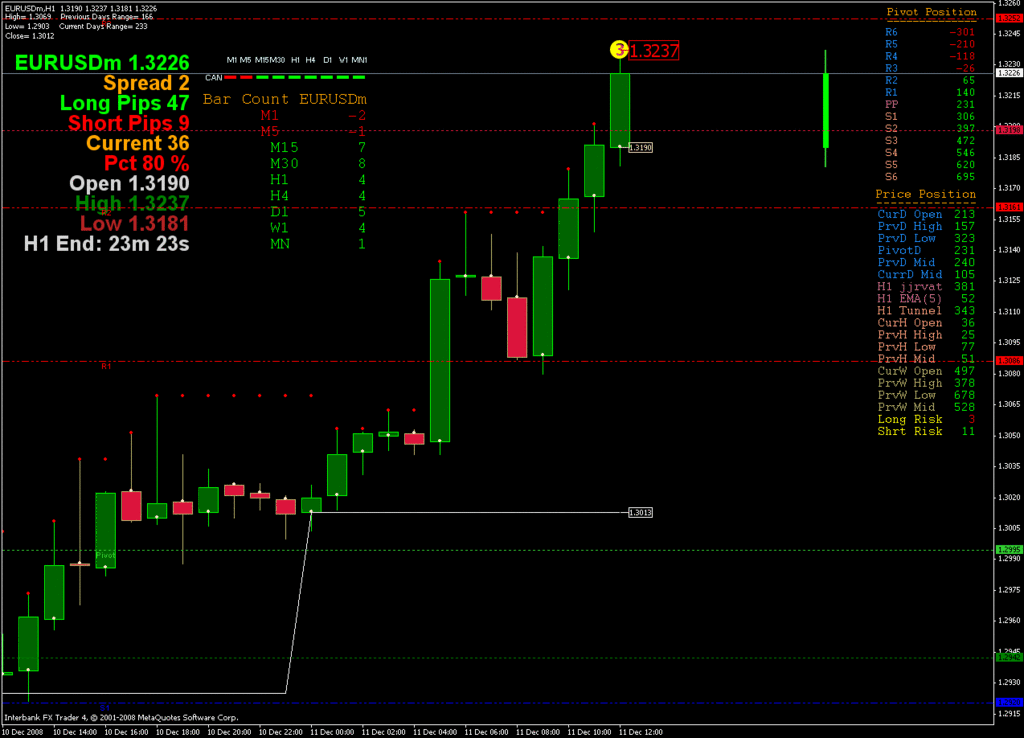
Eur Usd tunngu masa nak retrace. Mungkin up sampai 1.3290.

eurusd.gif

indi ni untuk EURDSD je ke?
 
FOREX DEALERS VS CLIENTS

Default How the retail Forex works. Dealers vs. clients.
Here is the question I just got in my PM :
“Hello Igrok,
I would like to know one statistic result. How many traders lose money in Forex? Is it really 90% - 95% ?”

I guess someone else might be interested in the info as well. So, I’m posting it here now. This is my article written about the issue long time ago and also posted on my amazon blog:

“Have just found an old laptop with some actual statistics provided to me by a couple of some major international FX dealing companies back a few years ago. The data was extracted directly from their back office systems and is accompanied by a bunch of their own analysis and comments. I guess some of these numbers could be of interest to public.
But first, just a few words about how retail FX business works. Usually, when I was asking my students if they know how dealers make their money the answer was always the same: “On dealing spreads. The difference between bid and ask is what a dealer usually puts in his pocket.” Such naïve belief still persists among the general population of retail FX market traders.
In fact, this business works quite differently. Because cash currency market in its origin is an interbank market it operates in large contracts. Much larger than the contracts traded by an average retail customer. Because of that, the companies providing services to retail clients have no other choice but to bucket small positions of their customers inside the house. Some of such client’s positions are becoming offset by one another but obviously not all of them. When the general sentiment about market’s direction is particularly strong among small-size traders then the total number of open longs and shorts becomes largely disproportional and shifted one way or another. When the “bucket” becomes “too big to carry” the dealer passes it into the market covering house’s exposure. However, because only a couple of percent of traders are actually making money in the Forex market over a longer time, such statistics provides dealer with pretty good opportunity to make a lot of money just keeping their clients’ positions inside the house for as long as possible. In this case a dealing company business is little different than a business of Las Vegas style casino where every customer is betting against the house. In our case it is virtually the same and client’s losses become dealer’s profits and vise versa.
Some of the dealers, especially those with deeper pockets and consolidated management routinely carry very large exposures on daily by betting against their customers. Some of them routinely carry inside the house an exposure in excess of hundreds of mio. USD.
In order to prevent some unnecessary risks and to get some protection from possible bankruptcy if the things go ugly for a dealer, every dealing company has some guidelines and internal policy with the idea of limiting their risks.
Here is what they usually do:

1. Limit their exposure to a certain size. After reaching the preset limit, the position gets covered in the market or hedged. Customers with large capitals and big trades are also treated differently than the rest of the clientele.
2. They also make customers’ profiling. They filter out those clients that could potentially beat the odds and trade profitably. So, they don’t bucket such customers and usually immediately pass their contract to a larger counterpart like the clearinghouse or another bank. Sometimes even to another dealer. The rest of the customers with lack of brains or a lack of experience and relatively small trading capital get bucketed inside the house.

I remember myself trading through a major Europe based dealer, which began to cover all of our positions only after paying us a few mio USD of trading profits out of his own pocket in a couple of month trading period. Then they even established a dedicated telephone line for our two-way communications and greatly improved their services since.
So, here is some approximate statistics for “A Dealer vs. a Trader casino style game” from the dealer’s point of view, which I believe should be true for the industry in general. (Over 24-month period)


Winning months – 15. Losing months – 9.

1. Total annual profit – 63% (of the total amount of all the customers’ funds in trade).
2. Average monthly profit – 5%.
3. Max monthly gain – 37%.
4. Max monthly loss – 10%
5. Total customers’ loss (USD) – 41 mio. Average customer monthly loss – 1,8 mio.
6. Roughly 40-50% of customers’ losses can be attributed to spreads and slippages.
7. Average “life expectancy” for an active individual trader without him adding more funds into the account ~ 2 months.

There could also be some dirty tricks that some of the dealers practice for increasing their profits and minimizing the risks. Some of the most common are:

1. Skewing quotes away from the real market price. Usually shifting them in the direction of the immediate trend. (Doesn’t happen with the most reputable dealers nowadays)
2. Executing stops before the market has reached them or outside actual trading range. (Pretty common for small “bucket-shops”).
3. Suddenly increase dealing spreads to hit the stops or do not execute limits even if the market has traded there. (Happens sometimes even with reputable dealers. Limits execution problem is my most frequent problem that I have to deal with on a regular basis).
4. Executing stops with unreasonably large slippages. (To me happens mostly only if trading large contracts. Even with banks).
5. Canceling executed trades. (Have never seen it personally but have seen lots of reports from others).
6. Re-quoting market orders in a slow market for a worse price. (Extremely common practice on all levels).
7. Constantly re-quoting every order in the fast market without offering an alternative price and thus not allowing making a trade at all. (Only those dealers whose trading platform is intentionally programmed to perform such a trick).
8. Disconnecting internet-based trading platform at the moments of increased market volatility or just freezing it for a while. (Usually, right before or during a major economic news release) (Normal practice for smaller “ bucket-shops” but now also becomes relatively popular among larger guys too).


This broker, called City Index Asia Pte Ltd., has been misrepresenting themselves. I hope that fellow traders here do not get conned.

Since I refused to accept their initial compensation offer of a few thousand dollars for exiting my open positions, their CEO, Dave, has called-off our meeting scheduled tomorrow. Thus, I've decided to open up their can of worms now.

An official complaint has also been lodged to FIDREC and the MAS yesterday.

City Index misrepresented that their retail FX prices are fair and transparent, and that they charged only a fixed deal spread. They also misrepresented that they have expert staff to offer professional services, but chose not to answer my question which is vital and relevant in influencing my trading decisions.
Their managers are also unaware of certain very important available functions in their own trading platform, which are relevant and useful to clients' trading decisions - example trading volume. They chose not to tell me what the units in the volume column stands for ( 1 for one mini or standard or? ) despite repeated reminders for an answer since almost 2 months ago.

However, my findings show that they are reaping their clients off via the following unscrupulous methods:

1. Repeated and frequent slippages that can add up their clients' trading costs by as high as an additional 100 pips more per lot per trade!

2. Even when no slippages occurred, the actual price captured in a client's statement is often a few pips more than what appeared on the screen when a trade is executed.

3. Their dealers entered my open positions and exited them without my instructions. Initially they denied doing so, but eventually offered to compensate me with a few thousand dollars as settlement, which I did not accept due to reasons which I'll explain during FIDREC/MAS investigation.

4. They have dealers to trade against me.

5. They fixed off-market prices by as high as 152 pips, when at that identical time a check with two other brokers' platforms showed no price gaps at all.

6. They manipulated prices to STOP out trades that have STOP LOSS level set, even as far away as over 100 pips!

7. They manipulated indicators that traders usually relied upon, to trick them into entering trades in the wrong direction.

I have documented details of my complaint in the report in PDF format, downloadable directly from :

http://www.pchenxu.addr.com/ci/Findings_CityIndex.pdf

If they are allowed to get off scot-free by their scams, traders in general will suffer, and will eventually become a huge social problem for the nation.

I urge the relevant authority in your nation to inititiate prompt investigations against them.

Sincerely, Dr. Pierre
Mobile: +65-90018710
 
Last edited:
City Index

Dear forum users,

City Index welcomes comments and feedback on our platform, service, product offerings and customers’ trading experience. However, as a matter of practice, we do not respond directly to specific issues raised in forums. This is to protect client details.

We do ask our clients and other interested parties to contact us directly for clarification and issues resolution. We can be reached on 1800-826 9953 (toll free from Singapore), +65 6826 9953 (outside of Singapore) or via email at [email protected]

In addition, we strongly advise all our clients and indeed clients of other brokers not to share personal financial information with members of the public. If you have questions regarding your statements or contract notes, we suggest you raise these directly with your broker or your financial advisor, who would be more suited to dealing with these matters.

Best regards,
City Index Asia
 
tt dh lama x update

Tak pakai lagi dah. Susah nak kuasai trade horizontal lines ni. Kalau ikut idea asal dia, memang tak pakai indi. Just CS dan horizontal line.
Thread yg lebih kurang sama konsep dgn ni, thread magic numbers by bro Azraneus. Boleh refer kat situ.
Dah ada teknik ciptaan sendiri. lebih selesa, dan serasi..:D:D
 
Tak pakai lagi dah. Susah nak kuasai trade horizontal lines ni. Kalau ikut idea asal dia, memang tak pakai indi. Just CS dan horizontal line.
Thread yg lebih kurang sama konsep dgn ni, thread magic numbers by bro Azraneus. Boleh refer kat situ.
Dah ada teknik ciptaan sendiri. lebih selesa, dan serasi..:D:D

slm bro, apa nama indi yg ada nyatakan nama pair, harga semasa, spread, masa candle bertukar,long brp short brp, current, pct,open, high dan low:D
 
Last edited:
Status
Not open for further replies.

Live Forex Chart

Currency
Rates
EUR / USD
1.15246
USD / JPY
160.305
GBP / USD
1.33430
USD / CHF
0.79622
USD / CAD
1.39325
EUR / JPY
184.744
AUD / USD
0.70520
Back
Top
Log in Register