BTC
USD
83,207.5
Gold
USD
4,181.73
Time now:
Jun 1, 12:00 AM
blockchain privacy
-
DeFi [ANN] WMIX.to Private Bitcoin Mixer | Free 0.001 BTC Mix, PGP Guarantee & Tor Access
WMIX.to: Private Bitcoin Mixer WMIX is a fully automated Bitcoin mixing service developed for users who value transaction privacy, clear service terms, and verifiable deposit information. Every order includes a PGP-signed letter of guarantee, allowing the user to confirm that the generated...- irfanpak10
- Thread
- bitcoin mixer bitcoin privacy blockchain privacy btc mixer cryptocurrency pgp tor wmix
- Replies: 60
- Forum: CryptoCurrencies
-
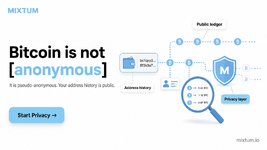
Bitcoin Privacy: Why BTC Is Not Anonymous
Bitcoin Is Not Anonymous, and That Changes Everything A lot of people still repeat the same sentence: “Bitcoin is anonymous.” It sounds good, but it is not true. Bitcoin is pseudo-anonymous. Your name is not directly written beside your address, but the activity behind that address is public...- irfanpak10
- Blog entry
- 2 min read
- bitcoin mixer bitcoin privacy blockchain privacy btc privacy clean coins crypto privacy no logs mixer pgp guarantee
- Category: Cryptocurrencies
-

The Most Damaging Privacy Event: Your Exchange Withdrawal
For most people, Bitcoin enters their life through a KYC exchange. That first withdrawal — from a verified exchange account to a personal wallet — feels routine. It is also one of the single most damaging privacy events in a Bitcoin user's history, because it permanently ties a real...- irfanpak10
- Blog entry
- 2 min read
- anonymous bitcoin bitcoin mixer blockchain privacy btc tumbler exchange withdrawal privacy identity anchor kyc withdrawal withdrawal tracking
- Category: Cryptocurrencies
-

Half the Year's Gone — Reset Your Bitcoin Privacy Now
Half the year is gone. If you've been meaning to take Bitcoin privacy seriously and kept pushing it down the list, the midpoint of 2026 is a natural reset point. Every month you wait, more of your transaction history accumulates on a permanent public ledger — so the best time to break the chain...- irfanpak10
- Blog entry
- 2 min read
- anonymous bitcoin bitcoin mixer bitcoin privacy checklist blockchain privacy clean coins h2 2026 mid year privacy reset privacy habit
- Category: Cryptocurrencies
-

Nothing to Leak: Privacy That Doesn't Depend on Promises
Many services promise privacy and then quietly undermine it by collecting the very data that could compromise you. The strongest privacy guarantee is not a promise to protect your information — it is never holding that information in the first place. MixTum is built so that there is structurally...- irfanpak10
- Blog entry
- 2 min read
- anonymous bitcoin bitcoin mixer blockchain privacy no identity mixer no kyc bitcoin no logs privacy by architecture privacy by design
- Category: Cryptocurrencies
-

Obscure or Replace? The Real Mixer Debate
Privacy-minded Bitcoiners often debate decentralized, trustless mixing tools versus managed services. Decentralized coordination has a clear philosophical appeal — no operator to trust. But in practice, decentralized mixers come with usability, liquidity, and anonymity-set trade-offs that...- irfanpak10
- Blog entry
- 2 min read
- anonymity set bitcoin mixer blockchain privacy coin replacement coinjoin comparison decentralized mixer mixtum comparison trustless mixing
- Category: Cryptocurrencies
-

Your Public Tip Address Is Showing Everyone Your Income
Independent creators — writers, streamers, artists, adult-industry performers, and niche educators — increasingly accept Bitcoin because it works across borders and avoids platform deplatforming. But accepting crypto publicly creates a quiet problem: a tip address shared with an audience of...- irfanpak10
- Blog entry
- 2 min read
- anonymous creator income bitcoin mixer blockchain privacy content creator crypto creator bitcoin privacy freelance payments tip address privacy
- Category: Cryptocurrencies
-

One KYC Touch Can Unmask Hundreds of Your Addresses
When people picture blockchain tracing, they imagine following a single coin from address to address. The real power of modern chain analysis is subtler and far more sweeping: cluster analysis groups dozens or hundreds of addresses into a single identity using statistical heuristics — and most...- irfanpak10
- Blog entry
- 2 min read
- address clustering anonymous bitcoin bitcoin deanonymization bitcoin mixer blockchain privacy chain analysis cluster analysis common input heuristic
- Category: Cryptocurrencies
-

Stop Believing the 'New Wallet = Private' Myth
A common belief among careful Bitcoin users is that moving funds to a brand-new, self-custodied wallet makes them private. It feels intuitive: new wallet, fresh start, clean slate. Unfortunately, a fresh address inherits the full history of whatever coins are sent into it, and 'private wallet'...- irfanpak10
- Blog entry
- 2 min read
- address reuse anonymous bitcoin bitcoin mixer blockchain privacy fresh bitcoin address new wallet privacy private wallet myth self custody
- Category: Cryptocurrencies
-

'No Logs' Is Easy to Claim — Here's What MixTum Actually Deletes
Many services claim to be privacy-friendly while quietly retaining data 'for security' or 'for compliance.' For a Bitcoin mixer, retained data is a liability waiting to happen — it can be subpoenaed, leaked, or sold. MixTum's no-log policy is specific and worth understanding precisely. What 'No...- irfanpak10
- Blog entry
- 2 min read
- anonymous bitcoin bitcoin mixer bitcoin privacy policy blockchain privacy btc tumbler data deletion data retention no logs mixer
- Category: Cryptocurrencies
-

Should You Use MixTum Over TOR or Clearnet? Depends.
MixTum can be accessed two ways: the standard clearnet site and a TOR hidden service. Both run the same mixing engine, but they offer different privacy properties at the network layer. Choosing the right one depends on your threat model. What the Clearnet Version Offers The clearnet site...- irfanpak10
- Blog entry
- 2 min read
- anonymous bitcoin bitcoin mixer blockchain privacy btc tumbler clearnet mixing network privacy onion mixer tor bitcoin mixer
- Category: Cryptocurrencies
-

Leaving Bitcoin to Family? Don't Broadcast It On-Chain
Passing Bitcoin to heirs is a growing concern as long-term holders age and estates include significant crypto. Most planning focuses on access — keys, seed phrases, instructions. Far less attention goes to privacy: the act of transferring coins to heirs can permanently expose both the estate's...- irfanpak10
- Blog entry
- 2 min read
- anonymous bitcoin bitcoin inheritance bitcoin legacy bitcoin mixer blockchain privacy btc tumbler crypto estate planning heir privacy
- Category: Cryptocurrencies
-

Why 'Instant' Mixing Is a Timing Trap
Among the techniques used to deanonymize Bitcoin transactions, timing analysis is one of the most underestimated. It does not require breaking any cryptography. It simply observes when funds move — and a surprising amount can be inferred from timing alone. How Timing Reveals Connections If a...- irfanpak10
- Blog entry
- 2 min read
- anonymous bitcoin bitcoin deanonymization bitcoin mixer blockchain privacy btc tumbler delay privacy timing analysis transaction timing
- Category: Cryptocurrencies
-
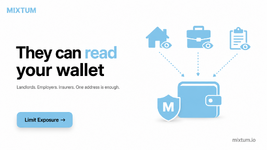
It's Not Just Governments — Your Landlord Can Read Your Wallet
bitcoin surveillance, who can see bitcoin, financial profiling, employer tracking, bitcoin mixer, blockchain privacy, anonymous bitcoin, crypto privacy Blockchain surveillance isn't just a government concern. Employers, landlords, and insurers can read your wallet too. Here's how MixTum limits...- irfanpak10
- Blog entry
- 2 min read
- anonymous bitcoin bitcoin mixer bitcoin surveillance blockchain privacy crypto privacy employer tracking financial profiling who can see bitcoin
- Category: Cryptocurrencies
-

Bitcoin for Nomads: Privacy Is a Safety Feature Abroad
Bitcoin is a natural fit for travelers and digital nomads: it crosses borders without banks, currency conversion drama, or frozen cards. But the same border-crossings that make crypto useful also raise the privacy stakes. A wallet that can be inspected at a checkpoint, or correlated with travel...- irfanpak10
- Blog entry
- 2 min read
- anonymous bitcoin bitcoin mixer bitcoin travel privacy blockchain privacy cross border bitcoin digital nomad nomad crypto travel safety
- Category: Cryptocurrencies
-

Just Use Monero' Misses One Big Thing
Every time Bitcoin privacy comes up, someone drops the "just use Monero" line. I love Monero too — but this answer skips a real problem. Monero is private inside its own network. The issue is the edges. Most of the crypto economy still runs on Bitcoin — exchanges, merchants, services. So the...- irfanpak10
- Blog entry
- 1 min read
- anonymous bitcoin bitcoin mixer bitcoin privacy blockchain privacy crypto privacy monero privacy coin xmr vs btc
- Category: Cryptocurrencies
-

Instant mixing is a red flag: why speed compromises your anonymity
When a Bitcoin mixer processes output immediately after receiving a deposit, the timing creates a correlation: blockchain analysis tools can scan for outputs that appear shortly after a known input and link them with high confidence. The faster the mixing, the stronger the timing signal. Been...- irfanpak10
- Blog entry
- 1 min read
- anonymous bitcoin bitcoin bitcoin mixer bitcoin tumbler blockchain privacy crypto privacy instant mixer risk
- Category: Cryptocurrencies
-

DeFi users: break the bridge between your exchange account and on-chain activity
For DeFi users who also use centralized exchanges, every on-chain transfer from CEX to DeFi creates a permanent link between their KYC'd identity and their decentralized financial activity. This link is public, permanent, and searchable. Been using MixTum (mixtum.io) for this type of scenario...- irfanpak10
- Blog entry
- 1 min read
- anonymous bitcoin bitcoin bitcoin mixer bitcoin tumbler blockchain privacy crypto privacy defi privacy
- Category: Cryptocurrencies
-

24/7 automated operation: why removing the human element increases trust — Forum Discussion
Privacy services that depend on human operators introduce a class of risk that automation can eliminate: an operator can be subpoenaed, bribed, or make a mistake. MixTum's mixing process is fully automated — individual orders are processed by the system without human intervention. Been using...- irfanpak10
- Blog entry
- 1 min read
- anonymous bitcoin automated bitcoin bitcoin mixer bitcoin tumbler blockchain privacy crypto privacy mixer
- Category: Cryptocurrencies
-

Bitcoin ATM users: your withdrawal location is written on the blockchain
Bitcoin ATM withdrawals create a specific privacy vulnerability: the ATM's physical location and the transaction timestamp are permanently linked on-chain to the withdrawal address. For regular ATM users, this creates a pattern that can be used to map their movements and financial behavior. Been...- irfanpak10
- Blog entry
- 1 min read
- anonymous bitcoin atm bitcoin bitcoin mixer bitcoin tumbler blockchain privacy crypto privacy privacy
- Category: Cryptocurrencies
