
hartono
Legendary Member

- Messages
- 17,047
- Joined
- Jun 26, 2012
- Messages
- 17,047
- Reaction score
- 2
- Points
- 125
Surabaya chosen as pilot for river plastic reduction program
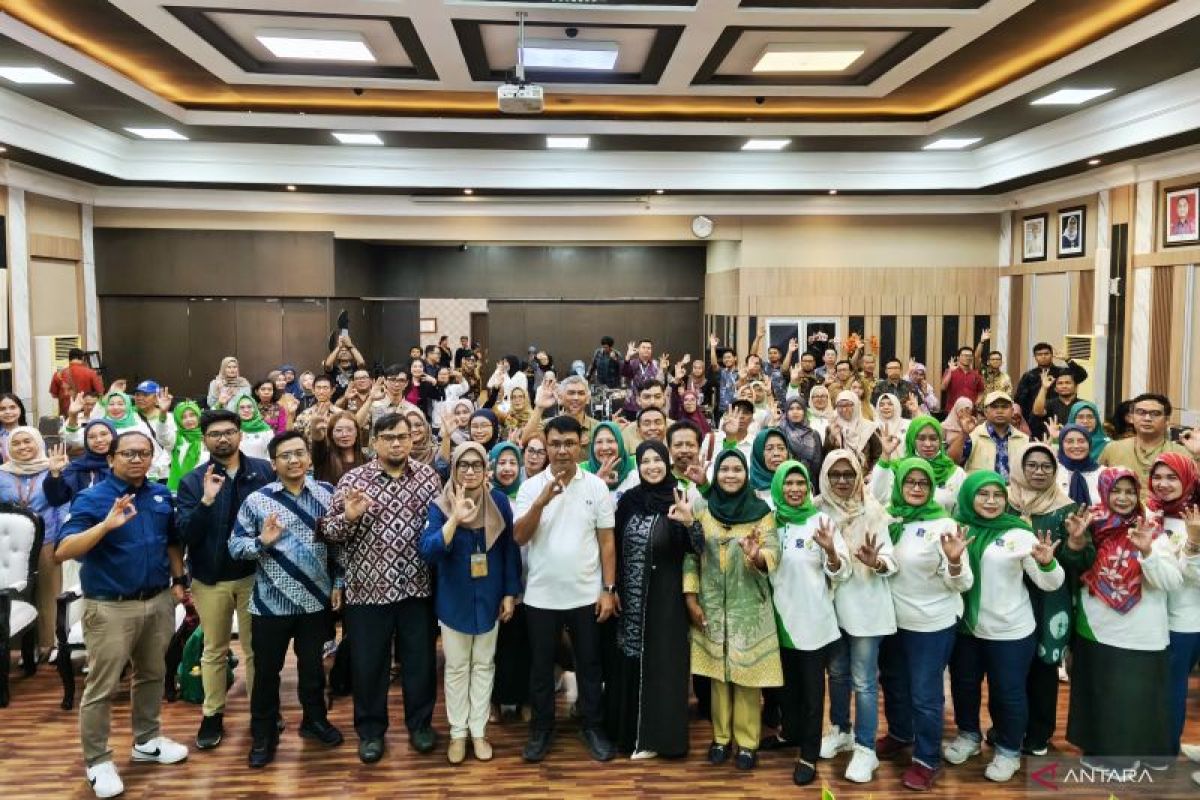
Assistant Deputy Staff for Circular Economy and Environmental Impact at the Coordinating Ministry for Food Affairs Ahmad Didin (third left) pose for a group photo after the launch of a river plastic pollution prevention partnership program in Surabaya, East Java, on Friday (June 5, 2026). /ANTARA/Naufal Ammar Imaduddin
Surabaya, East Java (ANTARA) - The Coordinating Ministry for Food Affairs has launched a river plastic pollution prevention partnership program aimed at reducing waste flowing from rivers into the sea, with Surabaya, East Java, selected as the first implementation site.
Assistant Deputy for Circular Economy and Environmental Impact at the ministry Ahmad Didin said Surabaya was chosen as the pilot location because it already has various community-based waste management initiatives.
"It is hoped that Surabaya will become a model city among the five target locations, allowing other regions to replicate successful waste management schemes," Didin said at the program's launch on Friday.
He explained that the program, which is also supported by the government of the United Arab Emirates (UAE), will initially focus on the Tebu and Mrutu rivers in Surabaya before expanding to Sidoarjo, Solo, Bekasi, and Bali.
The initiative includes river cleanups, waste filtration activities, waste-flow mapping, strengthening community-based waste management systems, and educating residents on waste sorting at the source.
Implementation of the program has been entrusted to the United Nations Development Programme (UNDP) Indonesia, which will support both central and regional governments in carrying out activities in the targeted areas.
"In addition to cleaning waste from rivers, the program seeks to reduce waste generation through behavioral changes so that waste does not end up in drainage systems and rivers," he said.
Meanwhile, Head of the Community Behavioral Change Working Group at the Ministry of Environment, Sri Murwani Nurfadhila Astuti, said the program's success depends on public participation in reducing and sorting waste at the source.
"We encourage people to reduce and sort waste at its source to create economic value while preserving river ecosystems," she said.
Surabaya chosen as pilot for river plastic reduction program
The Coordinating Ministry for Food Affairs has launched a river plastic pollution prevention partnership program aimed at reducing waste flowing from rivers ...
 en.antaranews.com

