BTC USD 84,140.3 Gold USD 4,285.46
Time now: Jun 1, 12:00 AM

Sejarah 'Orang Hanyut' di Pulau Bidong, Terengganu

NEMO

CG Super Hardcore Club
gemgemgem
Messages
109,177
Paid Membership
Joined
Jan 13, 2007
Messages
109,177
Reaction score
1,046
Points
1,101

pulau-bidong_text_header1.jpg


img_bidong_map.gif


http://www.youtube.com/watch?v=aMzN4Luhb_I
​

Orang Hanyut merupakan orang yang menjadi pelarian (orang vietnam) semasa negara mereka mengalami pergolakan dan
krisis komunis.

Peristiwa ini dikatakan berlaku sekitar tahun 1950-an dan berlarutan selepas beberapa tahun berikutnya.

Terdapat juga catatan yang menyatakan bahawa peristiwa hitam ini bermula pada tahun 1975. Pelarian vietnam mula mendarat di Pulau Perhentian,Terengganu apabila sekumpulan pelarian yang berjaya tiba dari vietnam. Pulau Bidong juga menjadi sebuah tempat pelarian vietnam pada masa itu

Ia kemudiannya diikuti oleh beberapa siri pendaratan lain sehingga meningkat kepada 1,400 pelarian pada 1977. Pada Ogos 1978, melalui pewartaan PU(A) 227, kerajaan negeri Terengganu bersetuju mengistiharkan pulai Bidung sebagai pusat penempatan pelarian Vietnam.

Orang Hanyut ini juga dikatakan mula mendarat di Pantai Seri Tujoh,Tumpat pada tahun 1950-an. Ini diperkuatkan lagi dengan pembinaan tugu peringatan pelarian vietnam yang terdapat di sini


Pada masa itu,mereka melarikan diri melalui jalan darat dan jalan laut. Kebanyakannya mereka menaiki tongkang,dan bot nelayan kecil untuk sampai ke negara-nagara lain termasuk Malaysia. Jumlah pelarian paling tinggi pada sesuatu pelayaran adalah pendaratan kapal Hai Hong di Pelabuhan Klang pada November 1978 dengan sejumlah 2,400 pelarian di atasnya.


refugee-camp-700_tcm2-16281.jpg


1979057.jpg


f_16pbidong1.jpg


f_16pbidong.jpg

FAKTOR-FAKTOR YANG MEMPENGARUHI KEDATANGAN
ORANG HANYUT

-kejatuhan kerajaan demokratik vietnam
yang disokong oleh Amerika ke tangan
komunis vietnam utara pada tahun 1975.

-kehidupan rakyat menjadi kucar-kacir.

-disebabkan kehidupan tidak terurus,mereka
sanggup merantau ke negara lain untuk membina
hidup baru di sana.

-pergolakan yang besar berlaku di negara mereka menyebabkan ratusan nyawa terkorban.

-mereka yang terselamat telah meninggalkan negara sendiri untuk menyelamatkan nyawa


KESAN KEPADA NEGARA

Pulau Bidung telah diisytiharkan sebagai ‘pulau larangan.’

Negara kita menerima lebih banyak pendatang tanpa izin setiap tahun nelayan tidak dibenarkan menggunakan perairan Pulau Bidung untuk menjalankan kegiatan mereka.


Di antara 1978-1990 jumlah pendaratan pelarian Vietnam ke Malaysia adalah 252,390 dan seramai 4,535 bayi
direkodkan kelahirannya.

Pulau Bidong dikosongkan sepenuhnya pada 1991.


bidong_1.jpg

bidong_2.jpg

bidong_3.jpg

bidong_4.jpg

4652061411_ea06e654bd.jpg

bidong19+(2).jpg

n_pg16bidong1.jpg

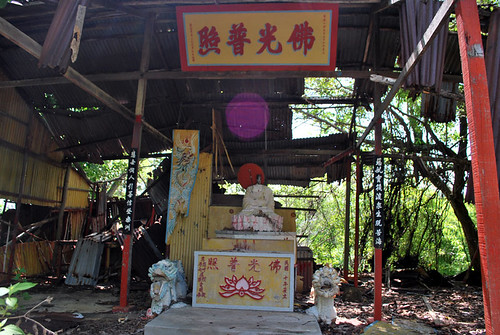
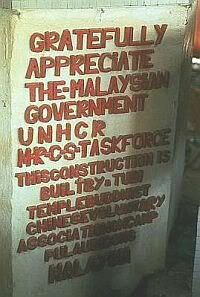
tinggalan pelarian Vietnam di Pulau Bidong​


Luahan Hati Orang Hanyut


Hi!

I was very glad to have come across your post. I was a former refugee that lived on Pulau Bidong in 1983.

I had almost forgotten my heritage and everything that my family gave up for me and my brother to be here today living and enjoying our lives in America.

I was only a 7-year old when my Mom, me, my brother, and my grandpa left Vietnam in a small wooden boat with a least 50 other people onboard in 1983. We encountered communist pirates (it would have been worse if they were Thais) along the way (and they took almost all of our possessions), we drifted for 5 days and nights until we came across an oil rig (but I'm not sure if they were American or European). They resupplied us with fresh water, rice, and apples. After another day, we made it to Pulau Bidong where we stayed for 6 months until we were transferred to a refugee camp on the mainland (Sungei Besi) where we stayed for another 6 months. Afterward, we were able to make it to American in late 1983.

This was something that I had kept quiet about my life as I tried to integrate myself into American society and culture. I tried so hard that I had almost forgotten about the entire Vietnamese experience.

Recently I returned to Vietnam and realized how beautiful the land, people, and culture are. I hated myself for forgetting about my ancestry and the struggles of the Vietnamese people. At this point in life, I want to go full circle and return to my origins. I think the process will bring me closer to my center to give me greater pride abd feelings of gratefulness in the Vietnamese experience.

I have heard that there are group trips to Malaysia to visit the island. If you know anyone organizing a trip then please let me know. I want to go back and visit!

We Vietnamese are very gratefully to the Malaysian Government/people for allowing us to temporarily stay at Pulau Bidong.

Thanks you!
Chris Nguyen
 
wah aku baru tau.. tak penah dengar..
 
pulaubidong.jpg

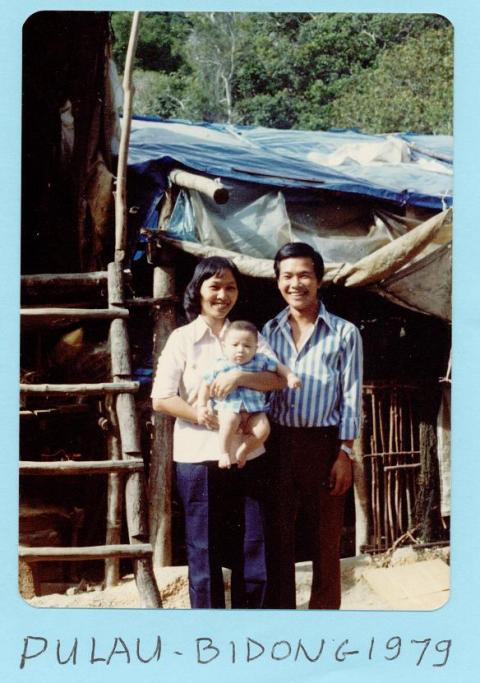
A picture of my parents and my brother. It was very expensive for them to take this picture ($2), but today, they are glad of having taken it!


Although I never set foot on Pulau Bidong, my parents have experienced hardships that they will always remember for the rest of their lives. They retell stories and recount memories of what it was like in Pulau Bidong during their time at the refugee camp in 1978-1979. Their stories are very tragic and I want to share their story as “Boat People” to the world. I saw a huge interest in talking and connecting with other Pulau Bidong ex-refugees when I googled “Pulau Bidong” so I decided to create this blog to see if they can connect with their long lost neighbors and friends of Bidong.

My parents fled Southern Vietnam (Ca Mau) after the Vietnam War in late 1978 when they were forced to leave because of all the hatred towards the Chinese people. The Chinese who did stay, were persecuted by the locals. My parents, along with their siblings acquired a boat through a friend, a compass, and a map for their journey. My parents, along with the people on their boat had no set destination in mind, just to flee and find freedom. They wanted to leave as quickly as they could, to find the freedom that the other millions of Chinese Vietnamese people who fled during the same time were looking for. They abandoned their house, belongings, mementos, and wedding photos in hope to flee the communist country. They took only what was most important to them. The most valuable thing my mom brought with her was her diamond ring which my dad bought for her for their wedding.

With the only navigation tools they had of a compass and a map, they sailed to the closest country with hopes that they will accept the refugees. They landed in Kuala Terengganu, Malaysia, a few days later, but was told to go to Pulau Bidong where a refugee camp was set up. There were many pirates who stole my parents siblings’ things such as their guitar, jewelery, and other valuable things. Luckily, my mom hid her wedding ring inside the waistband of her pants and the pirates never got to them. The pirates did not care who you were or what your purpose here was for. They only had a few things in mind, to rob, rape, beat and murder the Boat People who were going through hunger and sea sickness. Finally, after what was a horrendous, long boat trip and with many people sick, throwing up on themselves, they landed on the island of Pulau Bidong off the coast of Malaysia on 10/22/1978. My parents even recall having to purposely sink the boat they were in so that they were allowed in. They were boat #91, boat name called MH 375 (Minh Hai 375).

Because they were one of the first wave of Boat People there, there was barely any resources and shelter. Each family was put through the ultimate test of the survival of the fittest. My dad along with my uncles had to build their own houses out of wood from the forest, some string and some blue tarp they had gathered up. Fetching “fresh” water was not an easy job. Every time they wanted water to drink, cook or bathe in, they had to walk up to the mountainous area and collect water from wells which they dug up. Food was given in rations from the supply boat that arrived every once in a while. People would have to swim out or use the bridge to where the supply boat was parked. My parents recall the supply boat giving out peas and chicken inside tin cans. It was all they had to eat there.

As days passed by, more and more Boat People who fled Vietnam arrived at Bidong island. This created an economy in which people bartered for money, food, and essential things. Since my family knew their time on the island could be long, they needed money to survive so they thought of some ways to make a little business selling things. My dad was the first (he believes) baker there as he traded some of his belongings for flour to make bread. He cooked the bread in a tin cookie box in which he sold to other people for them to sell for profit. Luckily, my mom was (and still is) a good chef. She made Banh Bia to sell for others to get away from the rationed canned food they were given. But to start this little island business, it set her back some valuables. She had to trade her wedding ring for ingredients to be able to make the pastries. It was such a memorable and valuable item to my mom, but my parents needed to make sacrifices to raise and feed my newborn brother, who was born on Bidong island.

They were assigned to “Section F”, which was near the helicopter pad, in the back area of the island on the beach. They recall going to the PA system everyday and listening to who got to leave the camp to go to either USA, Europe, or Australia. They were always frustrated because they felt like they were never chosen. The PA also served as communication to the refugees. It told when new boats arrived, and when to pick up food. The PA even played Christmas music during Christmas time. It was their lifeline to survival and the freedom that would come soon.

On May 28th, 1979, my mom gave birth to my brother, Cuong Ngo on the island. The doctor that helped them was very nice. My mom remembers that there was another mom giving birth next to her at the same time (a girl). My mom really wants to connect with the doctor.

Many people in Pulau Bidong took care of Cuong Ngo. He was everyone’s favorite baby to take care of and to carry because he was very easy going. He gained the name of Bidong Cuong there. My mom also wants to connect with those who took care of her son.

13 months later, in 1979, my family was lucky enough to become sponsored by a Church in Alabama to come to America. And they currently reside in the Bay Area, California today.

Specifics

My parents, An Ngo and Phuong Du were on boat #91 MH375 from Ganh Hao (Ca Mau), VN to Pulau Bidong on 10/22/1978. They lived in Section “F” near the helicopter pad (by means of the rear of the beach). They left in 1979 to USA.

My dad (An Ngo) might be the baker who provided the Bidong refugee bread as he said he was the only baker he knew on the island during late 1978. He said he put cloth on top of the bread to keep it warm and sold it for people. He would sell 2 loaves for $1. They said they kneeded the bread, cooked it, and sold it.

My mom (Phuong Du) made a pastry called Banh Bia. Her son was born on May 28th 1979 (Kevin Ngo, or Bidong Cuong). A lot of my mom’s friends took care of Kevin Ngo, aka Bidong Cuong. She wants to connect with those who knew them.

Also, if anyone knows the nurse who delivered her son, please ask us (phuong168 [at] sbcglobal.net) There was another baby girl who delivered right at the same time.

We were planning to go back to Bidong Island this Christmas time but then the tour called and said that it was Monsoon season so they were closed until March. Does anyone know of another tour that does a complete tour of the island?

My parents plan to connect with anyone they may have talked to, communicated with in Bidong Island.

Any of these names ring a bell? An Ngo, Phuong Du, Minh Canh Du, Quang Canh Du (captain of MH375 boat #91), Hong Canh Du, Hui Canh Du, they were all part of my parents siblings.

-Andrew Ngo writing for Phuong Du and An Ngo from San Leandro, California, USA.

I will update this post with more stories from what my parents can recall.

If you know of an ex-Pulau Bidong refugee, or if you are one, please put in the comments, the boat number, date of arrival, name, and email as my family would love to connect with anyone they might know.
 
aku pernah mandi kat perigi dalam gambar tu... masa buat lesen scuba... banyak peninggalan sejarah kat bidong.... dan yang ruginya, masa tu cicak tokek tak der harga, bersepah tokek kat sana masa tu, siap aku baling kayu sebab bising sangat..
 
uiks, mok aku ade knal rpt sorg org vietnam b4 die g us. kemah mung nemo
 
tokera mesti byk kisah kat pulau dia..maklumla dia duk jaga pulau ni..haha
 
uiks, mok aku ade knal rpt sorg org vietnam b4 die g us. kemah mung nemo

bgus2...suh dia masuk citer sini..kalu dia laki..kalu girl..kasi je no hp..biar aku sendiri intebiu
 
aku pernah mandi kat perigi dalam gambar tu... masa buat lesen scuba... banyak peninggalan sejarah kat bidong.... dan yang ruginya, masa tu cicak tokek tak der harga, bersepah tokek kat sana masa tu, siap aku baling kayu sebab bising sangat..

ko mandi dlm perigi ke ko timba air dari perigi..:-?:-?
 
ingatkan mum pun org pulau tu jgk huhu
 
1979 ada kamera kaler rupanya.. aku baru tau..
 
Back
Top
Log in Register